
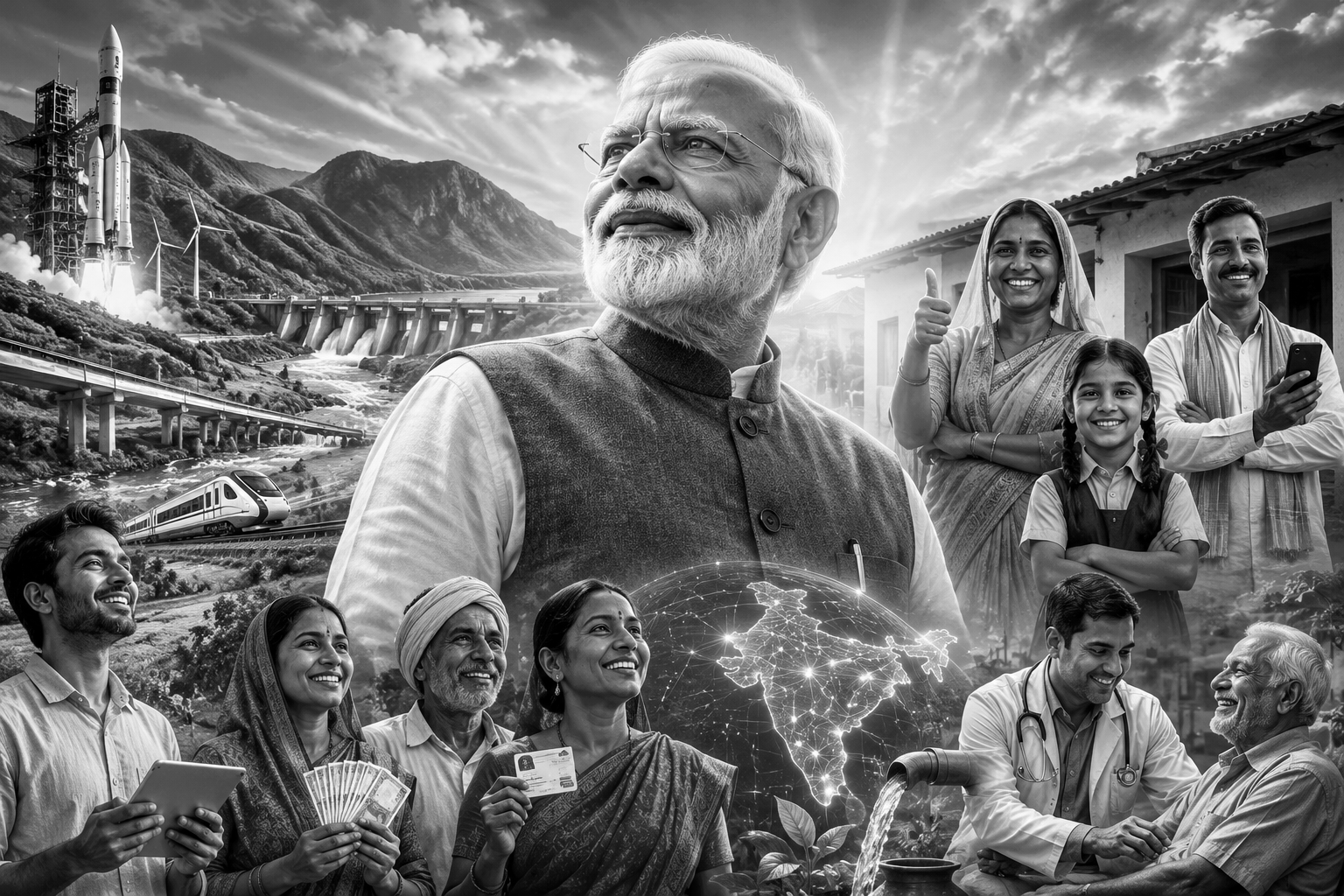
12 Years of NDA Rule: Modi Highlights Welfare Gains, Digital Push and Inclusion
As the NDA government completes twelve years in office and enters the second year of its third consecutive term, Prime Minister Narendra Modi used social media on Monday to reflect on what he described as a defining phase of welfare-driven governance . Framing the journey through the lens of Antyodaya , the idea of uplifting the last person in the queue, he positioned his government’s record as one shaped by large-scale welfare delivery and digital reform .
He pointed to flagship programmes such as Direct Benefit Transfer (DBT), Swachh Bharat Mission , PM Awas Yojana , and Ayushman Bharat , saying these initiatives were designed to ensure dignity, access, and opportunity for citizens. He also highlighted the role of Jan Dhan financial inclusion accounts , infrastructure expansion, and schemes like the Jal Jeevan Mission , along with the wider reach of digital governance systems , as the backbone of India’s welfare architecture.
According to official estimates cited by the government, rural poverty in India has declined from around 26 per cent in 2012 to below 5 per cent in 2024 , a shift presented as one of the most significant social changes in recent decades. The government also claims that over 25 crore people have moved out of poverty during this period, supported by direct transfers, improved targeting of subsidies, and expanded rural infrastructure that has strengthened last-mile delivery of welfare benefits. Officials argue that DBT in particular has helped reduce leakages and improve efficiency by transferring subsidies directly into bank accounts.
However, the twelve-year record has also drawn sustained scrutiny. Critics argue that while welfare delivery has expanded, the broader economic picture has been uneven, marked by concerns around unemployment, inequality, and slower structural job creation . Some also point out that key promises made in 2014, including large-scale job generation and stronger action on black money, remain partially unfulfilled benchmarks in public debate. The criticism is less about the existence of welfare schemes and more about whether they have been matched by deeper economic transformation .
On the ground, the outcomes appear mixed. Many development workers acknowledge that DBT and the Jan Dhan-Aadhaar-Mobile framework have significantly reduced leakages and improved transparency in welfare distribution. At the same time, challenges persist in last-mile connectivity , especially in remote and hilly regions where digital access remains inconsistent. In several rural areas, beneficiaries report delays in housing approvals under PM Awas Yojana , while maintenance and implementation gaps have been flagged in parts of the Swachh Bharat Mission as well.