
137 Cancer Drugs, Lower Prices: What the New Government Cap Means for Patients
The government’s decision to cap trade margins on 137 anti-cancer medicines could significantly reduce prices, but lasting relief will depend on awareness, access to healthcare and the reliable availability of affordable medicines.
For thousands of families across India, a cancer diagnosis brings not only emotional distress but also the prospect of mounting medical expenses. Treatment can involve surgery, chemotherapy, immunotherapy, radiation, repeated diagnostic tests and long-term medication. Even when treatment options are available, their cost can place enormous pressure on household finances, forcing families to exhaust savings, borrow money or postpone essential care. Against this backdrop, the Centre’s latest intervention to reduce the prices of anti-cancer medicines has renewed attention on the affordability of cancer treatment and the wider challenges facing patients.
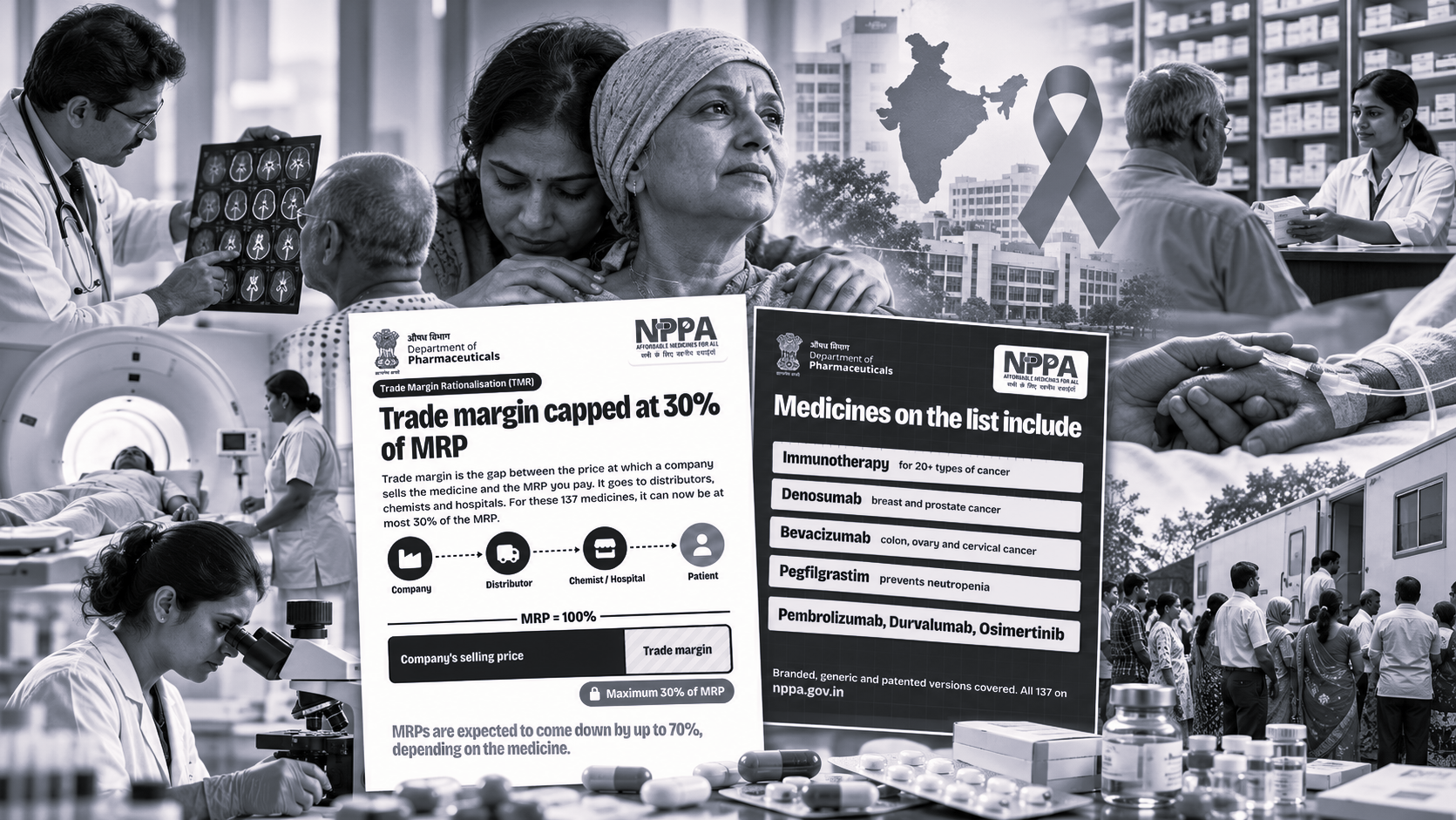
The National Pharmaceutical Pricing Authority (NPPA), under the Department of Pharmaceuticals, announced on October 17 that trade margins on 137 specified anti-cancer medicines would be capped at 30%. The revised prices are scheduled to take effect from November 9, 2026. According to the government, the move could reduce maximum retail prices by as much as 70% in some cases and generate estimated annual savings of around ₹2,500 crore for patients. These figures represent official projections; the actual savings will depend on the medicines prescribed, the prices charged before the change and how effectively the revised rates are implemented.
The decision follows an analysis that identified substantial mark-ups across parts of the anti-cancer drug market. Government assessments indicated an average trade mark-up of approximately 170%, with some products recording mark-ups exceeding 700%. By restricting the margin applicable to the specified medicines, the government intends to curb excessive increases between manufacturers and the final retail price. The list covers selected branded and generic products, including imported and domestically manufactured medicines, as well as patented and non-patented drugs.
Several important medicines are among those covered, including pembrolizumab, durvalumab, osimertinib, bevacizumab, denosumab and pegfilgrastim. These medicines are used in different cancer-treatment settings, although their suitability depends on the cancer type, disease stage and individual clinical assessment. The price cap does not mean every cancer medicine will become cheaper by the same percentage, nor does it make every treatment affordable for every patient.
Manufacturers are required to submit revised price information within the prescribed period and ensure that updated price lists are displayed and circulated. Retailers and hospitals must charge the revised prices from the effective date. State drug controllers are expected to monitor compliance, while manufacturers must maintain adequate production and supply. Patients can check applicable prices through the NPPA’s official resources and the Pharma Sahi Daam application.
This is not the first attempt to address the high cost of cancer medicines. In 2019, the government introduced a similar measure covering 42 anti-cancer drugs. It subsequently reported price reductions of up to 90% across 526 brands and estimated annual savings of ₹984 crore. The latest initiative expands the intervention, but its success will ultimately be judged by whether patients see meaningful reductions in their actual bills.
The financial burden extends beyond medicines
The cost of cancer care is rarely limited to the price printed on a medicine package. Patients may have to pay for scans, pathology tests, hospital admissions, travel, accommodation and follow-up consultations. Those living outside major medical centres can face additional expenses when they must repeatedly travel to cities for treatment.
A 2023 study published in Frontiers in Public Health estimated annual direct out-of-pocket expenditure at approximately ₹3.31 lakh per patient within its study population. Medicines and diagnostic services were important contributors to the overall burden, and financially vulnerable households faced a greater risk of catastrophic healthcare spending. The figure should not be interpreted as a nationwide average for every cancer patient, but it illustrates how treatment expenses can overwhelm household budgets.
For families without comprehensive health insurance or access to public support, even a substantial reduction in medicine prices may not be enough to make treatment manageable. The government’s latest intervention therefore addresses an important part of the problem, while highlighting the need for affordable diagnostics, accessible hospitals and stronger financial protection.
Public healthcare schemes can provide additional support
Several government programmes are intended to reduce the financial burden on eligible patients. Under Ayushman Bharat–Pradhan Mantri Jan Arogya Yojana (PM-JAY), eligible families can receive health coverage of up to ₹5 lakh per year for covered hospital treatment at empanelled institutions, subject to the scheme’s rules and package conditions. Certain cancer treatments are covered, but patients should verify whether their required procedure or treatment package is included.
The Health Minister’s Cancer Patient Fund, operated under the Rashtriya Arogya Nidhi framework, also provides financial assistance to eligible low-income patients receiving treatment at designated government institutions. Assistance of up to ₹15 lakh may be available, subject to eligibility, institutional requirements and approval. Patients and caregivers should approach the hospital’s medical social worker or relevant assistance desk to understand the application process and required documents.
These programmes can help eligible families, but awareness of eligibility, documentation requirements and participating hospitals remains essential. Financial assistance is most effective when patients can identify the available support before treatment costs become unmanageable.
Jan Aushadhi and AMRIT pharmacies offer lower-cost alternatives
The government’s Pradhan Mantri Bhartiya Janaushadhi Pariyojana (PMBJP) seeks to make quality generic medicines available at affordable prices through Jan Aushadhi Kendras. As of June 30, 2026, the government reported 20,149 Kendras operating across the country, offering 2,110 medicines and 315 surgical items, consumables and devices. It has estimated that the initiative helped citizens save approximately ₹45,000 crore over 12 years.
Generic medicines are generally priced substantially below comparable branded alternatives, with the government citing reductions of around 50–80% for many products. The programme says medicines are sourced from manufacturers meeting applicable quality standards and are subjected to batch testing through NABL-accredited laboratories. The Jan Aushadhi Sugam application can help people locate nearby outlets and check product availability.
However, patients should not assume that every medicine covered by the new price cap is stocked at every Jan Aushadhi Kendra. Availability varies, particularly for specialised cancer medicines. Patients should consult their oncologist or pharmacist before substituting a prescribed brand or formulation, especially when the medicine requires specific dosing, monitoring or handling.
Another option is the Affordable Medicines and Reliable Implants for Treatment (AMRIT) initiative, which operates through selected hospital-linked outlets. Managed by HLL Lifecare Limited, AMRIT offers medicines, implants and related healthcare products at discounted prices. Government-reported discounts can reach around 50% for certain products, although savings and stock availability vary by medicine and outlet.
Together, these initiatives can widen access to lower-cost medicines. Their practical value, however, depends on whether patients can find the prescribed drug, in the required strength and formulation, when they need it.
Awareness and early detection remain critical
Affordability is only one part of India’s cancer challenge. Awareness, timely diagnosis and access to screening are equally important because many cancers can be treated more effectively when detected early. Yet screening participation remains limited in several areas, reflecting gaps in public awareness, access to services and preventive healthcare.
The National Family Health Survey-5, conducted in 2019–21, found that only 0.9% of women aged 30–49 reported ever having undergone breast examination for screening, while 1.9% reported cervical cancer screening. These figures measure screening participation, not general awareness of cancer, and they underline the distance between the availability of preventive services and their actual use. Regional studies have also identified barriers such as fear, stigma, misinformation, cost and difficulties reaching healthcare facilities, although findings from individual regions should not be treated as nationally representative.
The government has reported expanding cancer screening through public health facilities. By July 20, 2025, more than 10.18 crore women aged 30 and above had reportedly been screened for cervical cancer under the relevant programme. This cumulative figure reflects the reach of a government initiative and should not be directly compared with survey-based screening percentages, which use different methods and populations.
Healthcare infrastructure is also being expanded. A Ministry of Health update in July 2026 reported 524 Day Care Cancer Centres, 6,410 Community Health Centre non-communicable disease clinics, 19 approved State Cancer Institutes and 20 approved Tertiary Cancer Care Centres. These figures indicate the scale of planned and reported capacity, but approval or establishment does not automatically guarantee that every facility is fully operational or equally accessible to patients.
Turning a price decision into lasting relief
The cap on trade margins is a significant intervention in a healthcare system where the cost of cancer treatment can determine whether patients continue or interrupt care. Yet the announcement alone cannot establish how much an individual family will save. The real impact will become clearer after the revised prices take effect on November 9, when patients, hospitals and pharmacies begin applying the new rates.
The government must ensure compliance, prevent shortages and make updated prices easy to verify. Hospitals and pharmacies should communicate revised prices clearly, while public awareness campaigns should help families understand the availability of assistance schemes and lower-cost medicine sources. At the same time, greater investment in screening, diagnostics and accessible treatment centres is necessary to address the wider burden of cancer.
For patients, the most meaningful measure of success will not simply be the number of medicines covered or the percentage reduction announced. It will be whether they can obtain the right treatment on time, pay less at the pharmacy and hospital, and continue care without falling into financial distress.
Lower medicine prices can provide important relief, but affordable cancer care requires more than a price cap. It requires reliable supplies, stronger public healthcare, financial protection and sustained efforts to ensure that people recognise cancer symptoms and seek medical attention early. Only when these measures work together can a policy announcement translate into tangible relief for patients and their families.