
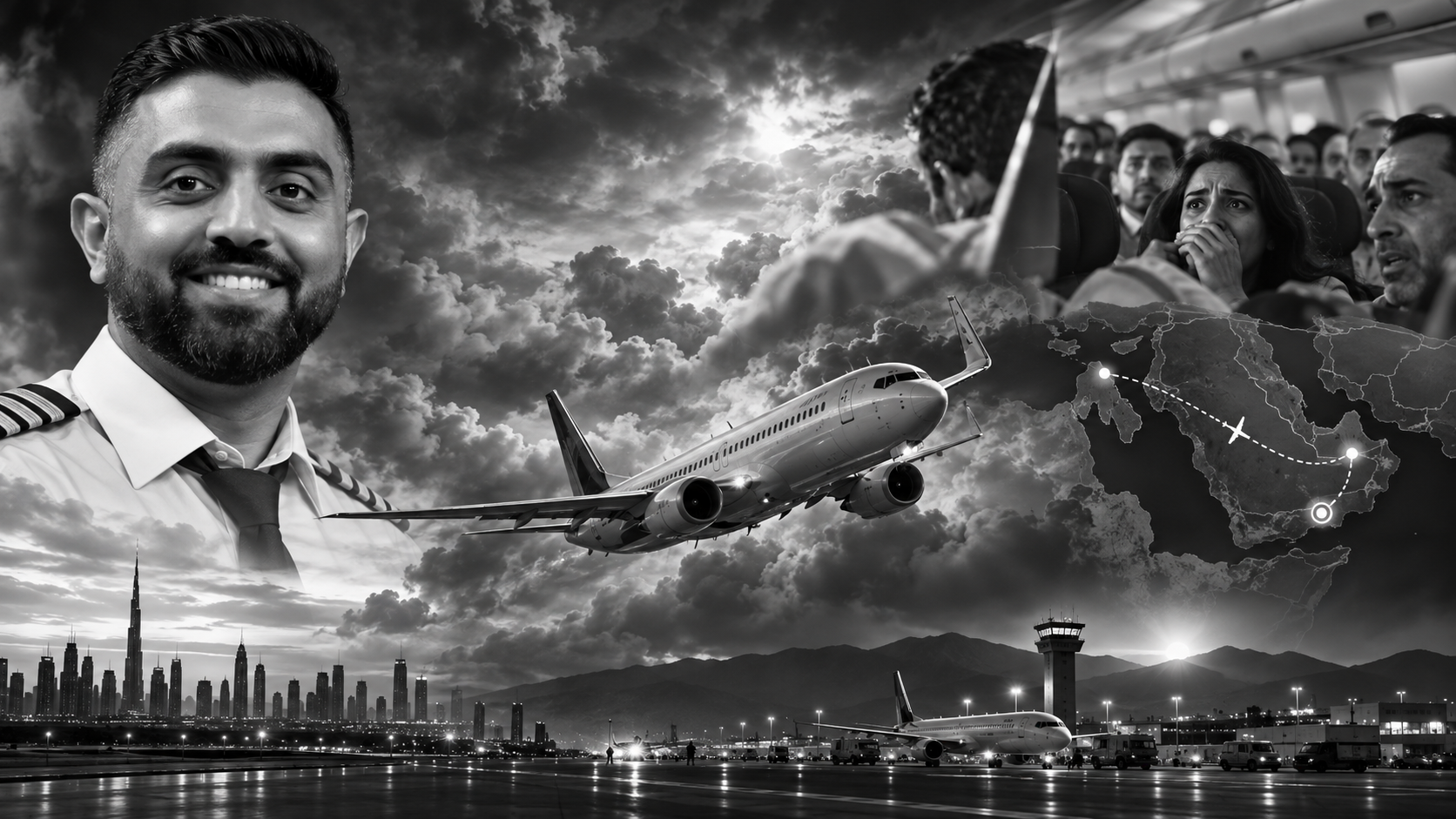
14,000 Feet in Seconds: The Boeing 737 Flight That Nearly Became a Disaster
An ordinary Dubai-Tel Aviv flight turned into a fight for survival after an alleged cockpit attack sent a Boeing 737 MAX 8 into a dramatic descent. An injured Indian captain, passengers and fellow pilots helped avert catastrophe - but the incident has exposed difficult questions about insider threats, pilot vetting and aviation security.
A Routine Flight Turns Into a Nightmare
Flydubai Flight FZ1073, a Boeing 737 MAX 8, departed Dubai for Tel Aviv on September 30 with 174 people aboard. The flight initially proceeded normally before becoming an extraordinary aviation emergency. Flight-tracking data showed the aircraft cruising at around 34,000 feet before experiencing dramatic altitude fluctuations. Reports indicate that it subsequently lost around 14,000 feet in less than 30 seconds. The aircraft transmitted the emergency code 7700, followed by 7500, associated with unlawful interference.
The crisis was reportedly not caused by a conventional mechanical failure. According to Israeli officials and passenger accounts, an altercation inside the cockpit involving the co-pilot and captain triggered the emergency. The aircraft eventually diverted from its route and landed safely at Tabuk, Saudi Arabia.
Captain Machchhar at the Centre of the Rescue
At the heart of the incident was Indian captain Smit Machchhar, who was reportedly seriously injured during the confrontation. Israeli officials said the co-pilot attacked him with a weapon and attempted to take control of the aircraft. Despite his injuries, Machchhar managed to open the cockpit door, allowing passengers and other crew members to intervene and restrain the attacker. Israeli Prime Minister Benjamin Netanyahu and Indian Prime Minister Narendra Modi subsequently praised the captain's actions.
Machchhar was initially treated at a hospital in Tabuk and underwent surgery before being airlifted to the UAE for further treatment. Reports on October 1 said he was in stable condition and recovering. His actions have become the human centre of an incident that could otherwise have ended in catastrophe.
Passengers Become Part of the Rescue
The response inside the cabin was equally extraordinary. Passengers Yaniv Hayun, Asaf Rajuan, Tzvika Manes, Tali Manes and others reportedly helped restrain the attacker and assist the injured captain. Hayun also described taking hold of the aircraft controls during the crisis, saying he had some knowledge of what to do from watching the television programme Air Crash Investigation. Other passengers described the aircraft dropping sharply and the fear that they might not survive.
Their accounts underline how quickly passengers were forced to become part of the emergency response. What began as a routine international flight turned into a situation in which the captain, off-duty pilots, crew members and ordinary passengers collectively helped keep the aircraft airborne.
The Weapon Mystery
One of the most important unanswered questions concerns the weapon. Initial accounts referred to a knife, while subsequent reporting has raised the possibility that a cockpit crash axe may have been involved. Investigators have yet to conclusively establish the weapon publicly. That distinction is critical because it determines whether the incident involved a prohibited personal weapon entering the aircraft or an emergency tool already available inside the cockpit.
This leads to a broader security question: if a prohibited weapon was involved, how did it reach the flight deck? It would be premature to claim that the co-pilot was inadequately screened. Pilots undergo professional, licensing and security checks. The more difficult question is whether existing systems can identify an insider threat — an authorised crew member who subsequently becomes dangerous.
Why the Saudi Landing Matters
The aircraft's diversion to Saudi Arabia added an extraordinary geopolitical dimension. FZ1073 was travelling from the UAE to Israel, yet an aircraft carrying mostly Israeli passengers ended its emergency flight in a country that does not have formal diplomatic relations with Israel. Saudi authorities received the aircraft, provided medical assistance and dealt with the incident before the passengers continued their journey to Israel on a replacement aircraft.
The route itself symbolises the changing Middle East. Dubai-Tel Aviv air connectivity emerged after the 2020 Abraham Accords, which established diplomatic relations between the UAE and Israel. Flydubai launched its scheduled Tel Aviv service in November 2020, turning aviation into one of the most visible expressions of that new relationship.
Terror Attack or Individual Act?
Israeli officials have described the incident as a suspected terrorist attack and have raised questions about the attacker's background and possible external connections. However, the UAE investigation is still examining the motive, including whether there was prior planning, outside direction or any connection to terrorist activity. No wider connection should be presented as established fact until investigators produce evidence. Flydubai has also urged against premature speculation.
The alleged attacker has been identified by Israeli authorities as an Omani national, adding another regional dimension because Oman, like Saudi Arabia, does not have diplomatic relations with Israel. His background, professional history and possible motive will now come under scrutiny.
Israel's Next Move: Security, Not Revenge
Israel has not publicly announced military retaliation over the incident. Its immediate response has been directed towards aviation security. Israeli authorities have said they will increase checks on pilots flying into the country and seek greater information about the identities and backgrounds of foreign pilots. Flydubai also suspended flights to and from Israel following the incident.
The eventual response will depend on what investigators discover. Evidence of an isolated individual act would produce one kind of security response; evidence of organised planning or external direction would carry much wider implications.
The Question FZ1073 Leaves Behind
The significance of FZ1073 extends beyond the survival of one Boeing 737. The incident exposed aviation's most difficult security paradox: how do you protect an aircraft when the alleged threat is already authorized to sit inside its cockpit?
The reinforced cockpit door is designed to keep dangerous outsiders away from the controls. Yet in this case, according to the reported sequence, the injured captain's decision to enable access allowed passengers and crew to help save the aircraft.
Machchhar's recovery, the passengers' intervention and the safe landing in Saudi Arabia transformed what could have become a mass-casualty disaster into a story of survival. But the unanswered questions remain: How did the confrontation begin? What weapon was used? Was the descent deliberate? Could warning signs have been detected? And was anyone else involved?
Until investigators answer those questions, FZ1073 remains more than a dramatic flight incident. It is a warning about the vulnerability of modern aviation to a threat that may not come from outside the aircraft — but from inside the cockpit itself.