
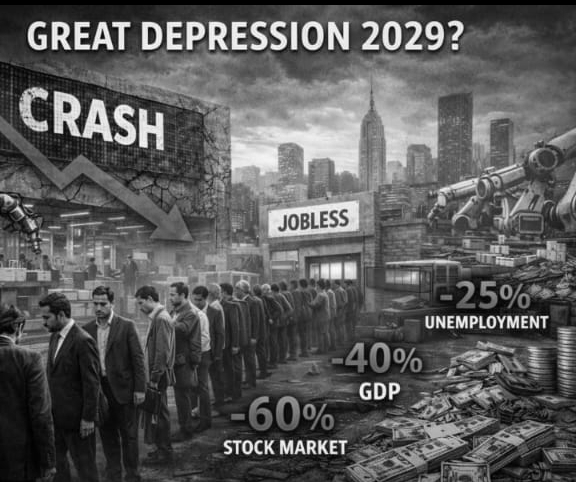
1929–2029: A Century Later, Could the Great Depression Return?
Imagine waking up one morning in October 2029 and hearing the same words that haunted the world a hundred years ago: “Markets have crashed.” It sounds dramatic, almost cinematic, the kind of thing we associate with black-and-white photographs, long breadlines, men in worn-out coats clutching tin bowls, and stockbrokers staring blankly at fallen ticker tapes. But that was real. In 1929, the world slipped into what we now call the Great Depression the worst economic collapse in modern history. Banks shut down overnight. Life savings vanished in hours. One out of four workers in the United States had no job. Factories went silent. Farmers destroyed crops because they could not sell them. Global trade shrank. Hope shrank. And for a decade, uncertainty ruled daily life.
Back then, it began with a stock market crash. But it did not end there. It became a chain reaction of falling demand, collapsing banks, mass unemployment, shrinking incomes, and governments scrambling for answers. Leaders like Franklin D. Roosevelt had to rethink the very role of the state in the economy. The Depression was not just an economic event; it reshaped politics, society, and global power equations. It eventually contributed to instability in Europe, including the rise of extremist regimes in countries such as Germany.
Now fast-forward exactly one hundred years. It is 2029. The world is not worried about overvalued railway stocks or fragile gold standards. It is worried about something far more powerful: Artificial Intelligence.
The New Trigger: AI-Driven Overproduction
Unlike 1929, the world of 2029 is hyper-connected, digitized, and algorithmically optimized. AI systems design products, write code, draft contracts, generate marketing campaigns, manage supply chains, and even produce entertainment content. Productivity has soared. Corporations proudly announce record output with reduced human intervention. Factories are automated. Offices are quieter.On paper, this seems like progress. But beneath the headlines lies a dangerous paradox.
AI increases production capacity dramatically — both in goods and services. Software systems replace entire teams. Chatbots replace customer support. Autonomous logistics reduce labor needs. Manufacturing lines require fewer workers. Corporate boards celebrate cost reduction and efficiency.
But here lies the economic dilemma: if millions lose jobs or face stagnant wages, who buys the goods and services that AI produces?
This is the same structural flaw that contributed to the Great Depression — overproduction combined with under-consumption.
The Layoff Spiral
In 2029, mid-level employees are the first to feel the shock. Routine coders, back-office analysts, legal assistants, marketing managers, and financial processors find themselves replaced by AI tools that work 24/7 at negligible cost. Corporations insist this is “transformation,” not retrenchment. Yet job numbers tell a harsher story.
Layoffs reduce household incomes. Lower incomes reduce spending. Reduced spending affects businesses that depend on consumer demand. Those businesses cut costs — often by laying off more workers. The cycle deepens.
Money circulation slows. Credit demand weakens. Banks become cautious. Investment stalls. Markets panic. Investors withdraw. Confidence — the invisible fuel of capitalism — erodes.Recession sets in.
Unlike 1929, the trigger may not be a single day like “Black Tuesday.” Instead, it could be a slow, grinding contraction — quarterly declines, job reports worsening month after month, consumer confidence indices falling steadily.
The danger of AI is not that it produces too little. The danger is that it produces too much without ensuring human purchasing power keeps pace.
Global Trade Shockwaves
In 1929, protectionist policies such as the Smoot–Hawley tariffs worsened the crisis. In 2029, the global economy is tightly interwoven. If major economies like the United States slow down due to automation-led job losses, demand for outsourced services, imported goods, and international investments declines sharply.
Export-dependent nations feel the tremors immediately. Capital flows reverse. Currency pressures mount. Emerging markets suffer disproportionately.And this is where India enters the story.
India’s Service-Heavy Vulnerability
India’s economic growth story over the last three decades has been powered largely by services particularly IT, business process outsourcing, consulting, and software exports. A significant portion of these services directly or indirectly serves clients in advanced economies, especially the United States.
This model worked brilliantly in the era of globalization and cost arbitrage. But AI disrupts this foundation.
If American companies automate instead of outsourcing, India’s service exports face structural pressure. If AI tools perform coding, testing, accounting, legal drafting, and analytics more cheaply than offshore teams, India’s comparative advantage narrows.
The most vulnerable segment? Middle-income white-collar professionals — the urban salaried class that drives consumption, housing demand, private education, automobile sales, and retail growth.
A slowdown in this segment could ripple through the Indian economy:
Urban real estate demand weakens
Consumer durable sales decline
Education loan defaults rise
Startup funding contracts
State tax revenues shrink
The Indian growth engine, heavily dependent on middle-class consumption and services exports, may sputter.
Structural Weaknesses: Education and Regulation
India’s education system, despite producing millions of graduates annually, remains largely examination-oriented rather than innovation-oriented. Skill mismatches persist. AI demands interdisciplinary thinking, creativity, research depth, and advanced technical capability. Many institutions still emphasize rote learning and outdated curricula.
Regulatory frameworks are also evolving slowly. Labor laws, data governance norms, and digital competition policies struggle to keep pace with technological change. While digital public infrastructure is strong, deep-tech R&D investment remains modest compared to global leaders.
If AI adoption accelerates faster than reskilling mechanisms, displacement could outpace absorption.
In short, India may face the double challenge of external demand shocks and internal structural rigidity.
Is 2029 Destined to Repeat 1929?
History rarely repeats in identical form, but it often rhymes.
The Great Depression was exacerbated by policy mistakes — delayed government intervention, rigid adherence to the gold standard, and insufficient safety nets. Today’s policymakers have more tools: monetary stimulus, fiscal packages, unemployment insurance, digital cash transfers, and global coordination mechanisms.However, tools are effective only if deployed decisively.
If governments misjudge the scale of AI disruption — assuming market forces alone will rebalance labor markets — the adjustment could be painful and prolonged.
The risk is not a dramatic overnight collapse but a prolonged stagnation marked by underemployment, wage suppression, and weakened demand.
What India Must Do — Before 2029
If there is even a remote possibility of an AI-triggered downturn, India must act proactively.
1. Diversify Beyond Services
Strengthening manufacturing, electronics, green energy, and defense production can create employment buffers. Supply-chain integration and domestic value addition must accelerate.
2. Massive Reskilling Campaign
A national AI reskilling mission targeting mid-career professionals is essential. Continuous learning should become the norm, not the exception.
3. Strengthen Social Safety Nets
Urban unemployment insurance mechanisms need expansion. Consumption support during downturns can prevent demand collapse.
4. Encourage AI Ownership, Not Just Usage
India must move from being a consumer of global AI platforms to building indigenous AI products, research hubs, and intellectual property.
5. Education Reform
Curricula must shift toward problem-solving, interdisciplinary learning, and digital fluency from early stages.
6. Regulatory Agility
Policies must evolve rapidly to manage data, competition, and labor transitions in AI-intensive sectors.
The Final Reflection
In 1929, the world learned painfully that unchecked speculation, inequality, and policy rigidity can devastate economies. In 2029, the threat may not be speculative excess but technological imbalance — where machines multiply output while human incomes stagnate.
The Great Depression reshaped the twentieth century. Whether 2029 becomes a dark centenary or a moment of strategic reinvention depends on choices made today.Technology does not doom economies. Complacency does.
If India anticipates disruption, invests in people, diversifies its economic base, and strengthens institutional resilience, 2029 can mark not a repetition of despair but a renewal of economic imagination.
The question is not whether history will test us again.The question is whether we are prepared this time.