
22,446 Elephants, 150 Corridors: India’s New Conservation Challenge
India’s elephant conservation efforts entered a new phase on World Elephant Day 2026, with Visakhapatnam hosting the national celebrations against the backdrop of an increasingly complex challenge: protecting elephants not only inside forests, but also along the routes that connect their habitats with farms, villages, roads and railway lines. Union Minister of State for Environment, Forest and Climate Change Kirti Vardhan Singh said India’s commitment to elephant conservation reflected both its civilisational values and ecological responsibility, while Andhra Pradesh Deputy Chief Minister K. Pawan Kalyan presented “Conflict to Coexistence” as the State’s approach to human-elephant conflict.
22,446 Elephants and a New Scientific Baseline
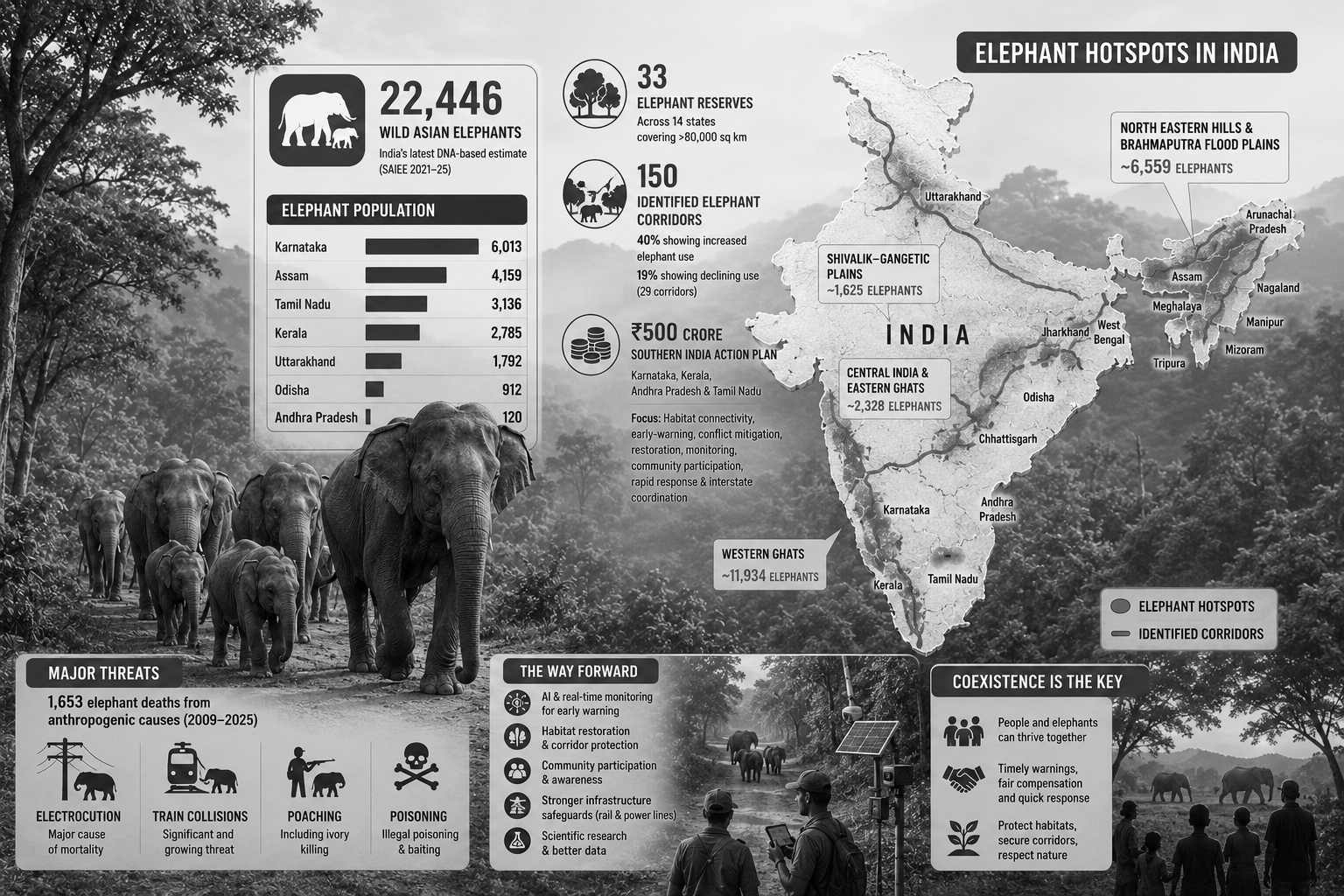
India’s latest scientific assessment estimates 22,446 wild Asian elephants under the Synchronous All-India Elephant Estimation (SAIEE) 2021–25. The assessment used DNA-based methods and provides a new national baseline for elephant conservation. Karnataka has the largest estimated population at 6,013, followed by Assam with 4,159, Tamil Nadu with 3,136, Kerala with 2,785, Uttarakhand with 1,792 and Odisha with 912. Andhra Pradesh has an estimated 120 wild elephants.
The latest number should not, however, be treated as proof of a straightforward population collapse from the earlier census. The methodology has changed substantially, making direct comparisons with conventional estimates difficult. The significance of the new assessment lies in establishing a more scientifically robust baseline from which future population trends can be measured.
The Elephant Landscape Is Bigger Than a National Park
The geography of India's elephant population explains why simply counting animals inside protected areas is not enough. The Western Ghats remain the country's largest elephant landscape, supporting around 11,934 elephants, while the North Eastern Hills and Brahmaputra Flood Plains account for roughly 6,559.
Elephants routinely travel across forests, agricultural areas and administrative boundaries in search of food, water and mates. A herd moving through the Bandipur-Nagarhole-Wayanad-Mudumalai landscape, for instance, is using one interconnected ecological system even though the forests are divided between Karnataka, Kerala and Tamil Nadu. This makes landscape connectivity central to conservation.
33 Elephant Reserves, 150 Corridors
India has established 33 Elephant Reserves and identified 150 scientifically validated elephant corridors across 15 elephant-range States. The national corridor assessment found that elephant use had increased in around 40% of the corridors, while 29 corridors, or 19%, recorded declining use. The assessment also identified corridors requiring restoration because of impairment.
The distinction between reserves and corridors is crucial. An Elephant Reserve protects habitat; a corridor protects movement. For an animal with enormous home ranges, the ability to travel safely between fragmented habitats is essential for access to food and water, breeding opportunities and long-term genetic connectivity.
The recent evidence also shows why corridor protection cannot be treated as a static exercise. Changing land use and infrastructure can alter elephant movement, forcing herds into human-dominated areas and increasing the probability of conflict.
The Hidden Cost of Development
India’s conservation challenge is not confined to habitat loss. Elephants increasingly face human-induced mortality from infrastructure and conflict.
A 2026 scientific study documented 1,653 elephant deaths from anthropogenic causes during the period examined, with electrocution, train collisions, poaching and poisoning emerging as persistent threats. Odisha, Jharkhand, West Bengal and Assam together accounted for almost 70% of the incidents in the study.
Railway tracks are particularly dangerous when they cut across traditional elephant routes. Power infrastructure and poorly designed electric fencing can also turn agricultural boundaries and forest edges into deadly barriers. Poaching remains another threat, including killings associated with ivory, although official mortality records generally classify such cases under poaching rather than establishing the motive behind every death.
These losses reveal an important reality: elephant conservation increasingly means preventing avoidable deaths, not merely expanding protected areas.
₹500 Crore Push for Southern India
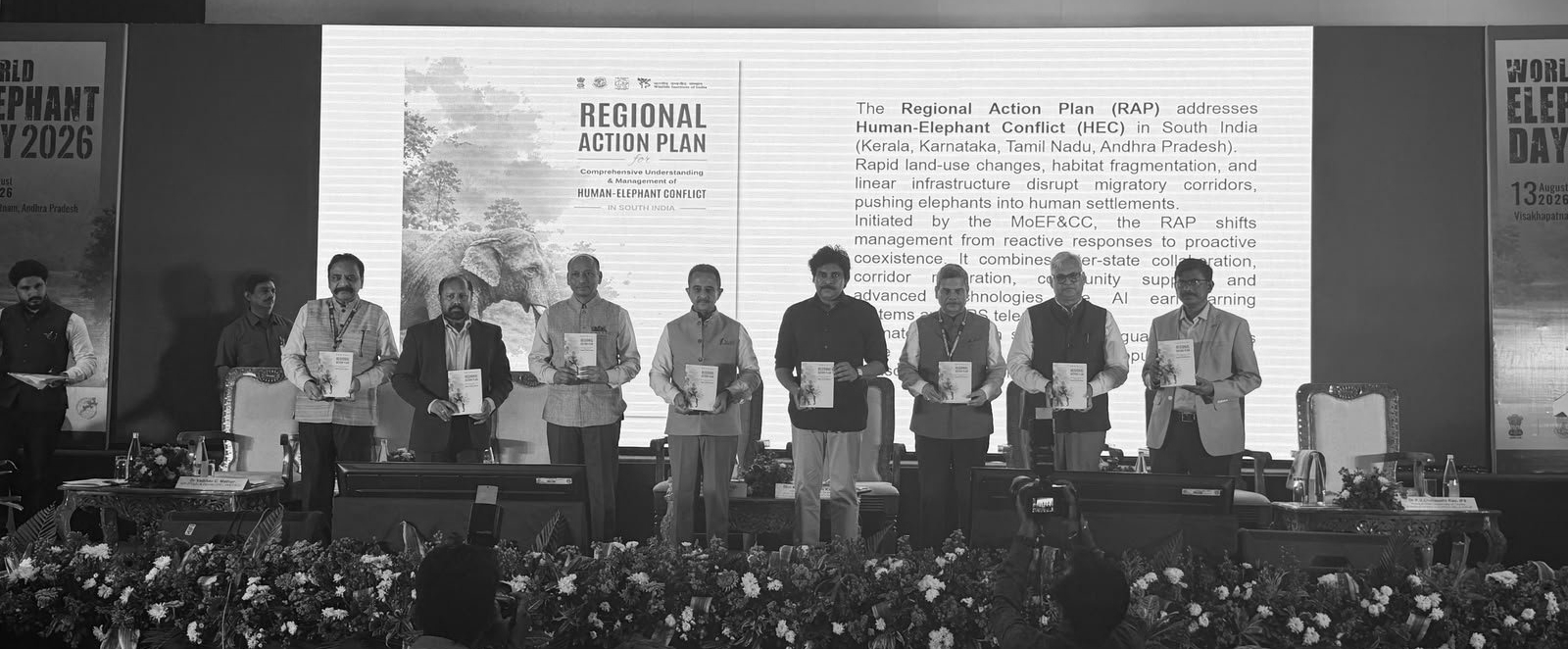
Against this background, the most significant announcement at the World Elephant Day celebrations was the release of the Regional Action Plan for Comprehensive Understanding and Management of Human-Elephant Conflict in Southern India.
The plan covers Karnataka, Kerala, Andhra Pradesh and Tamil Nadu and has ₹500 crore in Government of India support. Rather than treating conflicts as isolated incidents within State borders, it adopts a landscape-level approach covering habitat connectivity, corridor conservation, early-warning systems, conflict-mitigation infrastructure, habitat restoration, community participation, research, monitoring, rapid response, capacity building and interstate coordination.
This approach recognises a basic ecological fact: elephants do not understand State boundaries. Conservation strategies therefore have to work across them.
From Reactive Response to Predictive Conservation
Technology is expected to become an increasingly important part of this transition. Artificial intelligence, remote sensing and geospatial mapping are being combined with traditional knowledge and scientific field data to improve understanding of elephant movements and habitats.
The ambition is to move from reacting after an elephant enters a village to predicting where encounters are likely to occur. Better movement tracking, early-warning systems and rapid-response mechanisms could give communities and forest teams more time to act, while improved railway and power-line monitoring could reduce infrastructure-related deaths.
The World Elephant Day workshop also examined veterinary interventions, electrocution prevention, railway mortality, habitat and corridor management and integrated landscape planning, with emphasis on cooperation between forest departments, scientific institutions, Indian Railways and other stakeholders.
Andhra Pradesh’s Coexistence Model
For Andhra Pradesh, the issue has a distinct significance. The State's estimated wild elephant population stands at 120, far below the populations of Karnataka, Assam, Tamil Nadu and Kerala. But a smaller population does not mean a smaller conservation challenge.
Pawan Kalyan highlighted Andhra Pradesh's “Conflict to Coexistence” philosophy and the H.A.N.U.M.A.N. initiative - Healing And Nurturing Units for Monitoring, Aid and Nursing of Wildlife. The State is also emphasising technology, community engagement and capacity building for frontline forest staff.
The objective is to protect elephants while ensuring that communities living alongside their movement routes are not left to bear the costs of conservation alone.
Project Elephant Enters Its Next Phase
The celebrations also looked back at the evolution of Project Elephant, launched in 1992 as a Centrally Sponsored Scheme. The Centre released “30 Giant Steps”, documenting 30 major milestones and conservation initiatives between 2020 and 2026.
A special issue of the Journal of Wildlife Science commemorating three decades of elephant conservation was released, alongside the historical monograph “Asian Elephants in Central India Before 1947”.
The 23rd Steering Committee Meeting of Project Elephant, chaired by Kirti Vardhan Singh in Visakhapatnam, further reviewed current conservation priorities. It saw the release of The Trumpet Volume VI Issue 01, the Model Elephant Conservation Plan for the Nilgiri Elephant Reserve, Captive Elephant Husbandry: Science, Welfare and Practice, and Phase II of the human-elephant conflict study covering Kerala, Karnataka, Tamil Nadu, Odisha and West Bengal.
Conservation Success Cannot Be Measured by Numbers Alone
India's elephant conservation story is therefore more complicated than a single population figure. The country's wild elephants are Asian elephants ( Elephas maximus ), and conservation science focuses on populations, genetic diversity, habitat connectivity and ecological landscapes rather than separate “breeds”.
Natural movement between States should also not automatically be described as migration or permanent relocation. An elephant moving from Karnataka into Kerala or Tamil Nadu may simply be travelling through its traditional home range. Protecting such movement is essential because isolated populations can lose access to food, water, breeding partners and genetic exchange.
This is why conservation success must be measured through more than population counts. Calf survival, adult mortality, functioning corridors, healthy habitats, genetic connectivity, reduced conflict and safer infrastructure are equally important indicators.
Building a Culture of Coexistence
The World Elephant Day campaign also placed children at the centre of India's conservation effort. Project Elephant, in coordination with the National Museum of Natural History, reached more than 20 lakh students across 21,450 schools. Painting and mask-making competitions, rallies, street plays, awareness programmes and pledge-taking ceremonies were organised to highlight the ecological and cultural importance of elephants.
This effort reflects another emerging principle: conservation cannot remain confined to forest departments and wildlife experts. Communities, schools, researchers, infrastructure agencies, railways and State governments all have a role in making coexistence possible.
The Future Depends on Where Elephants Can Walk
India now has a substantial conservation architecture - 33 Elephant Reserves, 150 identified corridors, Project Elephant, scientific population estimation and a ₹500-crore Southern India conflict-management plan. Yet elephants continue to face electrocution, railway collisions, poaching, poisoning, habitat fragmentation and conflict with communities.
The central challenge has therefore shifted. It is no longer simply about protecting elephants inside forests. It is about protecting the landscapes between forests.
A forest without a functioning corridor can become an ecological island. A corridor without safeguards can become a railway or electrocution trap. And conservation without community participation can deepen resentment among people sharing their landscapes with elephants.
World Elephant Day 2026 thus marks a broader shift in India's conservation philosophy - from counting elephants to securing their future. The ultimate measure of success will not merely be whether the national figure rises, but whether breeding herds remain healthy, calves survive, adult elephants avoid preventable deaths, corridors stay functional and communities can live alongside elephants without fear or disproportionate economic loss.