
44 Lakh Manuscripts, One Mission: AI Preserves India's Legacy
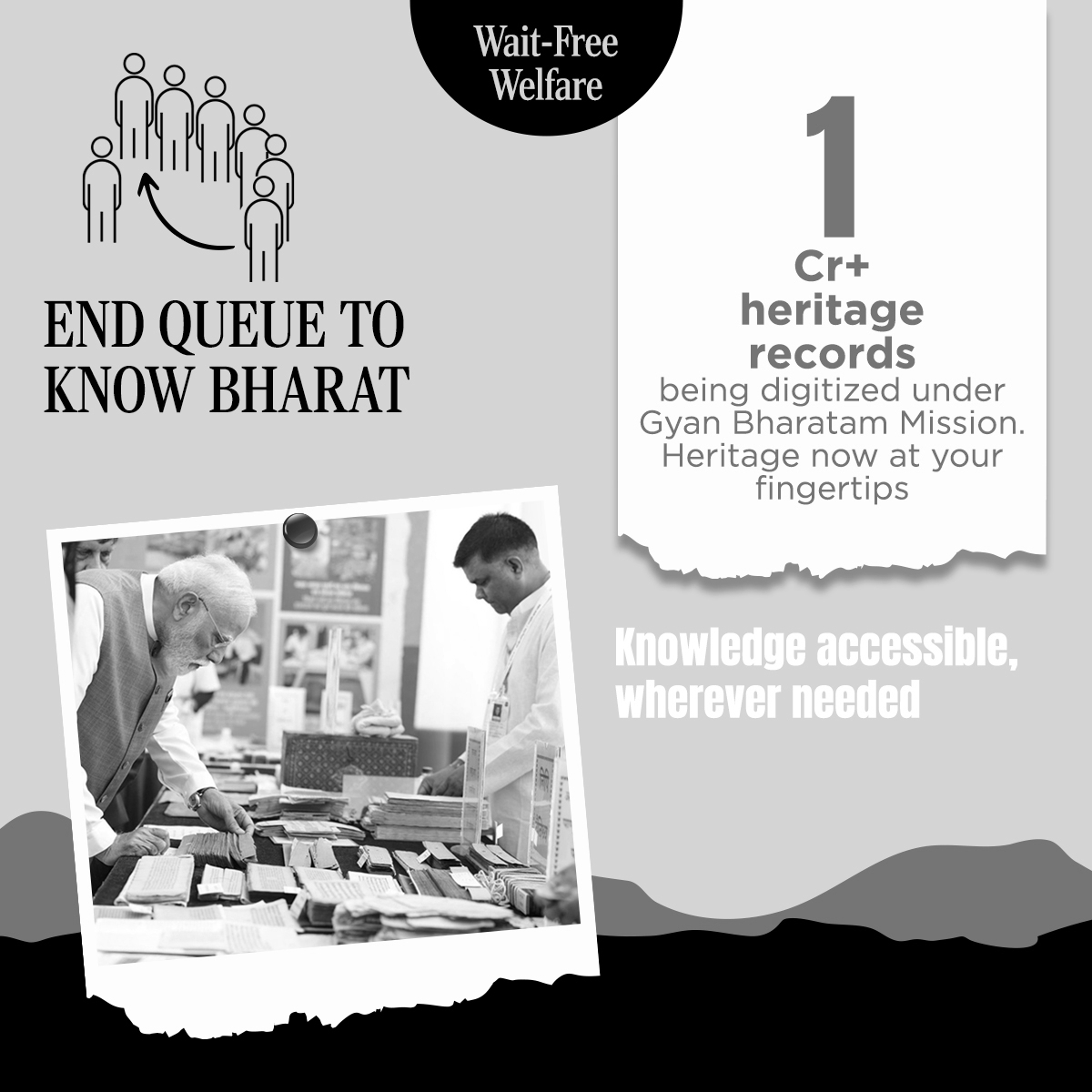
India is turning to artificial intelligence (AI) to preserve and decode centuries of knowledge hidden in ancient manuscripts, as the Centre accelerates efforts to digitally safeguard the country's vast cultural heritage under the Gyan Bharatam Mission . The initiative, announced in the Union Budget 2025-26, is emerging as one of the world's largest manuscript preservation programmes, combining modern technology with heritage conservation.
According to a government fact sheet titled "Vikas Bhi, Virasat Bhi – 12 Years of Preserving India's Heritage" , more than 44 lakh manuscripts have already been documented under the mission. Over eight lakh digitised manuscripts are currently being reformatted and standardised, while 1.29 lakh manuscripts have been made accessible to the public through the National Digital Repository (NDR) .
Launched by the Ministry of Culture , the Gyan Bharatam Mission aims to identify, document and preserve India's vast manuscript wealth, much of which remains scattered across temples, monasteries, libraries, universities and private collections. India is believed to possess one of the world's largest manuscript collections, containing valuable knowledge on astronomy, mathematics, medicine, philosophy, literature, linguistics and governance .
What distinguishes the mission is its use of AI to decode manuscripts written in ancient and regional scripts such as Sharada, Grantha, Modi, Brahmi and Nandinagari . Many of these texts have become difficult to read because of age, fading ink and a shortage of experts trained in ancient scripts. AI-powered tools are being developed to identify scripts, transcribe handwritten text, generate metadata, translate content and even reconstruct damaged portions of manuscripts.
The government has also launched a nationwide manuscript survey to build a comprehensive database of India's manuscript heritage. A key component of the initiative is Gyan-Setu , an innovation challenge encouraging researchers, start-ups and academic institutions to develop AI-based solutions for digitisation, archiving and decipherment of ancient texts. Institutions such as IIT Kharagpur, IIT Delhi and C-DAC are contributing to research in handwriting recognition, digital restoration and manuscript translation.
To support the mission, the Standing Finance Committee has approved ₹491.66 crore for the period 2025-2031 , according to Union Culture Minister Gajendra Singh Shekhawat . Officials say the objective extends beyond preservation, aiming to transform fragile historical documents into searchable digital resources for scholars and researchers worldwide.
The heritage report also highlighted broader conservation efforts. Under the National Mission on Monuments and Antiquities (NMMA) , India has documented 1.84 lakh monuments and heritage sites and catalogued 17.20 lakh antiquities . The government further noted that 653 antiquities have been repatriated since 2014 , including 613 artefacts recovered in the last five years, reflecting a renewed push to restore India's cultural legacy.
By combining AI with heritage conservation, the Gyan Bharatam Mission seeks to bridge India's ancient knowledge traditions with the digital future, ensuring that invaluable manuscripts survive and remain accessible for generations to come.