
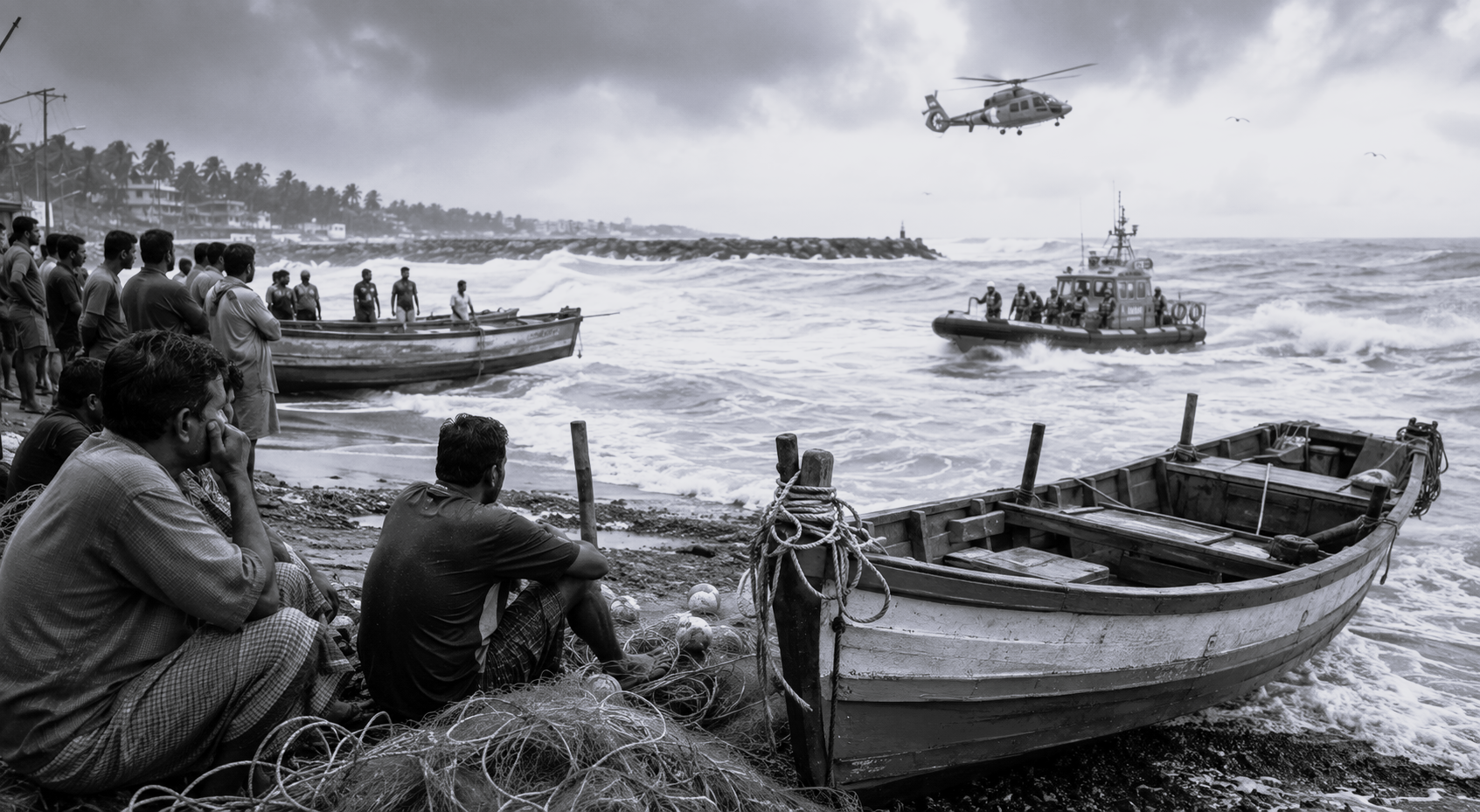
469 Fishermen Dead, 160 Missing Off Kerala Coast in 11 Years
Kerala's fishing community has suffered a devastating human toll over the past 11 years, with 469 fishermen losing their lives and 160 others still missing in sea-related incidents off the state's coast, according to data released by the office of Fisheries Minister V. E. Abdul Gafoor. The figures, covering the period from 2015-16 to 2025-26, were made public on Friday amid mounting protests by coastal residents over the disappearance of two fishermen in separate boat accidents last week.
The data underscores both the dangers of earning a livelihood at sea and the scale of rescue efforts undertaken by authorities over the past decade. During the 11-year period, enforcement agencies operating under the Kerala Marine Fisheries Regulation (KMFR) framework carried out 23,000 patrolling operations and 5,072 sea rescue missions, successfully rescuing 47,773 fishermen from storms, rough seas and other maritime emergencies.
The statistics reveal significant year-to-year variations in fatalities. The highest number of deaths was recorded in 2017-18, when 79 fishermen died, making it the deadliest year in the period under review. It was followed by 55 deaths in 2025-26 and 54 in 2023-24. The same year, 2017-18, also witnessed the highest number of missing fishermen at 29, while 26 fishermen each went missing in 2016-17 and 2021-22.
The latest figures for 2025-26 indicate that authorities conducted 2,107 patrolling operations and 560 sea rescue missions, leading to the rescue of 6,556 fishermen. Despite these efforts, 55 fishermen died and three others remain missing during the year, highlighting the continuing risks associated with marine fishing in the state.
The release of the data comes against the backdrop of growing anger among Kerala's coastal communities following two separate fishing accidents on July 31. The Neendakara Coastal Police have intensified the search for Gautam Krishna (26) of Puthenthura, who went missing after a fishing boat capsized near the coast. The tragedy claimed the lives of his father, Radhakrishnan (48), and grandfather, Rajeevan (74), who were also aboard the vessel. Additional rescue boats and personnel have been deployed to locate the missing fisherman.
In another incident, the Vizhinjam Coastal Police continue to search for John (54) of Pulluvila, who disappeared after a separate boat mishap off the Thiruvananthapuram coast on the same day. Frustrated by the lack of progress, John's family recently staged a protest outside the Vizhinjam Coastal Police Station, alleging that search operations were not being conducted effectively enough. The two incidents have reignited concerns over the speed and effectiveness of maritime rescue operations in the state.
Kerala's fishing sector remains one of the largest in India, with a coastline stretching nearly 590 kilometres along the Arabian Sea and hundreds of coastal villages dependent on marine fishing for their livelihood. Every year, the southwest monsoon transforms the sea into a hazardous working environment, bringing rough waves, strong winds and rapidly changing weather conditions that frequently disrupt fishing operations. While the government regularly issues weather advisories and temporary fishing restrictions during severe conditions, small mechanised and traditional fishing boats remain particularly vulnerable to capsizing and other accidents.
Experts note that marine accidents are often caused by a combination of rough monsoon seas, cyclonic weather systems, high waves, engine failures, sudden weather changes and delayed distress communication. Climate scientists have also warned that the Arabian Sea is warming faster than many other tropical oceans, contributing to more intense cyclones, unpredictable weather patterns and higher wave activity, thereby increasing the risks faced by fishermen venturing into deeper waters.
Over the years, Kerala has strengthened its marine safety infrastructure through GPS-enabled vessel tracking, mandatory registration of fishing boats, weather alerts transmitted via mobile networks and VHF communication systems, coastal control rooms, regular sea patrols under the KMFR framework, and coordinated rescue operations involving the Coastal Police, Fisheries Department, Indian Coast Guard, State Disaster Management Authority and, during major emergencies, the Indian Navy. Local fishermen also play a crucial role as first responders during many rescue missions.
However, the latest fatalities and disappearances have renewed calls for faster search-and-rescue responses, wider deployment of satellite tracking devices and emergency distress beacons, improved onboard safety equipment, stronger coordination among rescue agencies, and enhanced insurance and compensation support for affected fishing families. While the rescue of nearly 48,000 fishermen over the past 11 years demonstrates the effectiveness of Kerala's maritime emergency network, the deaths of 469 fishermen and the disappearance of 160 others underscore the persistent dangers confronting one of the country's most vital coastal communities.