
56 Critical Mineral Blocks Auctioned as India Builds Strategic Supply Chains
India's drive to secure the raw materials that will power the next generation of electric vehicles, renewable energy systems, semiconductors and defence technologies has gathered significant momentum. The Ministry of Mines recently completed the Seventh Tranche of critical and strategic mineral auctions, taking the total number of successfully auctioned critical and strategic mineral blocks to 56 .
The latest round saw the successful auction of 10 mineral blocks , pushing the overall success rate to more than 63 per cent , with 56 of the 88 unique critical and strategic mineral blocks offered by the Central Government finding successful bidders. While the numbers themselves are significant, they also reflect a larger transformation underway in India's mining sector as the country seeks to reduce import dependence and build resilient domestic supply chains for minerals that are increasingly becoming strategic assets.
The Seventh Tranche marked a milestone for Gujarat, Uttarakhand and Telangana , where critical mineral blocks were auctioned by the Central Government for the first time. The blocks contain minerals such as Graphite, Rare Earth Elements (REEs), Vanadium, Titanium, Glauconite and Rock Phosphate , all of which are vital for advanced manufacturing and clean-energy technologies.
For Telangana, the development is particularly noteworthy. The auction of a Vanadium, Titanium and Aluminous Laterite Composite Licence block in Sangareddy district signals the state's entry into India's emerging critical minerals ecosystem. While Telangana has long been associated with coal production through Singareni Collieries Company Limited (SCCL) , the latest development opens opportunities beyond traditional mining. SCCL itself has begun diversifying into the critical minerals segment and recently secured an Exploration Licence for a gold-copper block in Karnataka.
Strategic Minerals for a New Industrial Age
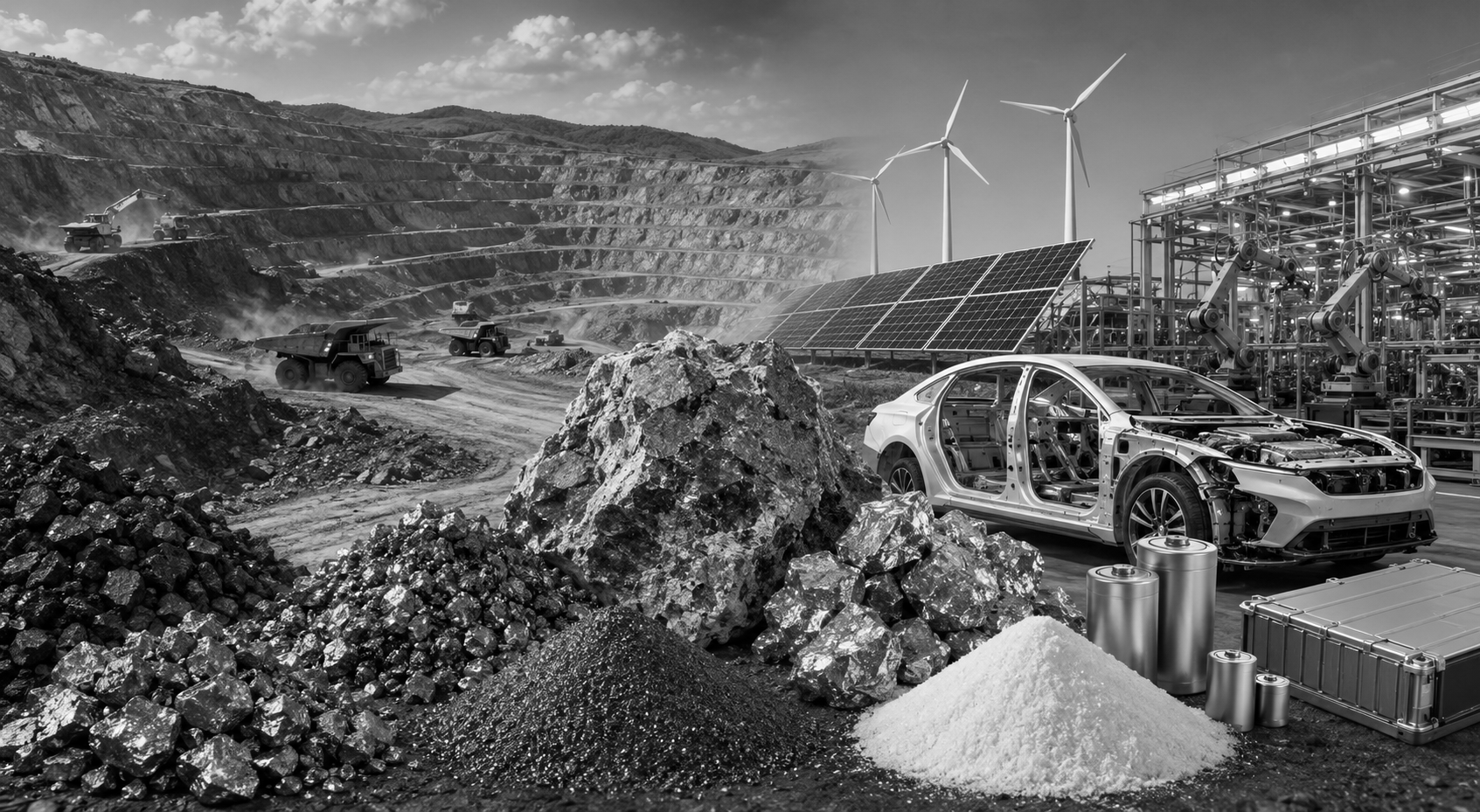
Unlike conventional minerals such as coal and limestone, critical minerals form the backbone of modern industrial and energy systems. They are essential for manufacturing batteries, electric vehicles, solar panels, wind turbines, semiconductors, electronics, aerospace components and defence equipment.
India remains heavily dependent on imports for several key minerals, including lithium, cobalt, nickel and rare earth elements . The challenge is compounded by China's dominance in global mineral processing. China controls around 85-90 per cent of global rare earth processing, nearly 90 per cent of graphite processing and a dominant share of lithium refining and battery material production, giving it a powerful position in global supply chains. Recognising these vulnerabilities, the Government launched the National Critical Mineral Mission (NCMM) to accelerate exploration, attract investment, encourage private participation and build strategic reserves of critical minerals.
India's Vast Mineral Wealth
The urgency behind the government's push is underpinned by India's substantial mineral endowment. The country possesses approximately 400.72 billion tonnes of coal resources and 47.37 billion tonnes of lignite resources , making it one of the world's most resource-rich nations in conventional minerals. India also has significant deposits of iron ore, bauxite, manganese, chromite, limestone, graphite, titanium-bearing minerals and rare earth resources. The country is estimated to possess more than 6.9 million tonnes of rare-earth resources , among the largest globally, along with one of the world's richest titanium-bearing beach sand deposits.
Yet, despite this abundance, India continues to import many critical minerals because a large part of its geological potential remains underexplored and underdeveloped. While countries such as Australia and Canada have spent decades building sophisticated exploration ecosystems, India is only now attempting to bridge that gap through policy reforms and increased private participation.
Exploration Becomes the New Frontier
To address this challenge, the Ministry of Mines simultaneously completed the Second Tranche of Exploration Licence (EL) auctions . The latest round expanded the Exploration Licence framework to Arunachal Pradesh, Uttar Pradesh and Odisha for the first time. With the completion of the second tranche, the number of successfully auctioned Exploration Licence blocks has reached 11 .
The Exploration Licence framework is particularly significant because it allows both public and private entities to undertake systematic exploration of critical and deep-seated mineral deposits before commercial mining begins. Historically, India's exploration efforts were dominated by government agencies such as the Geological Survey of India (GSI) and Mineral Exploration and Consultancy Limited (MECL). The introduction of Exploration Licences marks a strategic shift toward private-sector-led exploration, a model that has helped countries such as Australia and Canada become global mining powerhouses.
A Decade of Mining Reforms
The latest auctions are part of a broader transformation that began after the auction-based mineral allocation regime was introduced in 2015. During the first six years of the regime, from FY2015-16 to FY2020-21, only 108 mineral blocks were auctioned across the country. Following reforms to the Mines and Minerals (Development and Regulation) Act in 2021, auction activity accelerated sharply. Between FY2021-22 and FY2024-25, 364 mineral blocks were auctioned, while FY2025-26 alone witnessed a record 212 block auctions .
Overall, more than 700 mineral blocks have been auctioned since the auction regime was introduced. The numbers underscore how rapidly the sector has evolved from a slow-moving allocation process into a competitive, auction-driven ecosystem designed to attract investment and accelerate resource development.
How the Auction System Works
The Central Government conducts critical mineral auctions through the MSTC e-auction platform , India's official online mineral auction system. Companies participate in a transparent bidding process under the provisions of the Mines and Minerals (Development and Regulation) Act, 1957 and the Mineral (Auction) Rules, 2015.
Unlike a traditional asset sale, the government does not receive a one-time payment for a mine. Instead, the winning bidder commits to a long-term revenue-sharing arrangement linked to future mineral production. The host state government receives the largest share of mining revenues through royalty payments, auction premiums and dead rent. In addition to these payments, mining companies are required to pay statutory levies, which are government-mandated charges designed to support specific objectives.
One of the most important levies is the District Mineral Foundation (DMF) contribution. The funds collected through the DMF are used to improve the lives of communities affected by mining activities. These resources are invested in schools, hospitals, drinking water projects, rural infrastructure and livelihood programmes in mining regions.
Another key levy is the National Mineral Exploration Trust (NMET) contribution. NMET funds are used to support geological surveys, mineral exploration, resource mapping and the identification of future mineral assets. In this way, revenues generated from current mining activity help finance the discovery of future mineral resources.
State Governments Are the Biggest Beneficiaries
A common misconception is that the Central Government receives most of the revenue generated through mine auctions. In reality, the bulk of mining revenues flow to the host state. States earn substantial long-term income through royalties, auction premiums and other statutory payments once a mine enters production.
As a result, mineral-rich states such as Odisha, Chhattisgarh, Jharkhand, Karnataka and Telangana stand to benefit significantly from the expansion of mining activity. The Central Government's gains are largely indirect and come through GST collections, corporate taxes, increased industrial activity, job creation and reduced import dependence.
Private Sector Participation Is Rising Rapidly
One of the most significant developments in India's critical minerals sector is the growing role of private companies. In the early phases of the critical mineral programme, public-sector enterprises such as Coal India Limited, Oil India Limited, NLC India and SCCL emerged as dominant participants because of the strategic nature of these resources and the government's desire to ensure domestic control over critical supply chains.
However, recent auction rounds have witnessed a notable increase in private-sector participation. Companies such as Vedanta Limited, Hindustan Zinc, Dalmia Bharat Group and several emerging mining firms have become increasingly active in bidding for critical mineral assets. This trend reflects growing confidence in the sector and signals that investors increasingly view critical minerals as long-term strategic assets rather than conventional mining projects.
The rise in private participation mirrors the experience of advanced mining economies such as Australia and Canada, where private exploration companies play a central role in discovering and developing new mineral resources. India's transition toward a similar model is expected to accelerate exploration activity and attract greater investment into the sector.
Global Competitiveness: Where India Stands
The critical mineral push is ultimately about strengthening India's competitiveness in a rapidly evolving global economy. India possesses several important advantages, including a large geological resource base, strong domestic demand, ambitious manufacturing goals and substantial policy support through initiatives such as the National Critical Mineral Mission.
Nevertheless, significant challenges remain. Australia continues to lead the world in exploration intensity, mining productivity and mining infrastructure. Canada has built a world-class exploration ecosystem supported by specialised mining finance networks and thousands of junior mining companies. China, meanwhile, dominates the processing and refining stages of the critical mineral supply chain and controls substantial portions of global rare earth, graphite and lithium processing capacity.
India's biggest challenge is therefore not merely discovering minerals but developing the infrastructure needed to process, refine and integrate them into industrial supply chains. Experts often point out that the value captured from a mineral increases dramatically at each stage of processing. Mining ore creates only a fraction of the economic value ultimately generated through refining, battery manufacturing, semiconductor production and advanced industrial applications.
This is why the government's strategy extends well beyond mine auctions. It is increasingly focused on building an integrated ecosystem that includes exploration, mining, refining, battery manufacturing, semiconductor production, electric mobility and advanced manufacturing.
The Road Ahead
The successful auction of 56 critical and strategic mineral blocks represents far more than an administrative milestone. It reflects India's attempt to secure its place in the global competition for the resources that will power the industries of the future.
From the coalfields of Telangana to rare-earth deposits and battery mineral prospects across the country, India's mining sector is undergoing its most significant transformation in decades. The challenge now is to convert exploration licences into discoveries, discoveries into producing mines and producing mines into globally competitive industrial supply chains.
Ultimately, the success of India's critical mineral strategy will not be measured solely by the number of blocks auctioned. It will depend on how effectively the country can translate its vast geological wealth into production, processing capacity, manufacturing strength and long-term strategic security in an increasingly resource-driven world.