
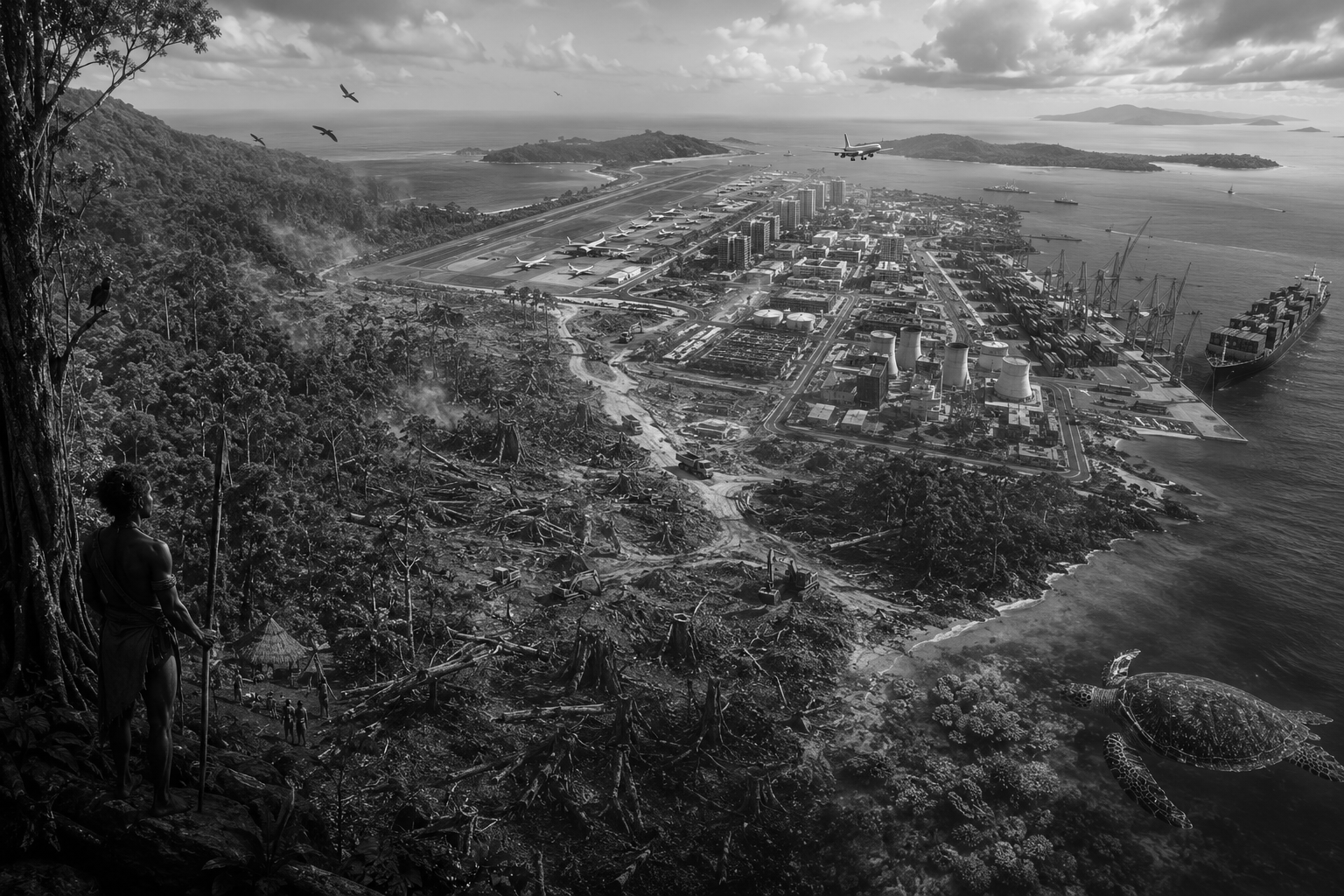
81,000 Crore and One Million Trees Later, Great Nicobar Starts With an Airport
Despite lawsuits, international criticism, warnings from genocide scholars, and protests from conservationists, the Modi government's ₹81,000 crore plan to remake Great Nicobar Island into the country's most consequential strategic and commercial outpost is moving from blueprint to ground reality, and the centrepiece of that transformation is an airport.
The Airports Authority of India (AAI) is overseeing the dual-use greenfield airport project and has already floated tenders for appointing a project management consultant. The facility will cater to civilian operations while also supporting Indian Navy and Indian Air Force aircraft and unmanned systems, mirroring the civil-military model used elsewhere in India. Its location is the key: proximity to the Six Degree Channel between Great Nicobar and Sumatra places it overlooking shipping lanes feeding into the Strait of Malacca , through which tens of thousands of vessels pass annually. Alongside this, expansion work at INS Baaz is underway to support special operations and transport aircraft.
The airport is one pillar of a much larger plan. At its core is the Galathea Bay International Container Transshipment Terminal , designed to handle 4 million containers by 2028 in phase one and up to 16 million containers annually at full capacity, positioning it among Asia's largest ports. Firms including Larsen & Toubro, Afcons Infrastructure, and JSW Infrastructure have submitted expressions of interest. The plan also includes a 450 MVA power plant and a township for 6.5 lakh people , on an island currently home to fewer than 10,000 residents. The ambition is to rival Singapore, Colombo, and Hong Kong as a transshipment hub while extending India's maritime power projection across the Indian Ocean.
Clearances have been secured. The Ministry of Ports, Shipping and Waterways confirmed environmental clearances and approval from the National Green Tribunal (NGT) , with no legal obstacles remaining. While the government increasingly frames the project in strategic and security terms, critics note that the airport forms only about 5% of the project area , with the rest dedicated to commercial infrastructure. They argue that presenting it primarily as a security initiative masks its commercial scale and ecological impact.
The ecological impact is severe. The project will require diversion of over 130 sq km of tropical rainforest and felling of around one million trees. Construction threatens coral reefs and leatherback turtle nesting grounds within a UNESCO Biosphere Reserve. The island lies near the Sunda Megathrust fault line , responsible for the 2004 Indian Ocean tsunami. The indigenous Shompen tribe , a small seminomadic community of a few hundred people, faces cultural and existential disruption from large-scale migration and development. While the government promises no forced displacement and compensatory afforestation, concerns persist about implementation and ecological adequacy.
As recently as March 2026 , construction activity including road cutting through forest areas was observed on the ground. The debate continues in Parliament, courts, and international academic circles, but on Great Nicobar Island, construction has already begun.