
A Blueprint Beyond the Bin: Lessons from Madanapalle
India's urban centres generate more than 1.5 lakh tonnes of municipal solid waste every day, making waste management one of the country's biggest environmental and governance challenges. Rapid urbanisation, changing consumption patterns and shrinking landfill space have placed enormous pressure on municipalities, with several metropolitan cities still struggling with overflowing dumpsites and rising waste transportation costs. Against this backdrop, Madanapalle Municipality in Andhra Pradesh is emerging as a compelling example of how a medium-sized town can transform waste into a valuable resource through scientific planning, community participation and circular economy principles.
Driven by the vision of Swachh Bharat Mission-Urban (SBM-U) 2.0, Madanapalle has adopted an integrated waste management system that extends far beyond routine garbage collection. The municipality's approach reflects the broader transformation taking place under India's flagship urban sanitation programme from the traditional "collect and dump" model to one where waste is scientifically segregated, processed, recycled, reused and recovered, with landfill disposal becoming the last option rather than the first.
A New Chapter in Urban Waste Management
Launched by the Ministry of Housing and Urban Affairs (MoHUA), Swachh Bharat Mission-Urban 2.0 represents the second phase of India's flagship cleanliness campaign. While the first phase primarily focused on eliminating open defecation, constructing household toilets and improving sanitation infrastructure, the current phase has shifted its emphasis towards creating Garbage-Free Cities through 100% source segregation, scientific processing of municipal solid waste, legacy waste remediation, circular economy practices, plastic waste management, resource recovery and citizen participation.
Approved with an overall outlay of ₹1.41 lakh crore for the 2021–2026 period, the mission has transformed urban sanitation into a comprehensive environmental programme. Of the total outlay, the Central Government contributes around ₹36,465 crore, while the remaining funds are mobilised through state governments, urban local bodies and other financing mechanisms. The mission has also encouraged municipalities to move beyond waste collection and focus on recovering value from every waste stream.
The Madanapalle Model
Generating around 62 tonnes of municipal solid waste every day, Madanapalle Municipality has developed an integrated waste management system that reflects the principles of Swachh Bharat Mission-Urban 2.0. Of the total waste generated, 36 tonnes is wet (biodegradable), 25.50 tonnes is dry waste and 0.50 tonnes is domestic hazardous waste. The municipality begins with source segregation, separating waste into biodegradable, non-biodegradable and upcycling categories at the household level to ensure scientific processing of every waste stream.
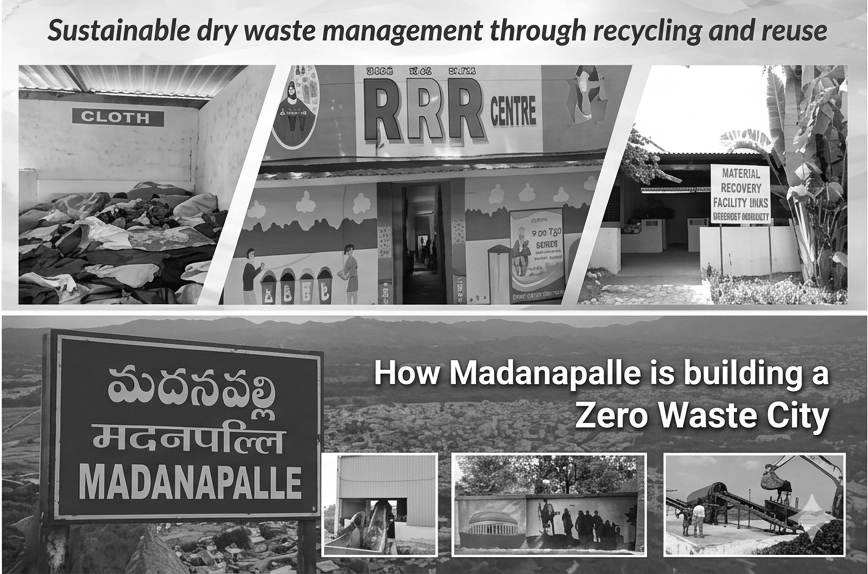
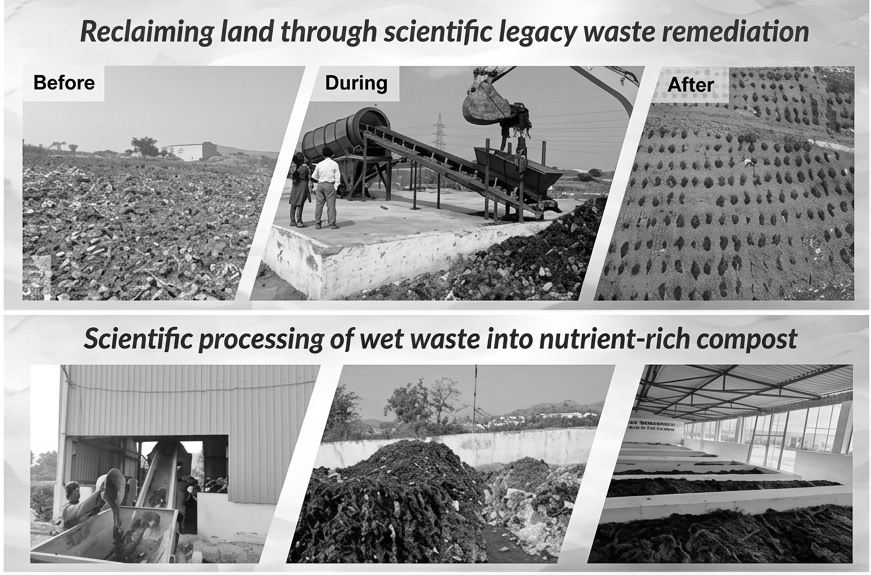
Recognising that nearly 60 per cent of municipal waste is biodegradable, Madanapalle promotes home composting, terrace gardening and on-site composting by Bulk Waste Generators. Every day, about 15.50 tonnes of wet waste is processed through windrow composting, producing 4.65 tonnes of compost for parks and plantations, while another 3 tonnes is treated through vermicomposting, generating 1.20 tonnes of nutrient-rich compost. Dry waste is routed to a Material Recovery Facility (MRF), where recyclable materials such as paper, plastic, glass and metal are segregated and sent to authorised recyclers. Non-recyclable combustible waste is converted into Refuse Derived Fuel (RDF) and supplied to cement industries for co-processing, reducing landfill dependence and fossil fuel use.
The municipality has also established a Reduce, Reuse and Recycle (RRR) Centre, which collects e-waste, clothes, books, toys and footwear through door-to-door drives. Usable items are repaired and redistributed to slum communities, homeless individuals and old-age homes, extending product life and promoting a circular economy. Complementing these efforts is the Waste-to-Art Park at NVR Layout, where discarded tyres and scrap materials have been transformed into artistic public installations, alongside awareness murals promoting cleanliness and waste segregation.
Another major achievement is the scientific remediation of 36,512 metric tonnes of legacy waste through biomining and bioremediation, reclaiming 9.40 acres of land, of which nearly 5 acres have been converted into plantation areas. Recovered RDF is supplied to cement plants, while soil and inert materials are reused for filling low-lying areas. By scientifically processing wet, dry, hazardous, green, e-waste, tyre waste and legacy waste, Madanapalle ensures that almost every waste stream is recovered, reused or recycled, making it an emerging model for sustainable urban waste management.
Learning from India's Best Practices
Although there is no official statement that Madanapalle adopted any specific city's model, its integrated waste management framework closely mirrors several nationally recognised best practices promoted under Swachh Bharat Mission-Urban 2.0. Cities such as Indore, Ambikapur, Panaji, Mysuru and Vijayawada have demonstrated that sustainable waste management depends on combining source segregation, decentralised composting, Material Recovery Facilities, biomining, recycling, citizen participation and circular economy principles, rather than relying solely on landfills.
Indore, consistently ranked India's cleanest city under Swachh Survekshan, has become the national benchmark by implementing 100% door-to-door collection, source segregation, composting, biomining, waste-to-art initiatives, Material Recovery Facilities and co-processing of non-recyclable waste in cement industries. Many of these practices now form the foundation of SBM-U 2.0, making them the national standard for municipalities across the country. Madanapalle's approach aligns with these proven strategies while adapting them to the scale and requirements of a medium-sized urban local body.
Lessons for India's Metro Cities
While metropolitan cities such as Hyderabad, Delhi, Bengaluru and Chennai generate several thousand tonnes of waste every day and continue to struggle with massive landfill sites like Jawaharnagar, Ghazipur, Deonar and Kodungaiyur, Madanapalle demonstrates that sustainable waste management is not solely dependent on expensive technology or large budgets. Instead, it shows that a well-planned, decentralised system can significantly reduce landfill dependence.
The municipality's biggest lesson is its philosophy that every waste stream should have a planned destination before it reaches a landfill. Wet waste is converted into compost, dry recyclables enter formal recycling chains, non-recyclable waste becomes Refuse Derived Fuel for cement industries, reusable household items are repaired and redistributed through the RRR Centre, discarded tyres are transformed into public art, and legacy waste is biomined to reclaim valuable urban land. By encouraging home composting, terrace gardening and on-site waste processing by institutions and bulk waste generators, Madanapalle also reduces transportation costs, fuel consumption and greenhouse gas emissions while promoting citizen participation.
The model highlights that metropolitan cities can complement advanced technologies such as GPS-enabled waste collection, smart monitoring systems and waste-to-energy plants with stronger source segregation, decentralised composting, Material Recovery Facilities, biomining and community-led reuse initiatives. The success of Madanapalle reinforces that waste should no longer be viewed as a disposal problem but as a valuable resource capable of generating compost, recycled materials, industrial fuel and even green public spaces.
Towards Zero Waste Cities
A Zero Waste City does not imply that no waste is generated. Instead, it means that nearly all municipal waste is segregated, composted, recycled, reused or scientifically processed, leaving only a minimal quantity for final landfill disposal. This approach not only conserves natural resources but also reduces greenhouse gas emissions, prevents groundwater contamination, recovers valuable urban land and supports a circular economy, where waste becomes an economic asset rather than an environmental burden.
Through source segregation, composting, recycling, biomining, Material Recovery Facilities, RRR Centres, Waste-to-Art initiatives and active citizen participation, Madanapalle is steadily progressing towards this vision. While larger cities continue to battle the complexities of managing enormous waste volumes, the municipality has shown that sustainable urban sanitation is not determined by the size of a city but by the efficiency of its systems, the commitment of its administration and the participation of its people. In doing so, Madanapalle offers a practical blueprint for urban India, demonstrating that the future of waste management lies not in creating larger landfills, but in ensuring that every piece of waste has a purposeful destination.