
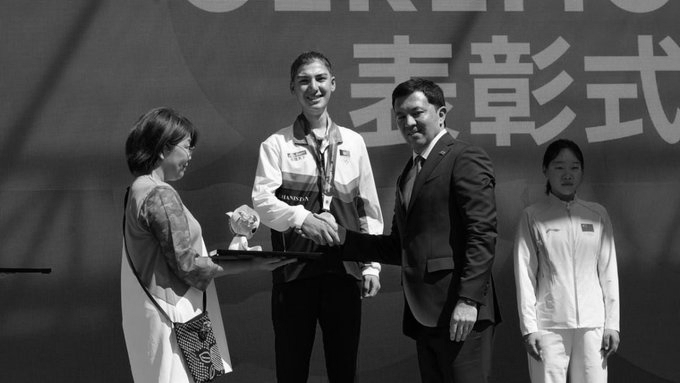
Afghan Cyclist Who Had To Disguise Herself As A Boy Wins Asian Games Silver
Afghan cyclist Fariba Hashimi won silver in the women’s road race at the Asian Games in Nagoya, but the medal represents far more than a sporting achievement. For Hashimi, reaching the podium meant overcoming years of restrictions, violence and displacement simply to pursue cycling.
Hashimi began riding as a teenager in Afghanistan, where women and girls faced hostility for participating in sport. Determined to train, she disguised herself as a boy so she could ride without drawing attention. She was later pelted with stones while cycling alongside her sister, Yuldus Hashimi, who is also a professional cyclist.
“I was born inside a country where the women who dream are getting attacked and I'm really happy that I have fought against that,” Hashimi said after her silver-medal performance.
The hostility eventually forced Hashimi to leave Afghanistan. With help from a former Italian champion, she fled the country and rebuilt her cycling career in Italy. She has since become a two-time Olympian, and her latest achievement has added an Asian Games medal to her record.
“This silver medal can show a lot of resilience from Afghan women and I'm really happy. I'm not alone. I know that behind me millions of women from many countries have the same dream and they are standing with me,” Hashimi said.
Her journey reflects the wider struggle faced by Afghan women in sport since the Taliban returned to power in August 2021. Women have been barred from most public sporting activities, while girls have been excluded from secondary education. Restrictions have also limited women's access to parks, gyms and travel without a male guardian.
Afghanistan's women's football team faced a similar upheaval after the Taliban takeover. The players were forced to flee the country, with more than 50 footballers and their families evacuated to Australia. Many left with little more than what they could carry.
The players subsequently trained and competed in exile while struggling for recognition as Afghanistan's national team. The Afghan football federation in the country did not recognise them, leaving the team in a prolonged fight to establish its status. FIFA only granted the players eligibility to represent Afghanistan internationally this year, ending a five-year struggle for official recognition.
The challenges have extended beyond football and cycling. Afghan wheelchair basketball players, boxers, martial artists and other athletes have faced similar experiences of fleeing their country, rebuilding their careers abroad and fighting for recognition.
That is why Hashimi's silver medal in Nagoya carries significance beyond the podium. It is a reminder of what an Afghan woman had to overcome simply to compete.
For Hashimi, the race ended with a medal. For many Afghan women athletes still facing restrictions at home, the struggle is not about winning medals. It is about having the freedom to participate, compete and be seen.