
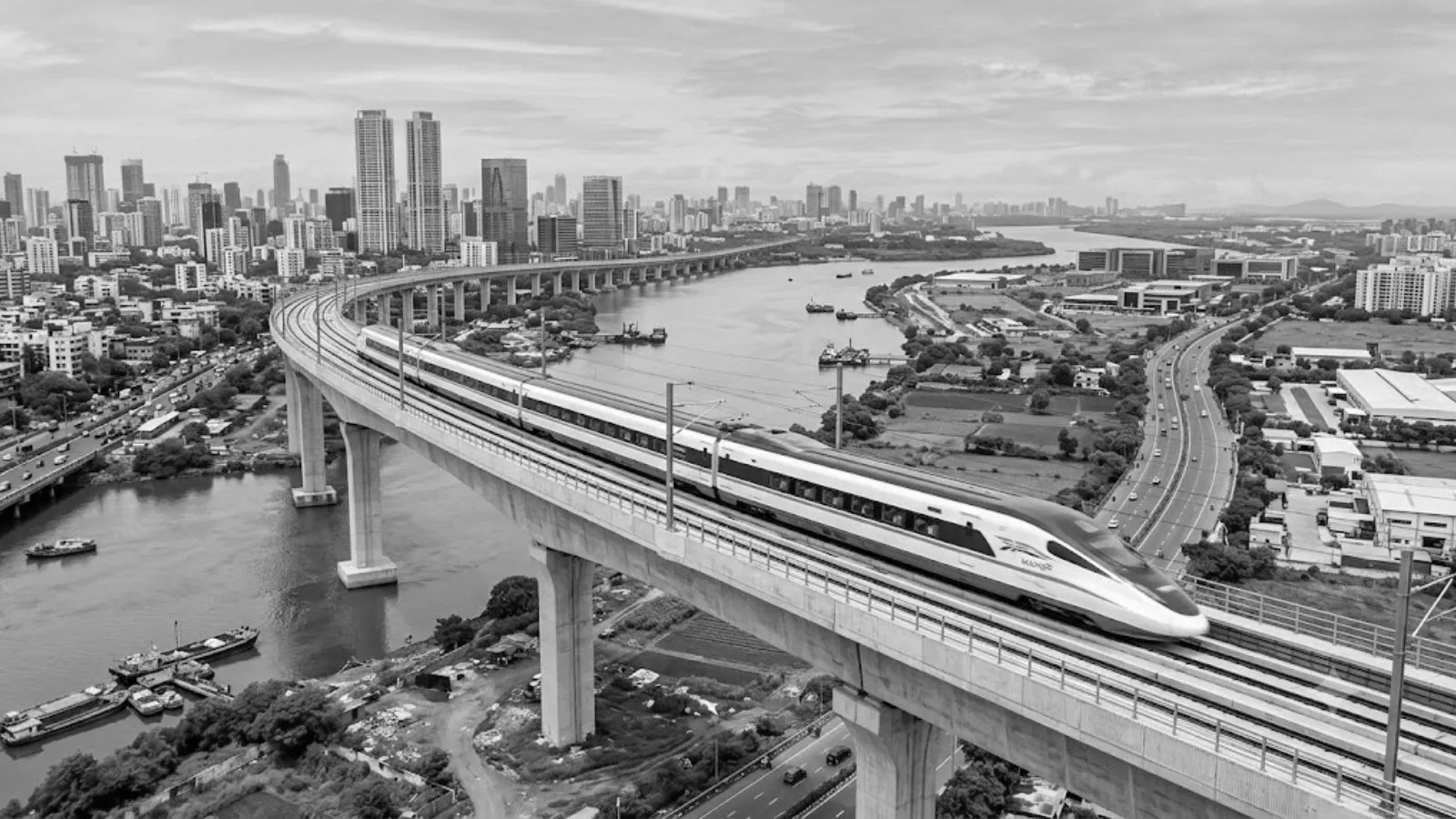
Ahmedabad Rail Expansion Gains Pace as Bullet Train Nears Milestone
Union Minister for Railways, Information & Broadcasting, and Electronics & Information Technology Ashwini Vaishnaw on Saturday announced a series of major infrastructure initiatives for Ahmedabad while reaffirming that India's first Mumbai–Ahmedabad Bullet Train Project is progressing rapidly, with nearly 80% of the work already completed .
During a review meeting with public representatives and civic leaders following his arrival in Ahmedabad, the minister said the first phase of the high-speed rail corridor between Surat and Bilimora is expected to become operational in 2027 . The service will subsequently be extended in phases to Vapi, Ahmedabad and Mumbai , marking a significant milestone in India's high-speed rail ambitions.
The 508-km Mumbai–Ahmedabad High-Speed Rail Corridor , being developed using Japan's renowned Shinkansen technology , is designed to support train speeds of up to 320 kmph . Once fully operational, it is expected to reduce travel time between Mumbai and Ahmedabad to nearly two hours. Unlike conventional Indian Railways, the bullet train will run on a dedicated standard-gauge network equipped with advanced signalling, fully fenced tracks, ballastless slab technology, earthquake detection systems and exclusive passenger operations.
The project has also emerged as a major technology-transfer initiative, introducing advanced tunnel engineering, bridge construction techniques and high-speed rail systems to India. Recent milestones include progress on India's first undersea railway tunnel beneath Thane Creek , mountain tunnel breakthroughs and extensive viaduct construction. Despite these achievements, the project's estimated cost has reportedly risen from around ₹1.08 lakh crore to nearly ₹1.98 lakh crore , primarily due to land acquisition delays, inflation and higher compensation costs.
Vaishnaw also described the day as a landmark moment for India's semiconductor sector, noting that Prime Minister Narendra Modi would inaugurate the country's third semiconductor plant in Sanand . Two other semiconductor projects had already been launched in the industrial hub earlier this year, strengthening Gujarat's position in India's emerging semiconductor ecosystem.
The meeting also resulted in approval of five major development projects for Ahmedabad. Officials were directed to complete the Omnagar Underpass (ROB) before Navratri, while a comprehensive redevelopment plan was cleared for Asarva Station , including a modern terminal and upgraded passenger facilities. A second entry gate from the Sarangpur side will be developed at Ahmedabad Railway Station, while work on the Shahpur–Ahmedabad Flyover will proceed after securing heritage-related clearances. In addition, a joint action plan will be prepared to expand and improve connectivity around Sabarmati Railway Station .
Officials said the combination of bullet train development, station modernization, urban transport upgrades and semiconductor investments is transforming Ahmedabad into a key hub for India's future transportation and technology-driven growth.