
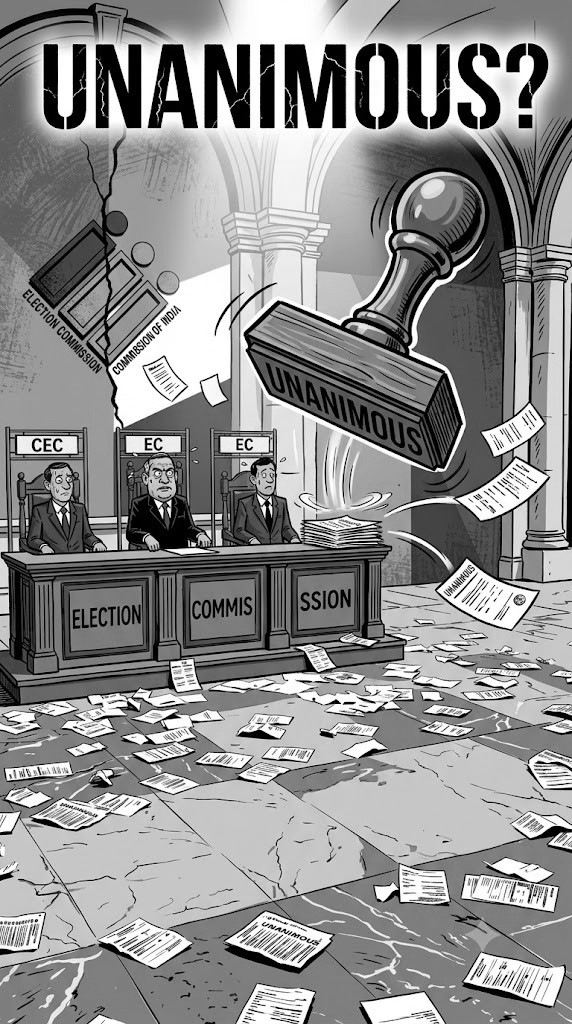
‘All SIR Decisions Unanimous’: EC Goes Into Damage-Control Mode As Gyanesh Kumar Faces Fresh Heat
The Election Commission has put its strongest emphasis yet on one message in the escalating SIR controversy: every decision on the Special Intensive Revision of electoral rolls was unanimous. But the clarification has come at a politically difficult moment for Chief Election Commissioner Gyanesh Kumar, with reports of repeated objections by two Election Commissioners, earlier legal challenges and mounting Opposition demands for his removal.
The EC said its SIR orders, including the June 24, 2025 order, had the approval of Kumar, Sukhbir Singh Sandhu and Vivek Joshi. It said differences, suggestions and inputs during deliberations were normal and should not be treated as dissent over final decisions. The Commission also announced nine measures to strengthen its functioning, including advance circulation of meeting agendas, recording of minutes and greater scrutiny of electoral IT systems.
But this is precisely where the political fight has shifted. An Indian Express investigation reported that Sandhu and Joshi had recorded objections at least 14 times in 10 months over issues including voter registration, deletion and restoration, changes to statutory Form 6, electoral databases and aspects of the SIR process. The EC has characterised these as suggestions or inputs, while insisting that final decisions remained unanimous.
Congress has called the latest statement "damage control", with Jairam Ramesh saying it did not directly answer the concerns raised in the reports. The Opposition has previously taken the issue to court and is again seeking action against Kumar. Kapil Sibal has called for scrutiny of EC records, including orders and material relating to the reported objections.
The controversy widened further after former Kerala chief secretary Jiji Thomson alleged that Kumar, while an IAS officer in 2016, asked whether he would contest the 2019 Lok Sabha election on a BJP ticket. Thomson said he declined. Kumar has not responded publicly to the allegation in the reports reviewed. Kerala Congress leader V D Satheesan has cited it while demanding Kumar's removal. The allegation remains unsubstantiated.
The political confrontation is now moving towards September 30, when at least 21 Opposition parties are expected to meet to discuss a joint strategy and a possible fresh move seeking Kumar's removal. The Congress Working Committee is scheduled to meet on September 29.
The SIR battle is also playing out sharply in West Bengal. The EC has told the Supreme Court that 22.21 lakh of 27.16 lakh deleted voters have filed appeals seeking inclusion, while total appeals have crossed 38 lakh. TMC chief Mamata Banerjee has attacked the SIR process, while BJP leader Suvendu Adhikari has blamed her for the deletion of more than 27 lakh names, saying the deletions followed judicial directions.
The issue has spread beyond established political parties too. The Cockroach Janta Party says its co-convener Ashutosh Ranka and more than 30 activists were detained in Assam ahead of a regional meeting. Founder Abhijeet Dipke has demanded Ranka's release. Activist Sonam Wangchuk has backed the CJP's proposed October 2 protest seeking accountability from the CEC, although he may not attend physically.
Meanwhile, the BJP and NDA allies have rallied behind the EC, saying its clarification settles the issue. Union minister Kiren Rijiju has also attacked Rahul Gandhi's demand for Kumar's resignation, saying such remarks send a "wrong message" to society.
So the real political question now is not merely whether the EC says "unanimous". It is whether that assertion adequately answers the questions raised by the reported 14 objections, the earlier legal challenges and the concerns over voter-roll procedures. The Commission says the final decisions were unanimous; the Opposition says the explanation amounts to damage control. That unresolved gap is now at the heart of the SIR battle.