
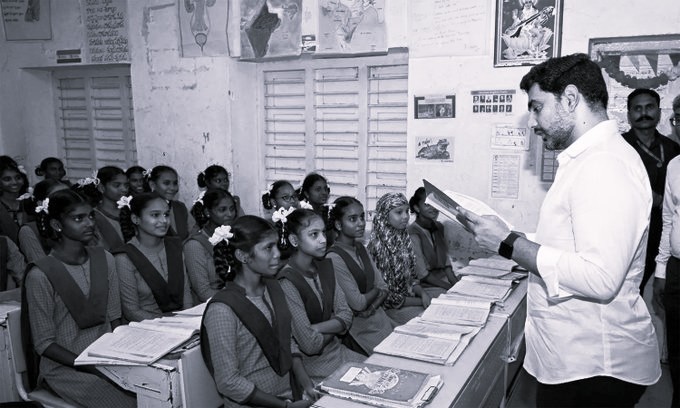
AP Revamps School Education With Focus On Gender Equality, AI And Practical Learning
Andhra Pradesh is reshaping its school education system to promote gender equality, practical learning, technology-based teaching and industry-ready skills, Education Minister Nara Lokesh said.
Speaking at a recent Public Affairs Forum of India event in Delhi, Lokesh said the government was working to ensure that children do not develop gender stereotypes at an early age. He cited changes in Classes 1 and 2 textbooks, where illustrations that traditionally showed women doing most household chores have been replaced with examples depicting men and women sharing domestic responsibilities.
The government is also using the weekly ‘No Bag Day’ to move beyond conventional classroom learning. Students are introduced to practical subjects such as family and farm budgeting, field visits and artificial intelligence. Lokesh said students were being taught both the benefits and possible negative effects of AI so that they could use the technology responsibly.
He said his long-term objective was to make classrooms more interactive through technology and gamified learning. Under the proposed model, a 45-minute lesson could be followed by a 60- or 90-second video highlighting key concepts and a short quiz. Clicker-based technology would allow students to respond during class and participate more actively instead of remaining passive listeners.
The government is also focusing on personalised learning by integrating student performance data into a Learning Management System. This could help identify specific areas where a student needs additional support. Through the Learning Excellence in Andhra Pradesh (LEAP) app, students could receive targeted homework and learning material. Parents and teachers would also be able to use the platform.
Lokesh said curriculum reforms were also being pursued in higher education, with discussions under way on whether university courses, majors and minors match current academic and market requirements. He stressed that curriculum reform would be a phased and continuous process.
On teacher availability, Lokesh said the ‘one class, one teacher’ model had expanded from 3% of schools in 2024 to 33% currently. The government has recently completed the recruitment process for 16,000 teachers and plans to undertake recruitment annually.
The minister also highlighted industry partnerships in technical education. Suzlon has adopted four ITIs and Royal Enfield one, with companies supporting equipment and industry-oriented curricula. The government, he said, would provide the required instructors while ensuring that training remains aligned with industry needs.
The broader objective, Lokesh said, is to connect values, practical experience, technology, personalised learning and employable skills across school, higher and technical education.