
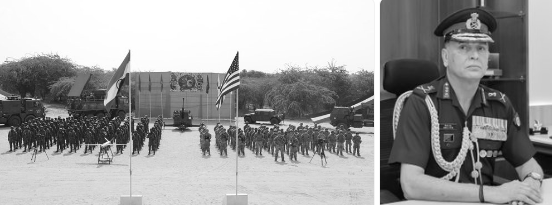
Army Chief Gen Dhiraj Seth Heads To Russia With Spare Parts, Air Defence And Tank Deals In Focus
Indian Army chief General Dhiraj Seth is set to travel to Russia on Wednesday, with spare parts, air defence systems, infantry fighting vehicles and future battle tanks likely to feature prominently in talks as New Delhi seeks to maintain critical Russian-origin equipment while reducing its dependence on foreign suppliers.
Gen Seth is expected to meet his Russian counterpart, Colonel General Andrei Mordvichev, and other senior military officials. It will be the first visit by an Indian Army chief to Russia since General Bipin Rawat travelled to Moscow in October 2018.
The visit follows a series of high-level India-Russia engagements. External Affairs Minister S Jaishankar visited Moscow in August for the 27th session of the India-Russia Inter-Governmental Commission and met First Deputy Prime Minister Denis Manturov and Foreign Minister Sergey Lavrov.
Russian President Vladimir Putin then visited India for the BRICS summit and held talks with Prime Minister Narendra Modi on September 11. The two leaders reviewed defence cooperation along with economic, energy, space and other areas. Modi also accepted Putin’s invitation for the 24th India-Russia Annual Summit in Russia.
Against this backdrop, Gen Seth’s visit could provide a more Army-specific focus to defence discussions.
A key issue is expected to be the supply of spare parts and maintenance support for Russian-origin equipment already in service. Russian systems remain deeply embedded in the Army’s armoured, mechanised and air-defence formations.
Russia is also offering new systems. The Pantsir-S1M mobile short-range air-defence system is being discussed for the Army’s Carrier Air Defence Tracked requirement, under which India plans to acquire at least 90 systems with a minimum of 50 per cent indigenous content.
Moscow is also offering the BMP-3 infantry fighting vehicle as India works to modernise its mechanised infantry. The Army is simultaneously pursuing an indigenous programme to upgrade its BMP-2 fleet, making the Russian proposal part of a wider debate over upgrading existing platforms versus adopting a new foreign system.
Another major issue is the Future Ready Combat Vehicle programme, which is intended to eventually replace the Army’s ageing T-72 and T-90 tanks. Russia could offer technologies linked to newer platforms such as the T-14 Armata or explore joint development and manufacturing.
The talks also come as Russia seeks deeper defence cooperation based on joint production and technology transfer rather than a traditional buyer-seller relationship. Moscow has recently pushed proposals including additional S-400 systems, Pantsir-S1M, radars, Su-57 fighter production and a major upgrade of India’s Su-30MKI fleet.
India, meanwhile, is steadily diversifying its weapons suppliers. SIPRI says Russia accounted for 40 per cent of India’s arms imports in 2021-25, down from 51 per cent in 2016-20 and 70 per cent in 2011-15.
Yet Russian equipment remains central to India’s military inventory. In March, India also signed a Rs 445-crore contract for the upgrade and sustainment of Russian Tunguska air-defence missile systems.
The Seth visit could therefore test how far India and Russia can combine continued support for legacy systems with indigenisation, technology transfer and joint production.