
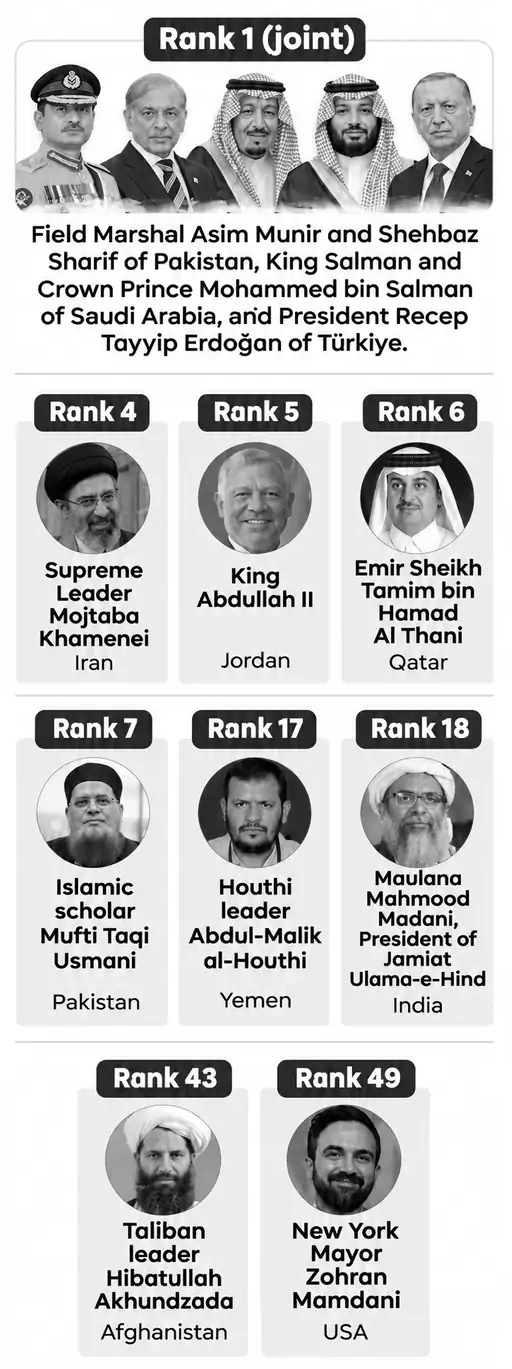
Asim Munir, Shehbaz Sharif Top ‘Most Influential Muslims’ List, One Indian Makes Top 20
Pakistan's Army chief Field Marshal Asim Munir and Prime Minister Shehbaz Sharif have been ranked joint number one in the 2027 edition of ‘The Muslim 500’, an annual list of the world's most influential Muslims. They share the top position with Saudi Arabia's King Salman, Crown Prince Mohammed bin Salman and Turkish President Recep Tayyip Erdogan. From India, Maulana Mahmood Madani, president of Jamiat Ulema-e-Hind (JUH), has secured the 18th position.
Published by the Royal Islamic Strategic Studies Centre (RISSC), a Jordan-based research institution, the 18th edition has named five leaders jointly at the top for the first time. The publication attributed the decision primarily to the Makkah Joint Defence Agreement, signed by Pakistan, Saudi Arabia and Türkiye on August 7, 2026. Under the mutual defence pact, an armed attack against one signatory would be treated as an attack against all three.
The report highlighted the combination of Saudi Arabia's financial strength, Türkiye's technology and manufacturing capabilities, and Pakistan's military strength as the basis of the alliance. Munir and Sharif had featured among the unranked 450 personalities in the 2026 edition before making a dramatic jump to joint first place.
Munir's profile describes him as the head of a military that exercises de facto control over Pakistan. It highlights his military and diplomatic influence while also acknowledging criticism surrounding political crackdowns and former Prime Minister Imran Khan's imprisonment.
Maulana Mahmood Madani is the only Indian among the individually ranked top 50, securing the 18th position, two places below his previous ranking. He heads Jamiat Ulema-e-Hind, established in 1919 by Deobandi scholars. The organisation has historically supported composite nationalism and opposed defining national identity solely through religion.
Madani completed his studies at Darul Uloom Deoband in 1992. His grandfather, Hussain Ahmad Madani, led the organisation until 1957, followed by his father, Asad Madani, who remained president until his death in 2006. Mahmood Madani served as general secretary from 2001 to 2021 before becoming its national president. A leadership dispute following his father's death had earlier divided the organisation.
The RISSC report recognises his work on minority rights, citizenship, religious freedom and protection of Waqf properties. It also acknowledges his legal assistance to people allegedly falsely implicated in terrorism cases and his opposition to Islamophobia. On Waqf protection, Madani has called it a collective religious obligation for Indian Muslims, while advocating financial transparency, mandatory audits, digitisation of legal records and better documentation. His criticism of Israel's military operations in Gaza and support for Palestinian rights are also highlighted.
Among other prominent personalities, Iran's Supreme Leader Mojtaba Khamenei ranks fourth, followed by Jordan's King Abdullah II at fifth and Qatar's Emir Sheikh Tamim bin Hamad Al-Thani at sixth. Pakistan's Mufti Taqi Usmani is seventh, while Yemen's Houthi leader Abdul-Malik al-Houthi is 17th. Other names include Taliban leader Haibatullah Akhundzada, Syria's Ahmed al-Sharaa and New York Mayor Zohran Mamdani, ranked 49th.
Several other Indians feature in the remaining 450 names, including AIMIM chief Asaduddin Owaisi, Islamic preacher Zakir Naik, businessman Azim Premji and Dawoodi Bohra leader Syedna Mufaddal Saifuddin. Bollywood actors Shah Rukh Khan, Aamir Khan, Salman Khan and Shabana Azmi, along with music composer AR Rahman, are also included.