
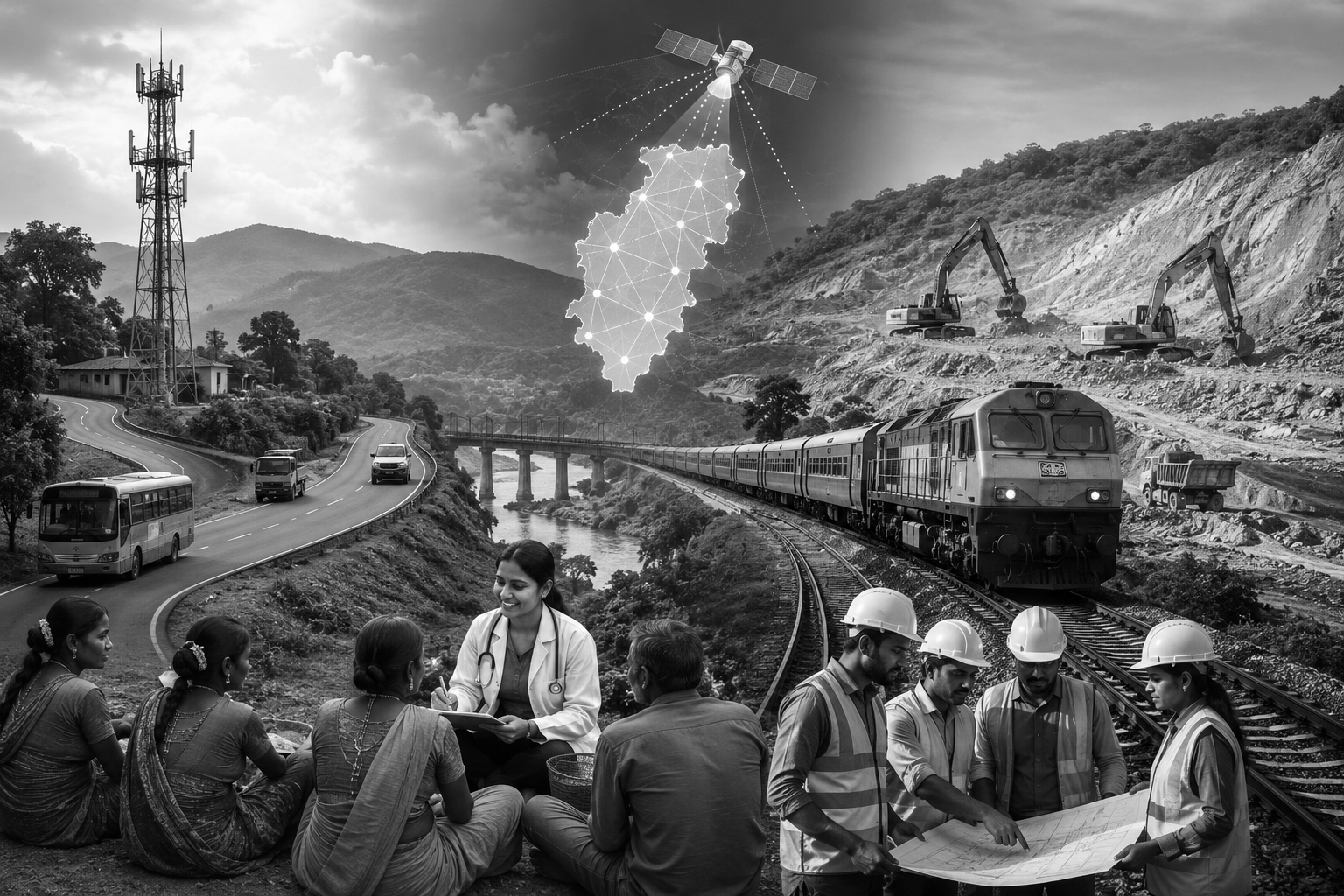
Bastar Emerges as Chhattisgarh’s New Infrastructure and Investment Frontier
The Chhattisgarh government has signed two memoranda of understanding with BISAG-N and National Logistics Data Services Ltd (NLDSL) to expand the use of geospatial technology and integrated logistics data under the PM GatiShakti framework, adding a digital planning layer to the state's wider push to convert improved security conditions into infrastructure, investment and employment. The agreements, signed on August 20, come as Chhattisgarh enters a new phase after years of Maoist violence, with Chief Minister Vishnu Deo Sai describing Bastar as a region moving towards sustained development, better connectivity and economic opportunity.
The pacts were signed during the PM GatiShakti and LEADS 2025 Dissemination Workshop, jointly organised by the state Commerce and Industries Department and DPIIT. Sai said the framework was strengthening data-driven decision-making, helping identify connectivity and logistics gaps and align industrial development with infrastructure. More than 35 state departments have been onboarded, with 41 mandatory and over 600 additional data layers mapped, alongside 45 use cases and 30 tools. Applications include GIS-based road black-spot identification, banking-access mapping and bus-route optimisation. Around 600 mobile towers have also been installed at tourism locations, while 700 acres in Nava Raipur have been finalised under the Bhavya Scheme.
The digital push comes alongside a wider post-Maoist development drive. The Centre says no district in Chhattisgarh is now classified as LWE-affected, while legacy areas continue to receive development support. Thousands of kilometres of roads and telecom infrastructure have expanded access to remote communities, alongside schools, skill centres, banking facilities and healthcare.
Bastar has emerged as a major focus of the investment push. The Bastar Investor Connect in 2025 attracted proposals worth around ₹52,000 crore, including a ₹43,000-crore commitment from NMDC. Rail connectivity is also being strengthened through the ₹3,513-crore Rowghat-Jagdalpur line and doubling of the Kottavalasa-Kirandul route, while road projects worth around ₹2,300 crore are planned across the region.
The state is simultaneously using its Industrial Development Policy 2024-30, Logistics Policy 2025 and One-Click Single Window System 2.0 to attract investment. Proposals worth ₹1.23 lakh crore were received at a 2025 industry dialogue, with more than 20,000 jobs expected.
Major players including NMDC, Indian Railways, BSNL, central road agencies, BISAG-N, NLDSL and private investors are now contributing to the transformation. Yet concerns over tribal rights, displacement and environmental sustainability remain. The larger test, officials say, is whether improved security and connectivity translate into local jobs, stronger livelihoods and inclusive economic growth.