
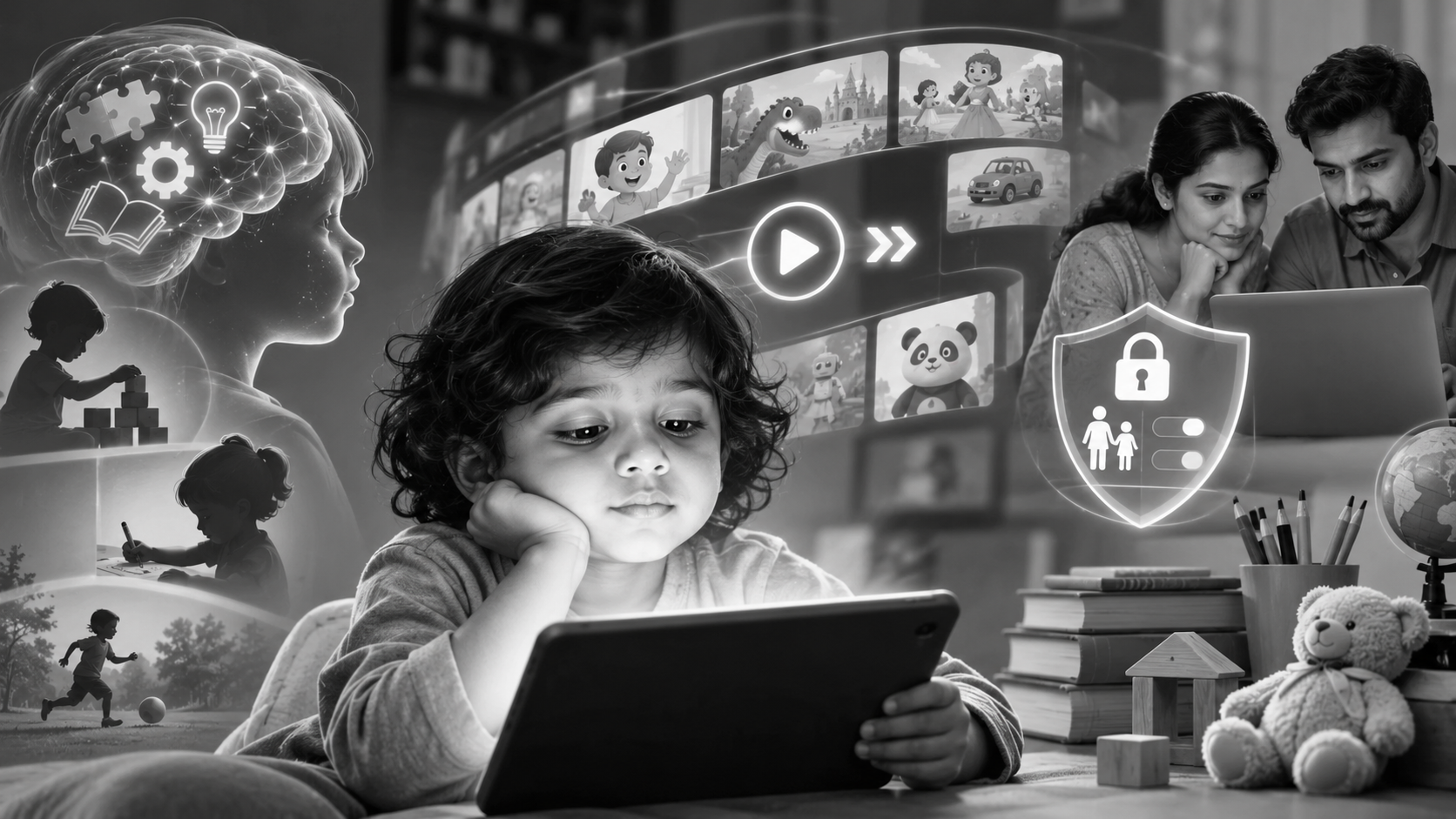
Before the First Classroom: How Algorithms Are Shaping Young Minds
A three-year-old watching colourful cartoons, nursery rhymes and animated educational videos on a smartphone has become a familiar sight in many households. For parents managing work and household responsibilities, digital devices often provide a convenient way to keep children occupied. However, what appears to be harmless entertainment raises an important question: What happens when children enter an algorithm-driven digital world before they are old enough to understand what they are watching? The concern extends beyond screen addiction to the possible influence of digital content on children's psychological development, independent thinking, imagination and understanding of educational concepts during their formative years.
The Growing Digital Exposure Among Preschoolers
The scale of early digital exposure is evident in Indian research. A 2025 systematic review and meta-analysis by researchers from the All India Institute of Medical Sciences, Raipur, covering 10 studies involving 2,857 children below five, estimated their average daily screen exposure at 2.22 hours. For children below two, the estimate was 1.23 hours. Another study published in BMJ Paediatrics Open in June 2025, involving 3,624 parents of children aged two to five across five northern Indian states, found that more than 60 per cent of children spent between two and four hours daily on screens. A separate study of 189 preschool children in Kerala found that 89.4 per cent exceeded one hour of daily screen exposure, with average usage reaching 2.14 hours. These findings highlight the growing gap between recommended screen-time limits and actual household practices.
The Invisible Algorithms Behind Children's Screens
Children do not need their own social media accounts to become part of the algorithm-driven digital ecosystem. They may encounter personalised recommendations through their parents' YouTube accounts, smartphones, tablets and smart televisions. Recommendation systems use signals such as viewing history and interactions to suggest additional content, while autoplay allows videos to continue without deliberate selection. A child watching a nursery rhyme may subsequently encounter cartoons, toy promotions, animated stories and other entertainment. The concern is whether these recommendations serve children's developmental needs or primarily encourage continued viewing. The content itself also matters, as preschoolers may encounter repetitive songs, fast-paced cartoons, commercial promotions, fantasy characters and even inappropriate material. Since young children learn through imitation, repeated exposure may influence their vocabulary, gestures, behaviour and preferences.
Psychological Development and Independent Thinking
Preschool years are crucial for developing attention, emotional regulation, patience, memory and problem-solving abilities. Many digital videos use bright colours, exaggerated expressions, repetitive music and frequent scene changes to maintain attention. Researchers are examining whether prolonged exposure to highly stimulating content influences children's ability to engage in slower activities such as storytelling, drawing and classroom learning. A 2024 systematic review and meta-analysis published in JAMA Pediatrics, covering 100 studies involving 176,742 children below six, found negative associations between programme viewing and cognitive outcomes, while background television exposure was also negatively associated with cognitive development. Age-inappropriate content was associated with poorer psychosocial outcomes. However, shared media use with caregivers showed a positive association with cognitive outcomes, highlighting the importance of parental involvement.
An additional concern involves inner speech, the internal conversation through which children gradually learn to organise their thoughts and actions. A 2022 study involving 29 five-year-olds in Italy found that children used less self-directed speech during digital problem-solving activities than during comparable physical tasks. Researchers described this as the digital bubble effect. The finding raises questions about whether screen-based activities provide sufficient opportunities for children to verbalise their thoughts, experiment and solve problems independently, although it does not establish permanent developmental damage.
Is Digital Content Changing Children's Imagination?
Imagination and mental visualisation develop when children create pictures and situations in their minds. Listening to a story about a forest or an imaginary character requires children to construct their own mental images, whereas animated videos provide ready-made visual representations. A 2021 longitudinal study following 109 preschool children over two years found an association between greater media consumption and weaker mental imagery performance. Although this does not prove that digital exposure damages imagination, it highlights the importance of independent storytelling, drawing, pretend play and creative activities. Children need opportunities to create their own characters and imaginary situations rather than continually receiving pre-designed visual experiences.
Learning Concepts or Merely Recognising Visuals?
Another important concern is whether children genuinely understand educational concepts presented through digital videos or simply recognise the colourful representations. A child may memorise numbers from an animated lesson but struggle to count actual objects independently. Similarly, watching an animated explanation of plants or animals does not necessarily provide the same understanding as observing them in the real world. A 2021 meta-analysis published in Child Development, examining 59 reports and 122 effect sizes involving children aged zero to six, identified the video deficit effect, finding that young children often learn less effectively from video demonstrations than from equivalent face-to-face demonstrations. The average difference was approximately half a standard deviation. Connecting digital lessons with hands-on activities, such as counting physical objects or examining actual plants, can help children translate visual information into meaningful understanding.
Parents, AI and Digital Protection
Parents play a crucial role in supervising children's digital experiences, particularly as working schedules and household responsibilities make smartphones convenient childcare tools. Devices are frequently used during meals, travel and tantrums, sometimes without parents checking subsequent recommendations. Platforms such as YouTube Kids offer approved-content settings, search restrictions and video-blocking options, while applications such as Qustodio and Bark provide various monitoring and filtering features. Google Family Link and Apple Screen Time also help manage applications and viewing limits. AI-assisted systems can potentially identify inappropriate content, flag concerning viewing patterns and provide parental alerts. However, their monitoring capabilities vary, and automated filters can make mistakes. AI should support parental supervision rather than replace it.
Safety Guidelines and Shared Responsibility
The World Health Organization (WHO) recommends no sedentary screen time for infants below one year and does not recommend screen time for one-year-olds. For children aged two to four, sedentary screen exposure should not exceed one hour daily, with less being better. The Indian Academy of Pediatrics similarly recommends avoiding screens below two years and limiting exposure to one hour daily for children aged 24–59 months under supervision. WHO also recommends at least 180 minutes of physical activity daily for children aged three to four, including 60 minutes of moderate-to-vigorous activity, alongside 10–13 hours of sleep. Parents should disable autoplay, restrict unrestricted searches, review viewing history, protect children's personal information and encourage outdoor play, reading and conversations. India's Digital Personal Data Protection Act, 2023, also provides safeguards concerning children's personal data, subject to applicable provisions and exemptions. UNICEF's 2025 guidance on AI and children further emphasises privacy, safety and responsible technology design.
Ultimately, protecting preschool children does not mean eliminating technology from their lives. It means ensuring that digital entertainment does not replace the experiences through which they learn to think, imagine, communicate and explore. Before children learn to navigate algorithms, society must ensure that they have the opportunity to learn how to navigate the world around them.