
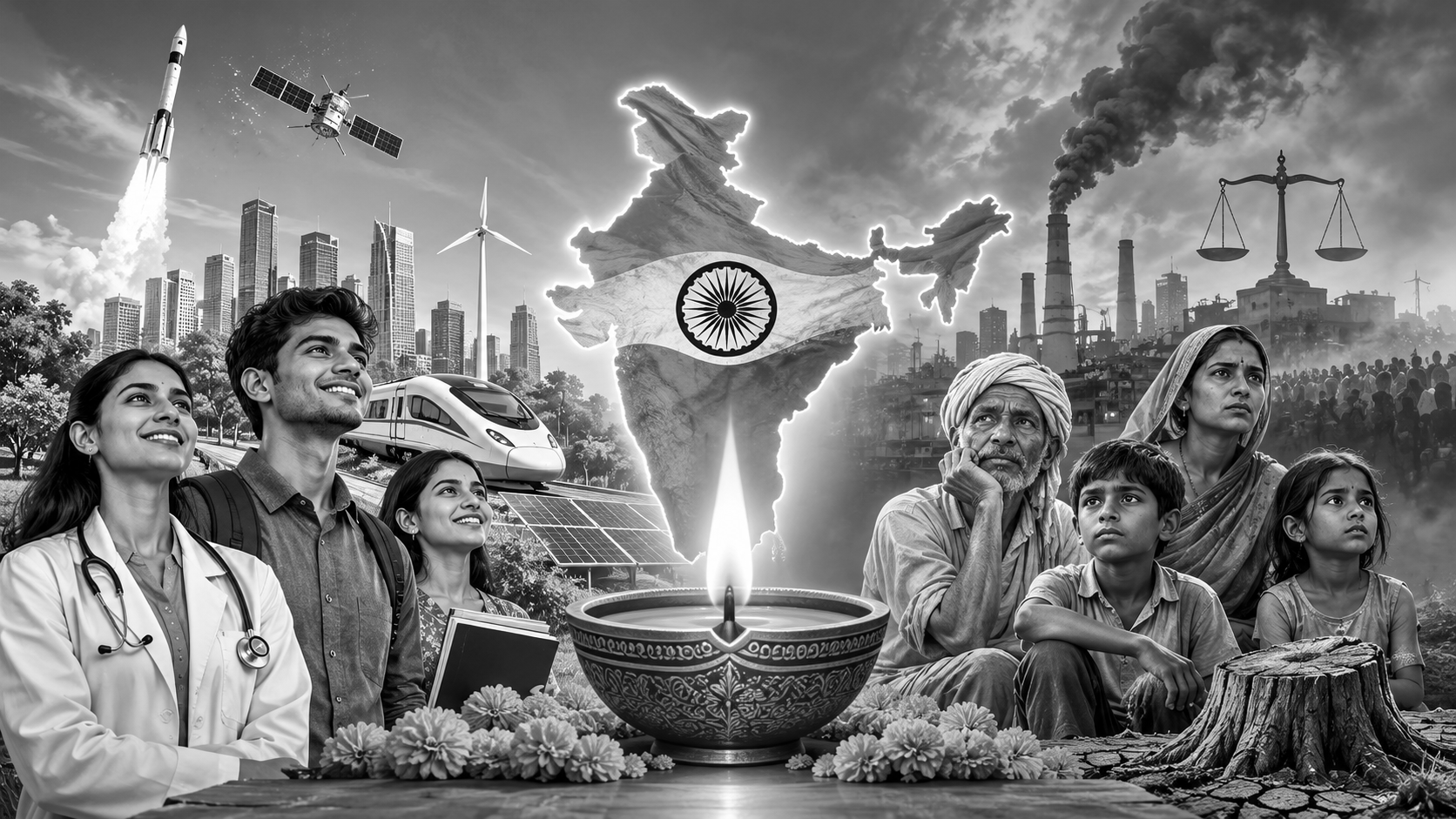
Between Darkness and Light: India's Journey Towards Progress, Equality and Unity
As the lamps of Deepavali illuminate homes across India, the festival offers an opportunity to reflect on a question that goes beyond tradition: Is the country moving towards a brighter future, or are growing challenges threatening to overshadow its progress? Deepavali symbolises the victory of light over darkness, knowledge over ignorance and good over evil. These values carry particular significance for a nation standing at a historic crossroads, balancing remarkable achievements with persistent social, economic and environmental challenges.
India today is a country of striking contrasts. It is a rising global power, a fast-growing economy and a major centre of technological innovation. Yet millions continue to struggle with unemployment, inequality, inadequate public services and environmental uncertainty. The real measure of India's development will therefore depend not only on how rapidly its economy grows but also on how fairly that progress reaches its people.
India's transformation over the past two decades has been remarkable. From expanding infrastructure and digital connectivity to advances in science and space exploration, the country has strengthened its position on the global stage. Initiatives such as Make in India, Startup India, Digital India and Skill India have encouraged innovation, entrepreneurship and technological adoption. India's space programme, particularly the successful Chandrayaan missions and Aditya-L1 solar mission, has demonstrated the country's growing scientific capabilities. Its expanding role in international forums, including the G20, and its engagement with the Global South have further enhanced its diplomatic influence. These achievements represent the bright lamps of progress, reflecting the aspirations of a nation determined to establish itself as a leading global power.
The digital revolution is another significant achievement. The Unified Payments Interface (UPI), launched in 2016, has transformed everyday financial transactions, allowing individuals and businesses to transfer money instantly. During FY 2025-26, UPI processed approximately 24,162 crore transactions worth Rs 314 lakh crore, according to government figures. Digital payments have made financial services more accessible, including in smaller towns and rural areas. However, technological progress also brings new challenges. Cybercrime, online financial fraud, data privacy violations and misinformation are growing concerns. Deepfakes and manipulated content further threaten public trust and informed decision-making. Digital India must therefore become not just a connected nation but also a digitally secure and responsible society.
Despite these achievements, economic growth alone cannot determine the quality of development. India's expanding cities, modern infrastructure and growing corporate sector coexist with villages where people continue to face limited employment opportunities, inadequate healthcare and educational disadvantages. The World Bank has reported a substantial decline in extreme poverty, from 16.2 per cent in 2011-12 to 2.3 per cent in 2022-23, reflecting considerable progress in improving living standards. Nevertheless, challenges involving informal employment, unequal access to quality services and regional disparities remain. Rising living costs, healthcare expenses, education fees and housing costs continue to place considerable pressure on low- and middle-income families. While some households benefit from expanding economic opportunities, others remain vulnerable to financial insecurity.
The difference between rural and urban development is particularly visible. Metropolitan cities attract investment, businesses and skilled workers, while many rural communities continue to depend heavily on agriculture and seasonal employment. Migration from villages to cities reflects not only aspirations for better opportunities but also the difficulties of securing stable livelihoods locally. Government programmes such as PM-KISAN, rural employment initiatives and financial inclusion schemes seek to address some of these concerns. However, their long-term success depends on effective implementation, adequate infrastructure and opportunities that allow people to become economically independent. Development cannot be considered complete when prosperity remains concentrated in particular regions or sections of society.
India's young population is frequently described as its greatest strength. However, a large working-age population can become a disadvantage if the economy cannot provide enough secure and meaningful employment. The Periodic Labour Force Survey (PLFS) Annual Report 2025 recorded an overall labour force participation rate of 59.3 per cent among people aged 15 and above. It also reported that unemployment among educated people with secondary education and above declined from 7 per cent in 2024 to 6.5 per cent in 2025. Although these figures indicate improvement, concerns about underemployment, informal work, recruitment delays and the quality of available jobs remain. Many graduates find themselves competing for limited opportunities, while industries increasingly demand specialised skills in artificial intelligence, automation, manufacturing and emerging technologies. Skill India and the Pradhan Mantri Kaushal Vikas Yojana seek to bridge this gap, but training must translate into sustainable employment rather than certificates alone.
Women's economic participation is another important measure of national progress. According to the PLFS 2025, the female labour force participation rate stood at 40 per cent, compared with 79.1 per cent for men. Although women's participation has improved, unpaid domestic responsibilities, workplace discrimination, safety concerns and unequal access to opportunities continue to restrict their economic independence. A developed India must create conditions in which women can participate equally in the workforce, access leadership positions and pursue their ambitions without compromising their safety or dignity. Gender equality should not remain merely a constitutional promise but must become a reality in homes, workplaces, educational institutions and public spaces.
Education remains one of the strongest instruments for transforming society, but access to schooling alone does not guarantee meaningful learning. The Annual Status of Education Report (ASER) 2024 highlighted improvements in foundational reading and arithmetic skills, particularly in government schools. However, learning gaps persist, especially among children from disadvantaged backgrounds. Teacher shortages, inadequate infrastructure, expensive private education and unequal access to digital learning can deepen existing inequalities. India's future workforce will require not only degrees but also critical thinking, practical knowledge, creativity and technological skills. Without quality education, the country's demographic advantage could gradually turn into a challenge.
Healthcare presents a similar concern. Although initiatives such as Ayushman Bharat have expanded access to publicly funded health coverage, the country continues to face unequal distribution of hospitals, doctors and medical facilities. Rural communities often travel considerable distances for specialised treatment, while out-of-pocket medical expenses can push vulnerable families into financial distress. By May 2026, more than 43.93 crore Ayushman cards had been issued under the Pradhan Mantri Jan Arogya Yojana, according to government data. Such initiatives represent important steps towards accessible healthcare, but improving public hospitals, preventive healthcare, nutrition and primary medical services remains essential. A nation's development should also be measured by whether its citizens can receive affordable treatment and quality education regardless of their financial background.
Meanwhile, environmental degradation has emerged as one of the most serious challenges confronting modern India. Air pollution, groundwater depletion, deforestation, river contamination and rising temperatures are no longer distant warnings. They directly affect public health, agriculture, livelihoods and economic stability. The Centre for Science and Environment's Climate India 2026 report revealed that India experienced extreme weather events on 99 per cent of days in 2025. These events claimed 4,421 lives and affected 17.41 million hectares of cropped land. Heatwaves threaten outdoor workers, farmers and vulnerable populations, while floods and cyclones repeatedly damage homes, infrastructure and agricultural production. Groundwater depletion and deteriorating river quality further threaten long-term water security.
India's renewable energy expansion and commitments towards sustainable development offer reasons for optimism. However, environmental protection must become central to development planning rather than an issue addressed after damage occurs. Investments in clean energy, public transport, waste management, water conservation and climate-resilient agriculture are essential for protecting future generations. The growing debate over firecracker pollution during Deepavali also reflects the larger challenge of balancing cultural celebrations with environmental responsibility. True progress requires development that does not compromise the health and resources of future generations.
India's democratic identity is among its most significant achievements. Its Constitution guarantees fundamental rights, equality and freedom of expression. Elections provide citizens with the opportunity to choose their representatives, while Parliament, the judiciary and independent institutions are expected to safeguard constitutional principles. However, democracy requires more than periodic elections. A free press, independent institutions, peaceful dissent, parliamentary debate and government accountability are equally important. Concerns about journalist safety, media independence, restrictions on expression and institutional accountability have generated debate about the health of democratic institutions. Reporters Without Borders ranked India 157th among 180 countries in its 2026 World Press Freedom Index, while Freedom House classified the country as 'Partly Free' in its 2026 assessment. These assessments underline the importance of protecting democratic freedoms and ensuring that institutions remain accountable.
Social harmony is equally important in a country as diverse as India. Religious polarisation, caste discrimination, communal tensions and hate speech can weaken the bonds that hold society together. India's strength lies in its linguistic, religious, cultural and regional diversity. Respecting these differences should be a foundation of national identity rather than a source of political or social conflict. The fight against discrimination must extend beyond public speeches. Equal access to education, employment, housing, justice and public services is essential for ensuring that every citizen feels included in the country's progress. At the same time, communities working together across religious, caste and regional boundaries demonstrate that unity remains possible despite differences.
India's growing international influence also brings additional responsibilities. Its relationships with the United States, China and neighbouring countries, participation in climate negotiations, role in global trade and leadership in digital public infrastructure will influence its future. Balancing national interests with international cooperation, energy security and environmental commitments will be essential to sustaining its global standing. The country must ensure that its ambitions as a global power are supported by strong domestic institutions, inclusive growth and a society that provides dignity and opportunity to all.
At the centre of this transformation are India's young people. Digitally connected and globally aware, they possess the potential to reshape industries, strengthen institutions and address social challenges. However, information overload, online manipulation and growing social divisions make critical thinking and responsible citizenship more important than ever. The next generation must use technology not merely for personal advancement but also for social transformation. Innovation in green energy, healthcare, education, agriculture and inclusive entrepreneurship can create opportunities while addressing national challenges. Young people must also develop a commitment to truth, empathy, equality and public responsibility. The challenge is not simply to produce more engineers, scientists or entrepreneurs, but to nurture compassionate citizens who value service, justice and humanity.
Deepavali teaches an enduring lesson: darkness cannot be defeated through complaints alone; it requires the conscious effort to bring light into every aspect of life. India's journey towards development similarly demands collective responsibility. Economic growth must create opportunities for ordinary families. Education must produce informed and capable citizens. Technology must empower people without compromising their safety. Democracy must protect freedom and accountability, while development must respect nature and social equality. Governments and institutions have an equally important responsibility to ensure that development reaches every section of society.
The question before India is not simply whether it can become a larger economy or a stronger global power, but whether it can become a more equal, compassionate and sustainable society. The choices made today will shape the country inherited by future generations. As lamps are lit during Deepavali, their message should extend beyond homes and celebrations. They should remind the nation that genuine progress requires both material prosperity and moral responsibility. The real victory of light is achieved when knowledge replaces ignorance, compassion defeats hatred, justice overcomes discrimination and development benefits everyone.
India stands between darkness and light, but its future is not predetermined. It will be shaped by the choices of its people, the integrity of its institutions and the values it chooses to protect. The journey towards an enlightened nation begins with each citizen, one lamp and one responsible action at a time.