
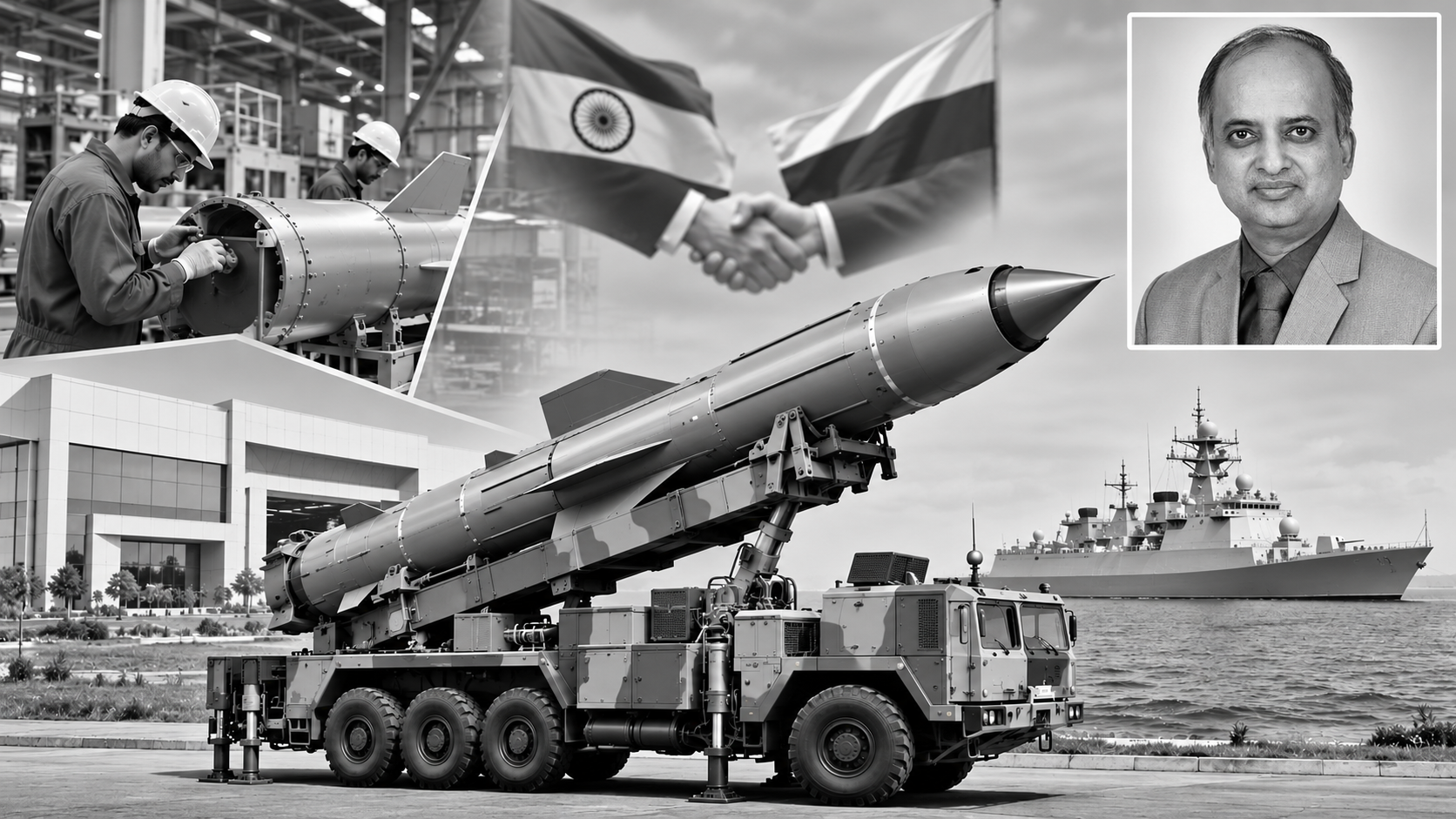
BrahMos Supplied to Philippines, Agreement Signed with Vietnam, Says CEO Jaiteerth R Joshi
India’s defence export ambitions are receiving a major boost, with BrahMos Aerospace supplying its supersonic cruise missile system to the Philippines, signing an agreement with Vietnam and securing an agreement with Indonesia, while several other Southeast Asian countries are showing interest in the weapon system. BrahMos Aerospace Chairman and Managing Director Jaiteerth R Joshi said discussions with other prospective buyers were at an advanced stage and could translate into agreements once the necessary government clearances were obtained.
Speaking to reporters in Hyderabad, Joshi highlighted the importance of non-destructive testing (NDT) in maintaining the reliability of missile systems manufactured 10 to 20 years ago. He said the technology had helped establish the continued reliability of older BrahMos missiles, including those used during Operation Sindoor. The subject will also feature at the upcoming NDE 2026 and AeroNDT 2026 conferences in Hyderabad from November 15 to 17.
The Philippines signed India's first BrahMos export contract on January 28, 2022, worth $374.96 million (approximately ₹3,525 crore) for three shore-based anti-ship missile batteries. Defence Secretary Rajesh Kumar Singh said the Philippines had received systems worth around $330 million. Vietnam signed an agreement in May 2026, with its initial order estimated at approximately $100 million (₹940 crore), although complete contractual details remain undisclosed. Indonesia also concluded an agreement in July, reportedly worth $200 million (₹1,880 crore) for two batteries.
The three-country export programme is expected to generate more than $600 million, with earlier estimates placing the combined initial arrangements at around $675 million, or ₹6,345 crore, at an assumed exchange rate of ₹94 per dollar. These are estimated contract values, not confirmed receipts. India is also reportedly negotiating a possible additional Philippines order worth $700–800 million, involving five more systems and nearly 60 missiles. Other potential markets include Saudi Arabia, the UAE, Egypt and South Africa, though these remain prospects rather than confirmed customers.
Established in 1998, BrahMos Aerospace is a joint venture between India's DRDO and Russia's NPO Mashinostroyenia, with India holding 50.5 per cent and Russia 49.5 per cent. Its authorised capital is $300 million. India contributed navigation systems, mission software and mobile launchers, while Russia brought ramjet propulsion and cruise missile expertise. More than 200 small and medium public- and private-sector enterprises have participated in its industrial ecosystem.
Domestic orders remain a major source of business. In March 2024, the Defence Ministry awarded contracts worth ₹19,518.65 crore for Navy missile systems and ₹988.07 crore for ship-borne systems. Another ₹661.50-crore contract for fire-control systems and launchers was signed in October 2026, carrying a minimum 68 per cent indigenous-content requirement. Together, these three announced contracts total ₹21,168.22 crore. The 2024 orders were expected to generate nine lakh man-days at the joint venture and 135 lakh man-days in ancillary industries.
The Lucknow integration and testing facility, spread across 200 acres and established at a reported cost of ₹380 crore, began rolling out its first batch in October 2025. It is designed for approximately 100 missile systems annually, with expansion potential to 150. Earlier projections indicated turnover of ₹3,000 crore and GST contributions of ₹500 crore.
BrahMos revenue reportedly crossed ₹5,200 crore in FY2025-26. Financial data for FY2024-25 showed standalone revenue of ₹5,524.3 crore and net profit of ₹853.5 crore. A notional 50.5 per cent share of that profit would be around ₹431 crore, but this is not an actual dividend. In 2019, a former company chief said the programme had generated ₹40,000 crore in business and returned over ₹4,000 crore in direct and indirect taxes up to that year.
Beyond manufacturing, the programme supports maintenance, training, upgrades and lifecycle management. NDT enables inspection without damaging components, helping assess the condition of older systems. The upcoming Hyderabad conferences will bring together more than 2,000 professionals and over 100 exhibitors to discuss advanced inspection, aerospace certification, artificial intelligence and predictive maintenance.
The programme's growing export footprint highlights India's transition towards advanced defence manufacturing. Its long-term success will depend not only on overseas orders but also on indigenous production, MSME participation, employment, technology development and sustained maintenance capabilities.