
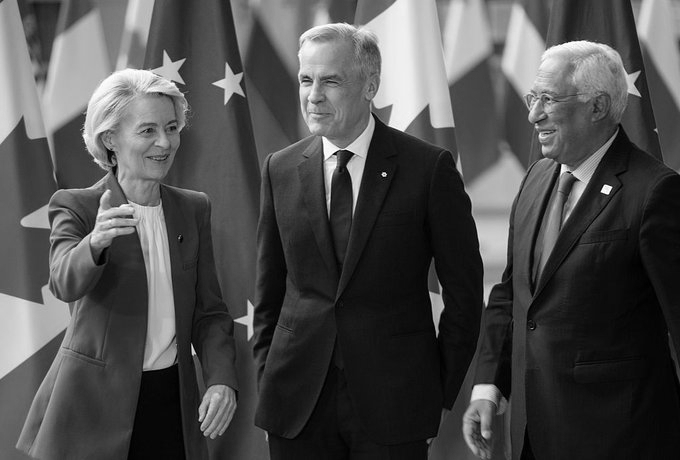
Canada Seeks ‘Unique Alliance’ With EU As Trump Trade War Deepens
Canada is moving closer to Europe as Prime Minister Mark Carney seeks a “unique alliance” with the European Union, while firmly rejecting suggestions that Ottawa wants full EU membership. The push comes as trade relations with the United States deteriorate further under President Donald Trump.
Carney said Sunday that Canada was “not looking to become a member of the European Union”, responding to a Wall Street Journal report that Ottawa was exploring whether it could obtain a new form of associate membership.
“What we are looking, and will begin discussions for, is a unique alliance between Canada and the European Union,” Carney told reporters at the Toronto International Film Festival. He said Canada and the EU “share the same values”, have similar priorities and possess “very complementary strengths.”
The reported associate membership idea does not currently exist within the EU. The Wall Street Journal said European and Canadian officials were exploring a possible arrangement that could provide Canada with deeper access to European markets without full membership. The discussions reportedly cover energy, artificial intelligence, defence and critical minerals, as well as strategic infrastructure.
One of the most significant proposals involves allowing Canadians to live and work in Europe without visas. Carney has discussed the possibility with European leaders, including French President Emmanuel Macron, according to reports. Canada and the EU are also examining cooperation involving underwater cables, data centres, cloud infrastructure, satellite networks and facilities that could help move Canadian energy to European markets.
Carney is travelling to Europe this week, where he is expected to set out his vision for the relationship. He will address the European Parliament in Strasbourg on September 17 and attend European Commission President Ursula von der Leyen’s State of the Union address.
His European outreach will continue with France. Carney is scheduled to meet Macron in Saint Pierre and Miquelon on September 20, with discussions expected to cover aerospace, energy, critical minerals and advanced technologies including quantum technology, satellites and supercomputing.
The EU is also signalling stronger engagement. The European Parliament is opening an office in Ottawa, describing the move as a step towards deeper political dialogue and cooperation with Canada. Canada has also joined the EU’s Security Action for Europe initiative, further expanding defence cooperation.
The timing is significant. Trump has intensified pressure on Canada as the two countries remain locked in a trade dispute involving tens of billions of dollars in cross border trade. Trump recently called Canada “the worst country to deal with” while saying Ottawa was “dying to make a deal”. He has also threatened new tariffs on Canadian cars, trucks and auto parts from January 1.
Canada is therefore trying to reduce its heavy dependence on the US market. Around 70 percent of Canadian exports go to the United States, making diversification an increasingly urgent priority.
Australia has now signalled support for Canada’s approach. Australian Trade Minister Don Farrell said Tuesday that Australia was “on the same page” as Canada and would closely watch Carney’s efforts to deepen ties with Europe. Australia is also seeking to diversify its trade relationships amid US tariff pressures.
However, major obstacles remain. Canada’s existing trade agreement with the EU, the Comprehensive Economic and Trade Agreement, has still not been fully ratified by all EU countries. Only 17 of the EU’s 27 member states have completed ratification, with agricultural concerns among the issues causing resistance.