
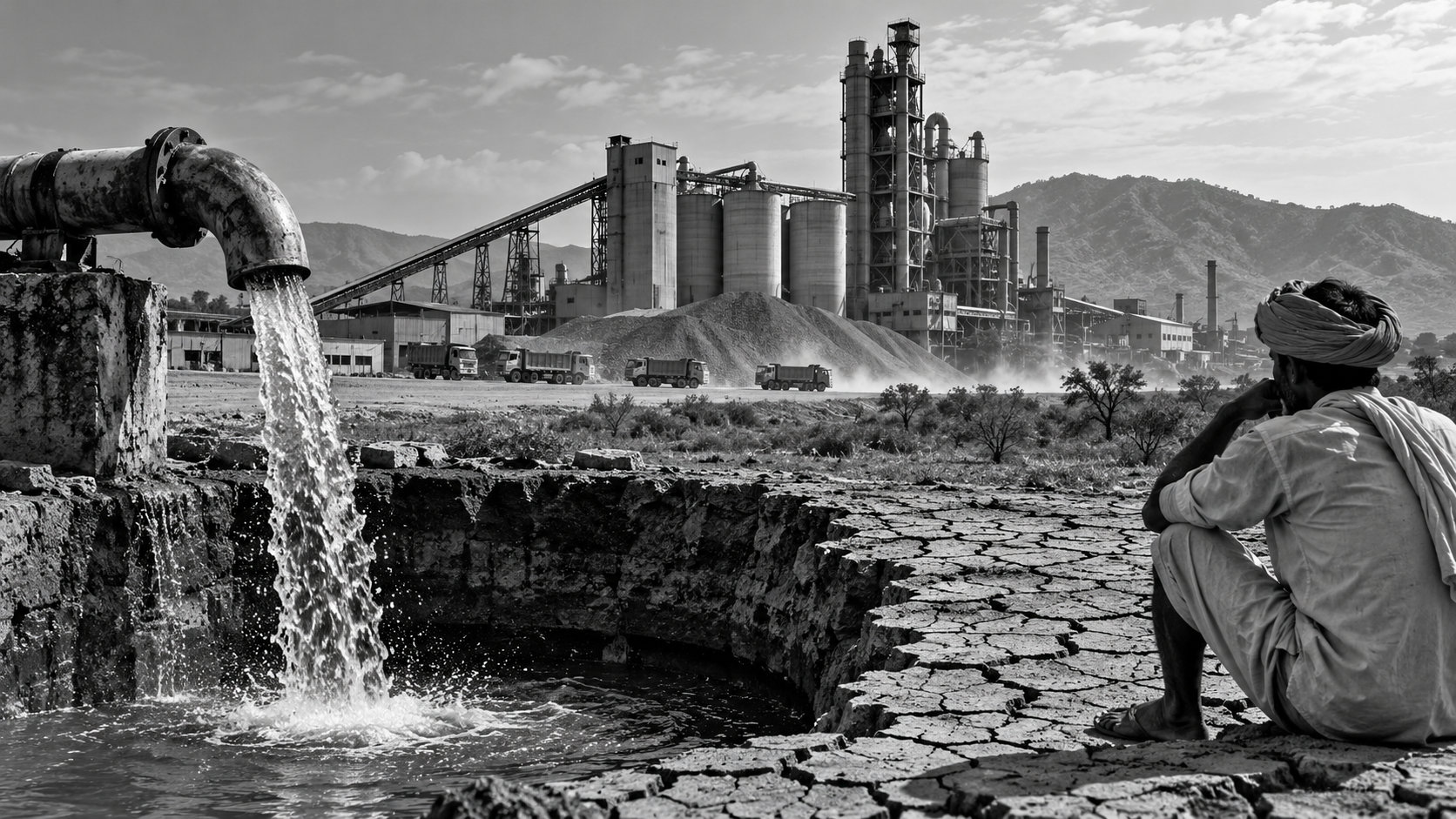
Cement Sector's Groundwater Share Surges to 38% in Water-Stressed Regions
India's cement industry is facing mounting environmental and operational challenges as groundwater dependence in water-stressed regions increased sharply in FY2025, raising concerns over the sustainability of industrial expansion amid growing pressure on the country's freshwater resources. Although the sector has improved its energy efficiency and marginally reduced carbon emissions intensity, increasing groundwater withdrawals, rising workplace injuries and persistent gender disparities indicate significant gaps in its environmental, social and governance (ESG) performance. The concerns have gained further significance amid developing El Niño conditions, deficient monsoon rainfall and increasing pressure on water availability across several regions.
According to a report released by the International Forum for Environment, Sustainability and Technology (iFOREST), groundwater's share of the cement sector's water withdrawals in water-stressed regions increased from 27 per cent in FY2024 to 38 per cent in FY2025. The assessment covered 18 cement companies, representing 87 per cent of India's production, across 107 Business Responsibility and Sustainability Reporting (BRSR) indicators. Although overall water withdrawal declined by 9.5 per cent, withdrawals in stressed regions, particularly Rajasthan, increased by more than 20 per cent.
The geographical concentration of cement manufacturing adds to the concern. Major clusters include Chittorgarh, Sirohi and Pali in Rajasthan, Gulbarga in Karnataka, Nalgonda in Telangana, Satna in Madhya Pradesh and Anantapur in Andhra Pradesh. Rajasthan is particularly vulnerable, with approximately 70.53 per cent of its assessed groundwater units classified as over-exploited in the 2025 assessment. Nationally, groundwater extraction reached 247.22 billion cubic metres (BCM), against extractable resources of 407.75 BCM. Agriculture accounted for 87 per cent of extraction, domestic consumption 11 per cent and industrial use around 2 per cent.
Cement manufacturing requires water for equipment cooling, dust suppression, material handling and power generation. Although nearly 99 per cent of India's installed cement capacity uses dry-process technology, reducing water requirements, supporting operations continue to depend on freshwater. Excessive extraction can lower water tables, increase agricultural and household costs, damage groundwater-dependent ecosystems and heighten the risk of saline intrusion in coastal aquifers.
The emerging El Niño conditions, expected to persist into early 2027, could intensify these pressures through weaker monsoon rainfall and reduced groundwater recharge. Meanwhile, cement prices averaged approximately Rs 355 per 50-kg bag in September 2026, according to ICRA, with higher coal, petcoke and diesel costs contributing to pricing pressures. However, El Niño's direct impact on cement prices remains uncertain, with construction demand and regional competition also influencing market trends.
The sector recorded energy consumption of 2.54 gigajoules per tonne, below the global average of 2.88, while renewables accounted for just 5.1 per cent of its energy mix. Total carbon emissions increased 4 per cent to 224.3 million tonnes. Workplace injuries rose 36.5 per cent to 359, while fatalities increased from 17 to 22. Women in key managerial positions earned 26.8 per cent less than men, and median pay for women workers declined 11.1 per cent.