
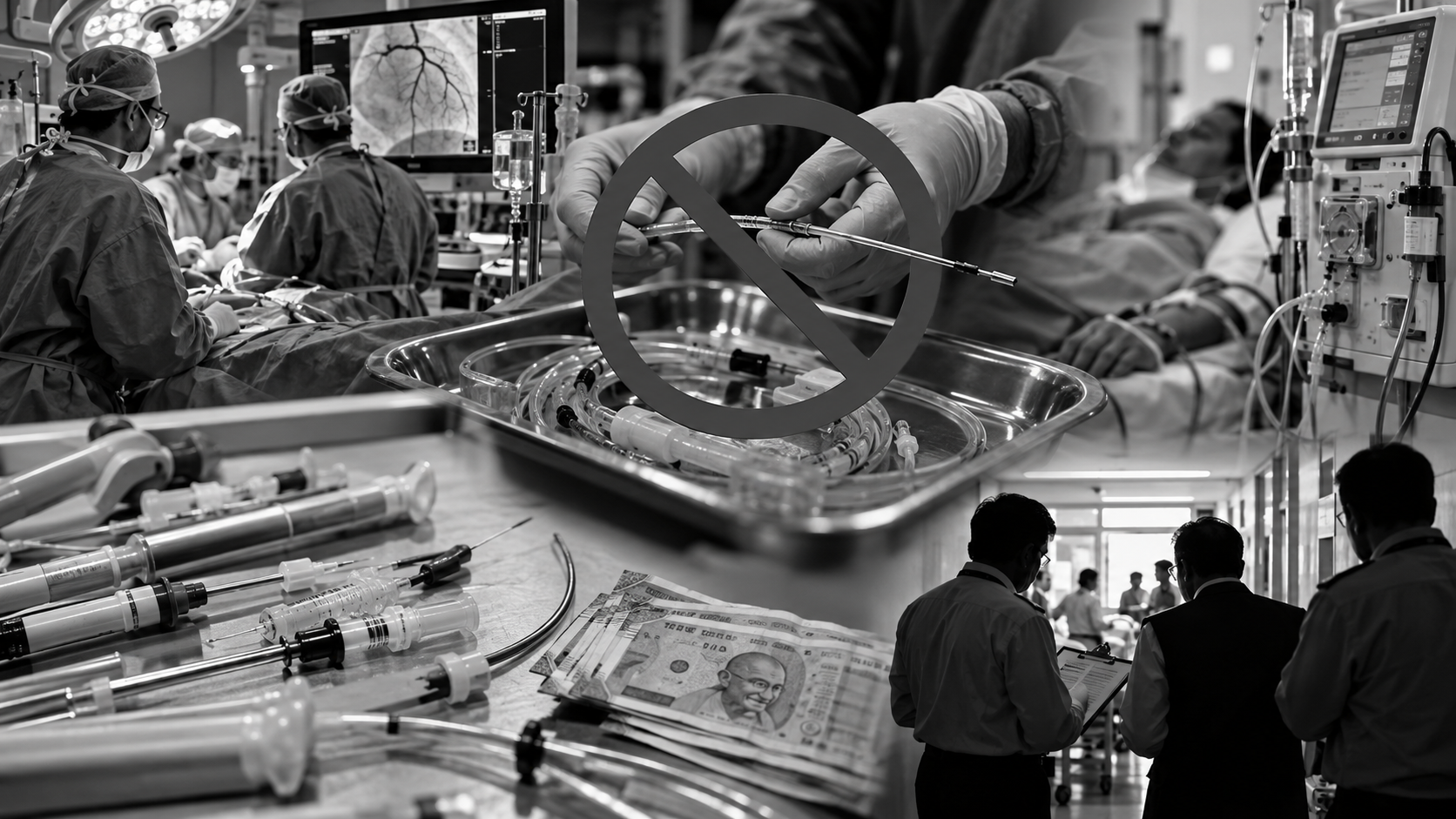
Centre Tightens Enforcement Against Reuse of Single-Use Medical Devices
The Centre has directed all states and Union Territories to strictly enforce the prohibition on reusing single-use medical devices and disposable surgical items across public and private healthcare facilities, citing infection risks, possible regulatory violations and concerns over patients being charged the full cost of equipment that may have already been used on others.
In a letter dated October 16, the Directorate General of Health Services (DGHS) said certain private and corporate hospitals were reportedly sterilising and reusing devices intended for one-time use, particularly in cardiology, nephrology, oncology, cardiothoracic and vascular surgery, and neurosurgery.
The devices identified include cardiac catheters, guidewires, balloon and ablation catheters, introducer sheaths, dialysers, blood tubing, surgical staplers, laparoscopic trocars, orthopaedic drill bits, syringes and needles. The Association of Indian Medical Device Industry (AiMeD) has also raised concerns about such practices.
The DGHS warned that sterilisation does not necessarily make previously used devices safe. Inadequate reprocessing, residual biological material and deterioration can compromise their performance, exposing patients to cross-infections, device malfunction and procedural complications. Potential infections include hepatitis B, hepatitis C, HIV and bacterial infections.
The directive also highlights alleged billing irregularities, with some patients reportedly charged the full price of new devices despite reuse. Industry estimates indicate that cardiac catheters costing approximately ₹1,500–₹2,000 may be sold to patients for ₹7,000–₹11,000. Pricing assessments have also found an infusion set purchased for ₹11.05 carrying an MRP of ₹325, while a 10-ml syringe procured for ₹6.75 carried an MRP of ₹57.20.
Earlier investigations highlighted the scale of the concern. In 2017, Maharashtra’s Food and Drug Administration reported alleged reuse of 66 devices across 45 subsequent angioplasty procedures at Fortis Hospital, Mulund, and 44 devices across 27 patients at Fortis Hiranandani Hospital, Vashi. Reports in 2018 said cases had been filed against seven hospitals, with courts issuing summons. These were reported allegations and proceedings, not proof of convictions.
In Faridabad, a separate investigation reported in 2025 concerned a cardiac-care centre at BK Civil Hospital. An FIR reportedly named 39 patients allegedly treated using reused devices and cited bills totalling nearly ₹14 lakh for seven patients, including Ayushman Bharat beneficiaries.
The DGHS said reuse could violate the Drugs and Cosmetics Act, 1940, Medical Devices Rules, 2017, and Clinical Establishments Act, 2010, alongside infection-control and biomedical waste requirements. Authorities have been directed to inspect facilities, monitor compliance and take appropriate action. Depending on the evidence and applicable provisions, violations may lead to regulatory or legal proceedings.
The directorate also referred to a December 2016 Central Government Health Scheme memorandum. A 2019 parliamentary response noted that states generally handled such complaints and that comprehensive complaint data were not maintained centrally. Healthcare facilities must use devices according to original equipment manufacturer instructions; sterile storage alone does not make a single-use device reusable.