
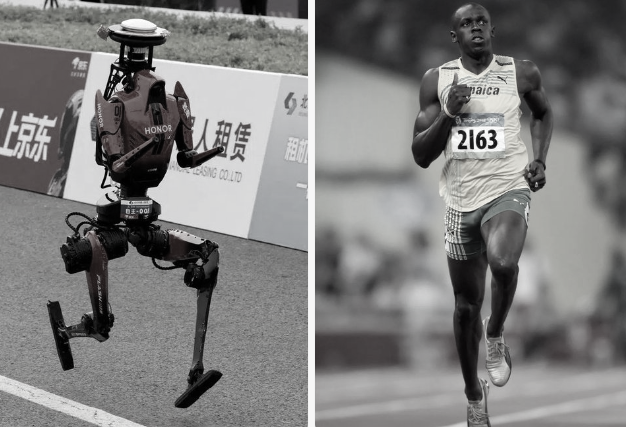
Chinese Humanoid Robots Smash Human Records, Run 100m Faster Than Usain Bolt
The future of robotics took a startling step closer to reality in Beijing on Saturday, as Chinese humanoid robots claimed performances that surpassed some of the most celebrated records in human athletics.
At the opening of the World Humanoid Robot Games, a humanoid robot completed the 100-metre sprint in 9.39 seconds, faster than the 9.58-second world record set by Jamaican sprint legend Usain Bolt in 2009.
The same competition produced another remarkable performance. A humanoid robot cleared 2.88 metres in the standing high jump, exceeding the human world record of 2.45 metres, set by Cuba’s Javier Sotomayor in 1993. Both record-breaking robots were developed by Beijing-based X-Humanoid.
The figures underline how rapidly robotics technology is advancing, although they come with an important qualification: robot competitions are not directly comparable with conventional human athletics because the machines compete under different mechanical and technical conditions.
The five-day event, now in its second edition, features 51 events and more than 1,000 competitions, ranging from running and table tennis to football, weightlifting and tug of war. More than 2,000 humanoid robots are taking part, with participants from 16 countries, including Germany, Japan and the United States.
The spectacle is being staged at Beijing’s National Speed Skating Oval, built for the 2022 Winter Olympics. It comes as China seeks to strengthen its position in advanced robotics and artificial intelligence, even as competition with the United States intensifies.
Chinese smartphone maker Honor also said one of its humanoid robots had clocked 9.32 seconds in a pre-event trial, reaching a peak speed of 14.5 metres per second.
Yet the impressive demonstrations do not necessarily mean humanoid robots are ready to replace humans in everyday life. Experts say the technology remains largely focused on research, demonstrations and controlled environments, with widespread commercial deployment still some way off.
For spectators, however, the message was clear. Robots that once struggled simply to walk are now running, jumping, playing sports and coordinating in large formations.
The real significance of Beijing's robot games may therefore lie beyond the medals and records. They offer a glimpse of a future in which machines are expected not merely to perform repetitive tasks, but to move, learn and operate in environments designed for humans.
And if a robot can already challenge records that stood untouched for years, the bigger question is no longer whether humanoid robots will become more capable, but how quickly they will move from spectacular demonstrations into everyday life.