
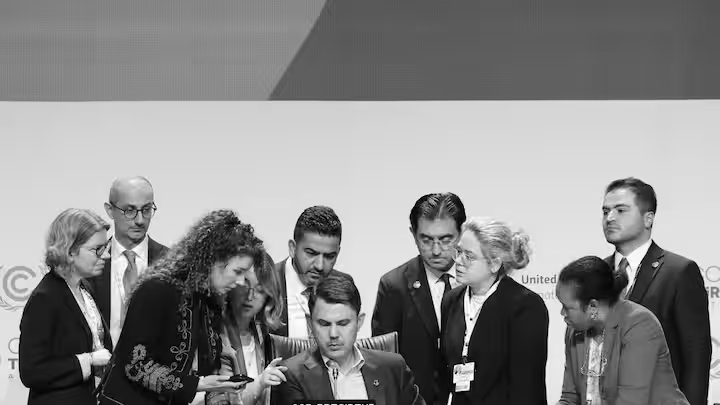
Climate Talks In Turkey End In Deadlock Over Fossil Fuel Transition, Carbon Capture And Finance
The COP31 climate summit in Antalya, Turkey, ended without an overarching agreement on Sunday after countries failed to bridge differences over fossil fuels, carbon capture technology and financial support for developing nations. Negotiations continued for nearly 48 hours beyond the scheduled closing, but the proposed main political agreement failed to secure consensus.
The biggest disagreement centred on whether the final text should explicitly mention fossil fuels, including coal, oil and gas, and commit countries to transitioning away from them. The latest proposal from the Turkish and Australian presidencies referred to the landmark 2023 Dubai agreement but stopped short of directly mentioning fossil fuels.
The European Union, Britain, Norway, Denmark and several vulnerable developing nations rejected the proposal. Speaking on behalf of the EU, Ireland's climate minister Darragh O'Brien said the bloc would not endorse an agreement that did not even mention fossil fuels, which are a major driver of global warming.
Norway's climate minister Sigrun Gjerlow Aasland said the proposed text took negotiations backwards, while Denmark's climate minister Samira Nawa argued that the absence of fossil fuel commitments and weak scientific language were major obstacles.
Vanuatu and the Marshall Islands also criticised the proposal, warning that it weakened the commitment to limiting global warming to 1.5 degrees Celsius. The Marshall Islands said it would not compromise its future to benefit fossil fuel interests.
Oil-producing countries, including Russia and Saudi Arabia, opposed explicit fossil fuel language. Russia's delegate Sergei Kononuchenko warned that reducing oil and gas supplies faster than demand could trigger price shocks, energy shortages and a shift towards dirtier fuels. Saudi Arabia argued that all technological solutions should remain available.
Carbon capture and climate finance emerged as other major sticking points. The proposed text retained support for carbon capture and storage, a technology criticised by environmental groups for potentially prolonging fossil fuel dependence. A proposed $120 billion adaptation-finance target was also missing from the draft, disappointing developing nations.
The proposal included an ambition to raise electricity's share of global final energy consumption to 35 per cent by 2035. However, the main agreement was not adopted.
COP31 President Murat Kurum acknowledged the lack of consensus, saying the presidency had not imposed the text on any delegation. He said no new draft would be prepared and existing decisions would be implemented. Despite the failure of the overarching agreement, negotiations on several smaller climate decisions continued.