
Cognitive Warfare Biggest Threat to India, Warns Former CDS Anil Chauhan
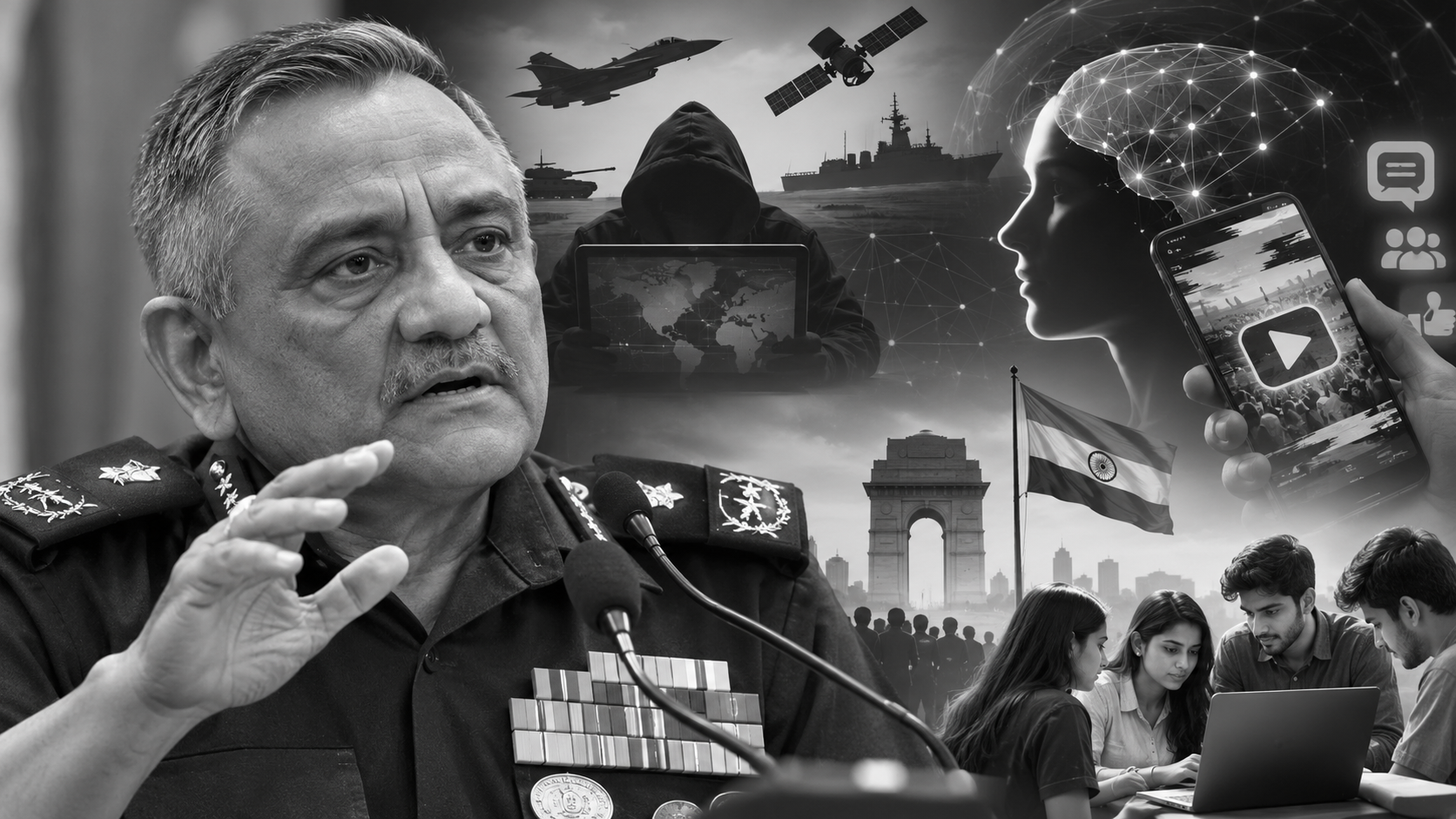
Former Chief of Defence Staff (CDS) General Anil Chauhan on Wednesday identified the cognitive domain as India's biggest contemporary security threat, warning that internal vulnerabilities, particularly when supported by external forces, could pose a greater danger than conventional military aggression. He said modern warfare was increasingly moving beyond physical battlefields, with cyberspace, social media and mobile phones being used to influence public thinking, manipulate perceptions and weaken social cohesion.
Addressing the Padmaa Festival, organised by the Gyangaynah Foundation in Chhatrapati Sambhajinagar, Maharashtra, Gen Chauhan said external threats were easier to confront because they were visible and often united the country. Internal threats, however, became more dangerous when supported by external forces. He urged citizens to overcome differences, counter false propaganda and strengthen national unity, emphasising the role of Gen Z and young people.
His warning comes as India prepares for multi-domain warfare involving six interconnected domains: land, sea, air, space, cyber and cognitive. The Joint Doctrine for Multi-Domain Operations, released on August 27, 2025, by Headquarters Integrated Defence Staff, envisages coordinating military capabilities with intelligence agencies, government institutions, research organisations and private-sector entities.
The importance of information management became evident during Operation Sindoor, launched in May 2025 following the Pahalgam terrorist attack. Gen Chauhan subsequently said approximately 15 per cent of the armed forces' effort during the operation went into countering misinformation and disinformation. The Ministry of Information and Broadcasting also reported action against more than 1,400 URLs containing false, misleading and inflammatory content.
India's expanding digital exposure presents additional challenges. According to the Ministry of Electronics and Information Technology, CERT-In recorded 29,44,248 cybersecurity incidents in 2025, compared with 20,41,360 in 2024, 15,92,917 in 2023, 13,91,457 in 2022 and 14,02,809 in 2021. These figures cover broader cyber threats, not cognitive warfare alone.
The spread of artificial intelligence-generated deepfakes, cloned voices and manipulated videos has further complicated efforts to protect public trust. The armed forces have also incorporated cognitive and cyber warfare into professional training, including the Tri-Services Future Warfare Course conducted in February 2026.
Gen Chauhan described young people as major contributors to Viksit Bharat 2047, stressing that strategic thinking, indigenous capabilities and self-reliance were increasingly important. He said mindset was becoming more important than military hardware in modern conflicts.
RSS chief Mohan Bhagwat, who attended the festival, said global powers sought to maintain their dominance and might not welcome India's progress, describing international competition through the principle of 'survival of the fittest'.