
Colorful Rainbow: Holi — A Symbol of Indian Culture
Coloring blossoming hopes and composing tunes for flourishing friendships, like a rainbow brought by the spring cuckoo in a colorful palanquin, hatred must dissolve and lamps of love must shine. Every heart should immerse itself in the joy of Holi. On the occasion of the festival, here are the key aspects of Holi.
Spring quietly enters India during this time. As winter fades and the warmth of the sun gradually touches the earth, the atmosphere changes. New buds bloom, flowers release their fragrance, and birds sing melodiously. The rainbow appearing in the sky seems to descend to the earth. All these elements together mark the beginning of a celebration. Holi is not merely a festival but a recurring colorful chapter in India’s cultural history.
India’s festivals reflect the principle of unity in diversity , and Holi holds a prominent place among them. Celebrated during the spring season, when nature renews itself, new hopes also emerge in people’s hearts. Known as the festival of colors, Holi symbolizes social unity, love, and the victory of good over evil .
Every festival has a mythological background, and Holi is deeply rooted in tradition.
In many parts of India, the evening before Holi is observed as Holika Dahan . According to legend, King Hiranyakashipu plotted to kill his son Prahlad because Prahlad was a devotee of Lord Vishnu. Hiranyakashipu instructed his sister Holika who had a boon protecting her from fire to sit with Prahlad in a blaze so that Prahlad would burn. However, the fire consumed Holika instead, and Prahlad emerged unharmed with divine blessings. This story conveys the powerful message that no matter how strong evil appears, good ultimately prevails .
In villages and towns, people gather at dusk to light a bonfire. As darkness falls, the flames illuminate the surroundings. People believe that not only wood but also arrogance, jealousy, and hatred are symbolically burned in that fire. The ritual quietly reminds everyone of devotion, sacrifice, and the triumph of righteousness.
The next morning transforms the environment completely. People wearing white clothes turn into colorful canvases. Everywhere there are smiles, laughter, songs, and playful shouts. The phrase “Bura Na Mano, Holi Hai” echoes through the air, washing away old disputes and misunderstandings. Children run through streets with water guns, while adults join them in playful celebrations. On this day, age, status, and wealth lose importance. Everyone speaks one common language the language of colors and joy.
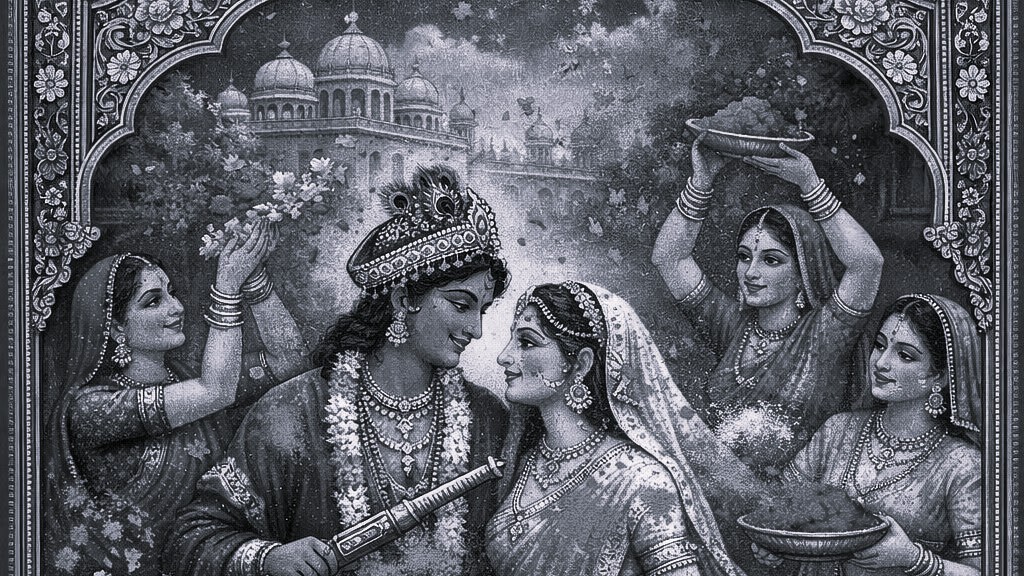
In North India, especially in Mathura and Vrindavan, Holi is celebrated as a symbol of the love between Radha and Krishna. It is believed that Krishna, troubled by his dark complexion, once asked why he looked different. His mother suggested that he apply colors to Radha so she would appear in his shade. From then on, playing with colors became part of the celebration. In these regions, Holi continues for weeks with music, dance, kirtans, and bhajans, making it a grand spiritual and cultural event.
In South India, particularly in Tamil Nadu, Holi is connected with the story of Kamadeva . According to tradition, Kamadeva tried to interrupt Lord Shiva’s meditation to facilitate the divine marriage of Shiva and Parvati. Shiva, angered by the disturbance, opened his third eye and reduced Kamadeva to ashes. Later, moved by prayers and devotion, Shiva restored him to life. This narrative reflects sacrifice and devotion. Rituals remembering Kamadeva’s burning are performed during Holi in these regions.
Holi also represents social harmony in modern times. Despite technological progress, festivals like Holi bring people together by setting aside caste, religious, and regional differences. When colors blend, distinctions disappear creating a powerful example of unity.
Different regions celebrate Holi in unique ways. In Barsana, Uttar Pradesh, women playfully strike men with sticks in the tradition known as Lathmar Holi . In Vrindavan, devotees celebrate with fragrant flowers instead of colors in Phool Holi . In Haryana, Dhulandi includes playful interactions among families. In Maharashtra and Goa, Rang Panchami is marked by young people forming human pyramids to break hanging pots, recalling Krishna’s legends. In West Bengal, following Rabindranath Tagore’s legacy, Vasantotsav is celebrated at Shantiniketan with cultural performances and yellow attire. Rajasthan celebrates Holi with royal processions, traditional music, and grandeur. Bihar observes it during Phalgun Purnima with folk songs and colorful gatherings marking the harvest season. In Tamil Nadu, known as Kaman Pandigai , people worship Kamadeva with devotion.
In the Telugu states of Andhra Pradesh and Telangana, Holi is generally celebrated in a quieter, family-oriented atmosphere compared to northern regions. Urban youth enthusiastically apply colors and use water guns, while villages give greater importance to Holika Dahan. People worship deities at home, respect elders, share sweets, and greet friends with colors. In some areas, it is observed as Kamadahanam , recalling the legend of Kamadeva. Sharing sweets and exchanging greetings remain special features.
Homes also become part of the celebration. The aroma of gujiya , the sweetness of malpua , the cool taste of dahi vada , and the refreshing flavor of thandai fill the atmosphere. Families and friends gather for meals, conversations, laughter, and memories. Songs like “Rang Barse” echo somewhere, while folk music resounds elsewhere. The rhythm of drums, clapping hands, and children’s laughter make music an essential part of Holi.
Today, new ideas accompany the festival: natural colors, water conservation, and environmental awareness. Yet the spirit remains unchanged: love, forgiveness, and equality. After the celebrations end, colors fade away, but the smiles, hugs, and forgiveness shared that day remain in hearts.
Holi is not just a one-day festival but a lesson on how life should be lived. It teaches people to burn negativity and welcome goodness. It reminds us that life contains many emotions like colors, and true happiness lies in accepting them all.
In 2026, let us celebrate Holi with the same enthusiasm and pass our culture and values to future generations. May this festival bring new light, joy, and health into our lives. Let us forget past grievances and share colors with one another.
Holi is not only a day filled with colors, it is a day to cleanse our hearts and embrace positivity. Happy Holi to everyone!