
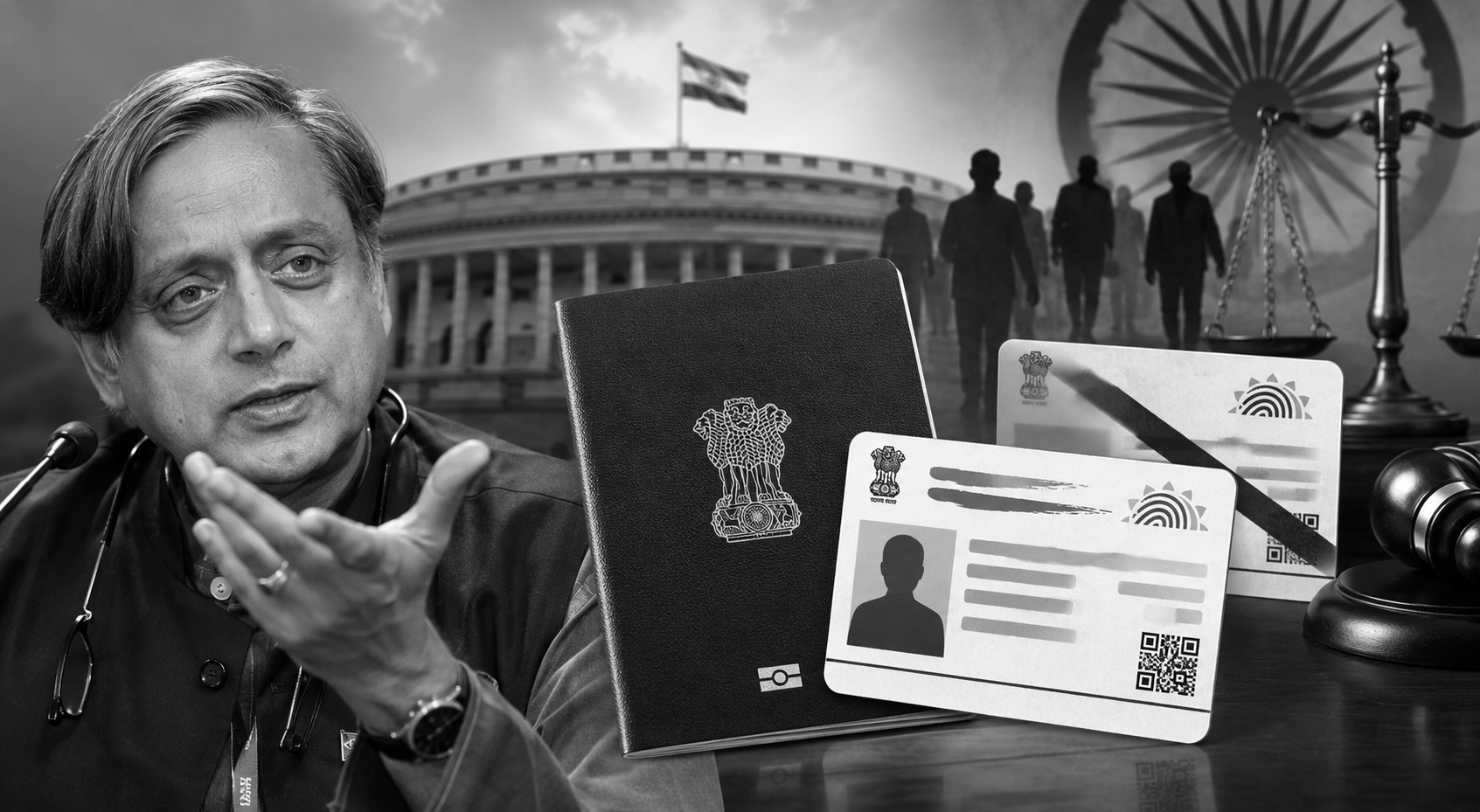
Congress MP Shashi Tharoor Seeks Passport, Aadhaar as Citizenship Proof
A fresh debate over what legally constitutes proof of Indian citizenship has intensified after the Centre reiterated that an Indian passport is primarily a travel document and not conclusive proof of citizenship, prompting senior Congress leader Shashi Tharoor to seek sweeping legal reforms. Calling the existing framework contradictory, Tharoor has proposed that both the passport and a standard Aadhaar card be recognised as definitive proof of Indian citizenship unless revoked by the government.
The controversy began after the Ministry of External Affairs (MEA) clarified on Passport Seva Divas that a passport is not a citizenship certificate but a travel document. The government later maintained that this is not a new policy and has remained the legal position for decades under Section 20 of the Passports Act, 1967 , which allows passports to be issued to non-citizens in exceptional cases and in the public interest.
Reacting to the clarification, Tharoor said it creates an " absurd legal paradox " because applicants undergo rigorous police verification and document scrutiny before receiving a passport. "If a passport is not proof of citizenship, then what is?" he asked, arguing that millions of Indians are left without a document that conclusively establishes their nationality.
The Thiruvananthapuram MP also referred to the Supreme Court's 2018 Aadhaar judgment , which held that Aadhaar is only proof of identity and residence , not citizenship. Since Aadhaar is issued to anyone who has resided in India for at least 182 days , it can be held by both citizens and eligible non-citizen residents.
To address this, Tharoor suggested that the Unique Identification Authority of India (UIDAI) introduce a visually distinct Aadhaar card for non-citizens, featuring a diagonal red stripe. Once differentiated, he said, Parliament should amend the law to recognise both a standard Aadhaar card and a valid passport as conclusive proof of citizenship.
Tharoor argued that such a dual-document system would simplify domestic verification, reduce bureaucratic hurdles during electoral roll revisions , and provide citizens with greater legal certainty. He also noted that India does not issue a universal citizenship identity card , unlike several countries, making documentation disputes inevitable.
Meanwhile, the Election Commission clarified that a passport continues to be one of the 12 valid supporting documents for voter verification, although it is not legally conclusive proof of citizenship. The row gained further attention after the MEA issued a June 20 Gazette notification increasing the fee for a fresh 36-page passport from ₹1,500 to ₹2,500 , even as the Opposition accused the Centre of creating ambiguity over citizenship documentation. The government has rejected the charge, insisting that the legal position remains unchanged and is firmly rooted in the Passports Act, 1967 .