
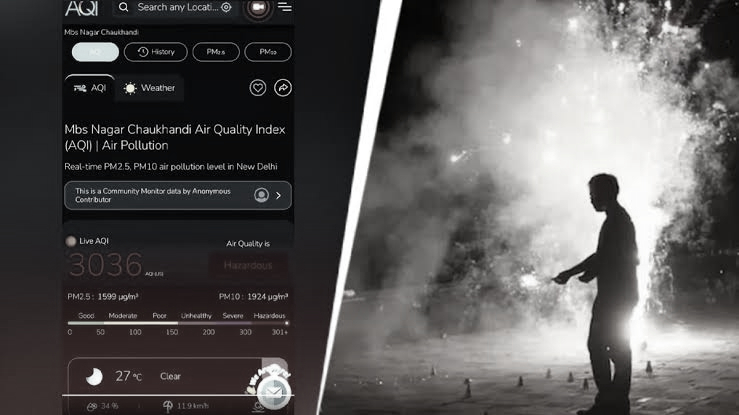

Delhi Chokes on Toxic Diwali Aftermath: AQI Soars Past 400, Pollution Monitors Go Silent
Delhi has once again been engulfed in toxic smog after Diwali, with pollution levels soaring across the capital and several monitoring stations reporting data gaps during peak pollution hours. The deployment of water sprinklers around AQI monitoring stations has also raised questions about the accuracy and reliability of pollution readings.
The scale of the deterioration was evident on Sunday night, when 20 of Delhi’s 59 air-quality monitoring stations recorded an Air Quality Index (AQI) in the severe category. The city’s overall AQI stood at 371 at 10 pm, while its daily average settled at 376, compared with 369 on Saturday, making it the most polluted Diwali in five years.
Sonia Vihar recorded an AQI of 463, followed by Jahangirpuri at 450. Burari, Alipur and Punjabi Bagh were among the other badly affected locations. Sonia Vihar, Jahangirpuri, Punjabi Bagh, Burari, Okhla and Rohini remained in the severe category throughout the day.
Thick smoke reduced visibility across several parts of the capital, while residents complained of the smell of burnt firecrackers and difficulty breathing. Despite restrictions, fireworks continued in Pitampura, Burari, Mayur Vihar and parts of Lutyens’ Delhi. The permitted window for green firecrackers was 6 am to 7 am and 8 pm to 10 pm on November 7 and 8.
The last time Delhi witnessed similarly high Diwali pollution was in 2021. The city’s AQI stood at 382 on Diwali, November 4, 2021, before deteriorating sharply to 462 the following day, entering the severe category. In comparison, Delhi recorded an AQI of 376 on Diwali in 2026, making it the most polluted Diwali in the city since 2021. However, the post-Diwali pollution peak in 2021 was considerably worse, with the AQI touching 462.
However, the bigger controversy emerged over what Delhi’s pollution monitors were recording, and, more importantly, what they were not.
An analysis by the Centre for Research on Energy and Clean Air (CREA) found that 45 of Delhi’s 59 monitoring stations had at least one missing hourly reading, while only 14 reported complete data across the monitoring parameters examined. The gaps coincided with the period when pollution levels were surging.
The analysis found 55 missing hourly PM2.5 readings and 116 missing PM10 readings. PM2.5 readings at several locations approached the monitoring systems’ upper reporting limit of 1,000 micrograms per cubic metre before disappearing from the records.
The problem was particularly concerning at locations including IIT Delhi, Burari Crossing, North Campus, Sonia Vihar and Dwarka. A separate examination of monitoring records found that PM2.5 readings at several stations climbed close to 1,000 before going blank. At North Campus, the concentration rose from 326 micrograms per cubic metre at 8 pm to 999 at 10 pm, after which readings disappeared. At CRRI Mathura Road, it reached 981, while ITO recorded 994 before its readings stopped.
More strikingly, Delhi Pollution Control Committee (DPCC) monitoring data reportedly captured particulate concentrations far above 1,000 during the same period, including 4,985 micrograms per cubic metre at Jahangirpuri, 4,697 at Punjabi Bagh, 3,744 at Mundka and 3,425 at Ashok Vihar. These readings suggest that the actual pollution peaks may have been substantially higher than what some official records captured.
The pollution problem, meanwhile, extends well beyond the national capital. A nationwide snapshot of government-monitoring-station data on Monday afternoon showed 16 cities in the severe category and 93 in the very poor category, out of 280 cities reporting readings.
Pollution levels were also alarmingly high across several states. Uttar Pradesh, Haryana, Madhya Pradesh, Rajasthan and Maharashtra all reported cities with AQI readings above 400, with some entering the severe category. The highest reading was recorded in Uttar Pradesh at 500, followed by Haryana at 492, Madhya Pradesh at 487, Rajasthan at 473 and Maharashtra at 431.
Hyderabad also witnessed a sharp post-Diwali pollution spike, with several localities recording extremely high pollution levels. Ravi Colony near Masjid Banda recorded an AQI reading of 995, while Serilingampally registered 666 around 11.30 pm on Sunday. The city's reported average AQI touched 509 around 9.30 pm, with PM2.5 concentration reaching 392 micrograms per cubic metre.
Firecracker celebrations continued until around 3 am in several localities, including Banjara Hills, Panjagutta, Ameerpet, SR Nagar and Somajiguda. The city’s reported AQI subsequently improved to 178 by Monday morning. However, questions also emerged over monitoring coverage, with reports indicating that some Telangana Pollution Control Board stations, including the University of Hyderabad station, were not functioning during the overnight pollution spike.