
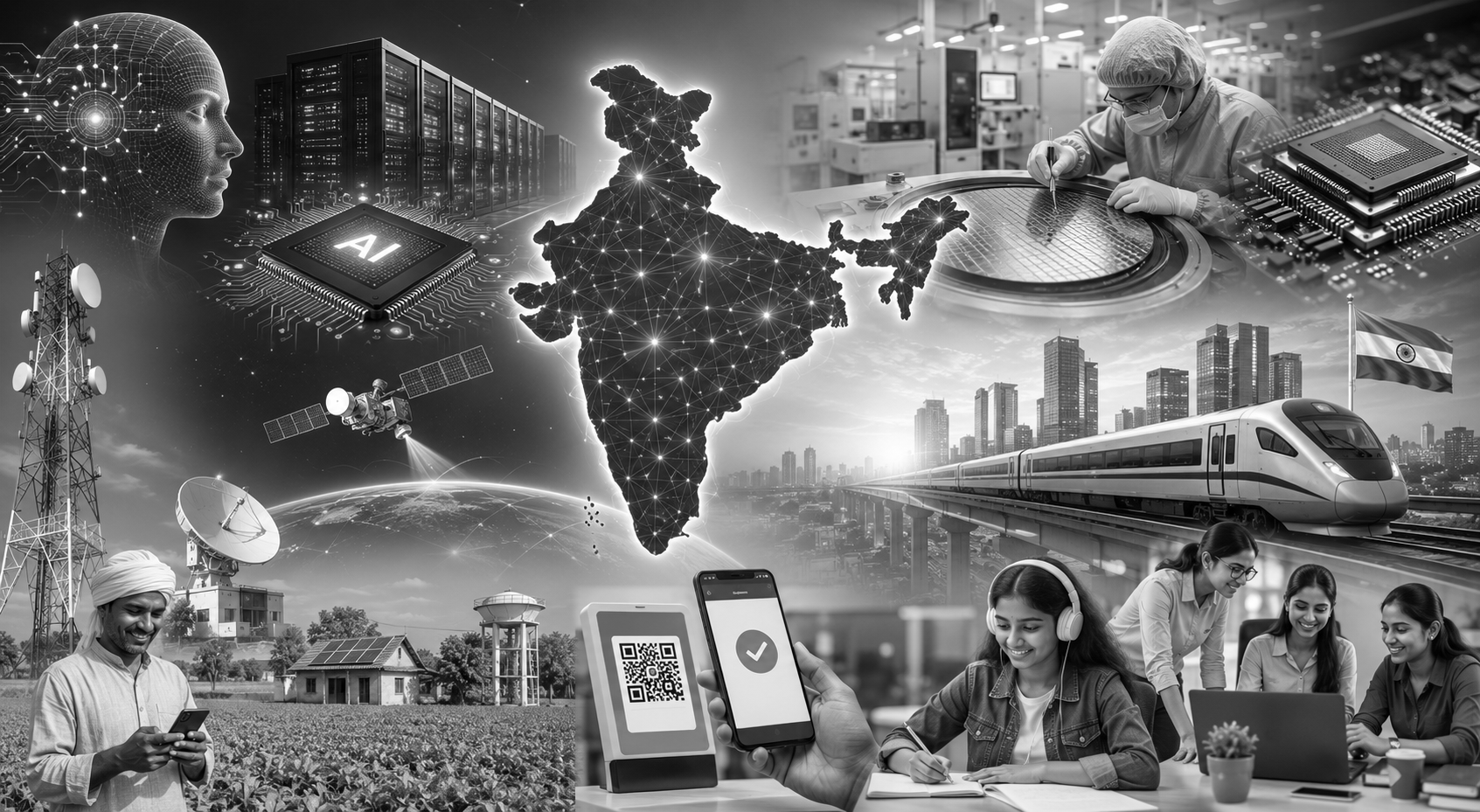
Digital India Nears 11 Years, Driving Growth Through AI, Semiconductors and Digital Infrastructure
As the Digital India programme approaches its eleventh anniversary on July 1, the Government of India has highlighted the transformative impact of the initiative over the past decade and outlined its vision for the next phase of technology-led growth driven by Artificial Intelligence (AI), semiconductor manufacturing, digital public infrastructure, advanced electronics production and affordable digital connectivity .
Launched on July 1, 2015, with the objective of transforming India into a digitally empowered society and knowledge economy, Digital India has reshaped governance, financial inclusion, public service delivery and digital access across the country. According to the government, the programme has moved beyond building digital foundations and is now focused on frontier technologies that are expected to define India's development trajectory in the coming decades and contribute to the vision of Viksit Bharat 2047 .
The impact of the programme is visible across sectors and geographies. High-speed broadband has reached remote villages, direct benefit transfers are being delivered instantly to beneficiaries, and students across the country are accessing educational resources through smartphones. During this period, internet connections have increased by nearly four times, while the cost of mobile data has dropped sharply from around ₹269 per GB to between ₹8 and ₹10 per GB, making internet access among the most affordable globally.
A major pillar of the next phase of Digital India is the IndiaAI Mission , which was approved with an outlay of more than ₹10,372 crore. The mission aims to create a comprehensive indigenous AI ecosystem capable of supporting research, innovation, public service delivery and industrial growth.
One of the mission's most significant achievements has been the establishment of a shared compute facility equipped with more than 45,000 Graphics Processing Units (GPUs) . This infrastructure is expected to provide the computational power required for large-scale AI development and deployment across the country.
Under the AI Foundation Model initiative, support is being provided to 15 Large Language Models (LLMs) and Small Language Models (SLMs) spanning speech, text and vision applications. The government's AI Kosh platform has emerged as a key national repository, hosting more than 12,519 datasets, 307 AI models and 20 toolkits , enabling researchers, startups and institutions to access critical resources for AI innovation.
The mission has also focused on democratising access to AI capabilities. A total of 27 Data and AI Labs have been established in Tier-II and Tier-III cities, while 684 fellowships have been awarded to students pursuing AI-related research and innovation. Through the YUVA AI programme, approximately 8.4 million learners have been introduced to AI concepts and skills.
To further strengthen the ecosystem, the government has established 18 Centres of Excellence and extended capacity-building support to 20 Indian AI startups . In addition, the release of AI Governance Guidelines in November 2025 marked an important step toward ensuring that AI systems developed and deployed in India remain safe, inclusive, transparent and trustworthy.
India's growing influence in the global AI landscape was also showcased during the India AI Impact Summit 2026 , held in February. The summit attracted delegations from more than 100 countries and 20 international organisations and engaged nearly 15 lakh participants through physical and virtual formats. The event concluded with the adoption of the India AI Impact Summit Declaration by 92 countries and organisations, signalling broad international support for India's approach to responsible AI development.
According to the government, the summit also generated more than USD 200 billion in AI-related investment commitments , reinforcing India's emerging position as a global hub for AI research, infrastructure and digital public goods.
Alongside AI, India has made substantial progress in building a domestic semiconductor manufacturing ecosystem. Under the India Semiconductor Mission , 12 semiconductor projects have been approved with a total investment pipeline of approximately ₹1.64 lakh crore . These projects include one semiconductor fabrication facility, two compound semiconductor fabrication units and nine semiconductor packaging units.
The government noted that the launch of India Semiconductor Mission 2.0 in the Union Budget 2026-27 reflects a deeper commitment to strengthening the country's semiconductor value chain. The next phase of the mission is expected to focus on semiconductor equipment, materials, indigenous intellectual property and resilient supply chains.
Progress has also been recorded in semiconductor design. Under the Design Linked Incentive Scheme, 24 projects are receiving support, while 105 companies have been assisted with advanced chip design tools. Additionally, 23 design tape-outs have been completed at various foundries, including advanced technology nodes, highlighting India's growing capabilities in chip design and innovation.
International confidence in India's semiconductor ambitions was evident during SEMICON India 2025 , which brought together more than 350 exhibiting companies from 48 countries and regions. The event witnessed the signing of 13 memoranda of understanding and participation from leading semiconductor industry executives, underscoring increasing global interest in India's semiconductor ecosystem.
The convergence of investments in AI, semiconductors and advanced manufacturing is already transforming India's electronics industry. The sector has expanded into an industry valued at approximately ₹13 lakh crore , while electronics has become the country's third-largest export category .
India has also emerged as the world's second-largest mobile phone manufacturer , reflecting the success of policy measures aimed at boosting domestic production and attracting global investments. The government said that an advanced manufacturing ecosystem encompassing AI-enabled data centre components, 5G equipment, networking hardware and other high-value technology products is steadily integrating India into global supply chains while creating significant employment opportunities.
Another landmark achievement highlighted in the report is the success of the Unified Payments Interface (UPI) , which completed ten years in April 2026. UPI has fundamentally transformed India's payment ecosystem and established the country as a global leader in real-time digital transactions.
During FY 2025-26, the platform recorded 24,162 crore transactions , demonstrating its scale and widespread adoption. UPI now accounts for approximately 81 per cent of India's digital payments and nearly 49 per cent of all real-time digital transactions globally .
The government's Digital Public Infrastructure model has also gained international recognition. UPI is operational in several countries, and cooperation agreements related to India's digital public infrastructure have been established with 23 nations , expanding the global footprint of India's digital innovation framework.
India's digital backbone has continued to strengthen significantly over the past year. Broadband subscribers reached 106.58 crore as of March 2026, while the BharatNet programme has connected 2.18 lakh Gram Panchayats through high-speed broadband infrastructure.
The expansion of 5G services has been equally rapid. According to the government, 99.9 per cent of districts are now covered by 5G networks, supported by the deployment of 4.74 lakh towers across the country. The launch of the National Data Centre for the North East Region in Guwahati in February 2026 further enhanced digital infrastructure and data sovereignty capabilities in the region.
The government also highlighted progress in strengthening India's digital governance framework. The Draft Digital Personal Data Protection Rules, released in January 2025, are aimed at establishing a robust consent-based data governance system. The framework includes provisions for data breach reporting, user consent management and the establishment of a Data Protection Board.
In addition, the Promotion and Regulation of Online Gaming Act , which received Presidential assent in August 2025, came into force on May 1, 2026. The formation of the Online Gaming Authority of India in April 2026 is expected to provide regulatory clarity and oversight for one of the country's fastest-growing digital sectors.
India's innovation and startup ecosystem has also recorded its strongest year since the launch of the startup programme. During FY 2025-26, more than 55,200 entities received recognition from the Department for Promotion of Industry and Internal Trade (DPIIT), representing the highest annual addition since the initiative began.
Employment generated by recognised startups reached 23.36 lakh jobs , reflecting a year-on-year increase of 36.1 per cent. The government noted that nearly 48 per cent of recognised startups have at least one woman director or partner, highlighting the increasing participation of women in entrepreneurship and innovation.
The broader innovation ecosystem has also shown steady progress. India's position in the Global Innovation Index improved from 81st place in 2015 to 38th place in 2025 , while the country now has more than 2.23 lakh recognised startups contributing to economic growth, job creation and technological advancement.
As Digital India approaches its eleventh anniversary, the programme is increasingly operating at the intersection of scale and innovation. While continuing to deliver digital services to hundreds of millions of citizens, it is simultaneously laying the foundation for India's future leadership in AI, semiconductors, advanced electronics and digital public infrastructure. The government believes that these efforts will not only accelerate economic growth and technological self-reliance but also position India as a leading force in the global digital economy over the coming decade.