
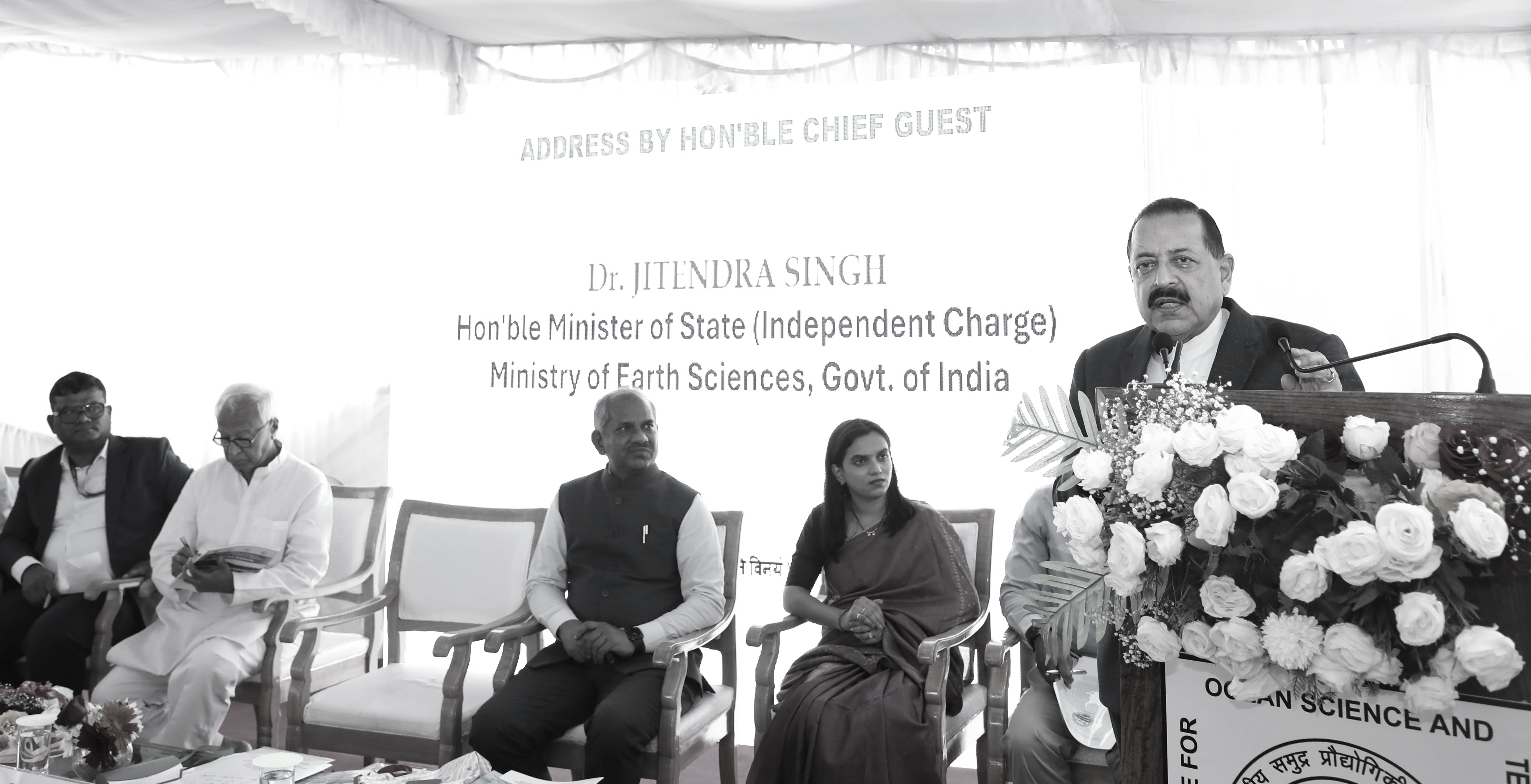
Dr Jitendra Singh launches Blue Economy pilot projects in Andaman & Nicobar Islands
Union Minister of State (Independent Charge) for Science & Technology and Earth Sciences Dr Jitendra Singh on Friday launched and reviewed key marine technology initiatives at the Atal Centre for Ocean Science and Technology for Islands (ACOSTI) in Sri Vijaya Puram (Port Blair) , aimed at strengthening the Blue Economy and livelihoods in the Andaman & Nicobar Islands.
Addressing scientists, officials and stakeholders, the Minister said India’s future economic value addition will increasingly come from untapped marine resources, as the country moves towards becoming one of the world’s leading economies. He said the government’s strong focus on the Blue Economy reflects Prime Minister Narendra Modi’s vision of inclusive development, ensuring island territories and coastal regions are not left behind while pursuing national growth.
The programme, held at ACOSTI a unit of the National Institute of Ocean Technology (NIOT) under the Ministry of Earth Sciences was attended by Andaman & Nicobar MP Bishnu Pada Ray , Dr M. Ravichandran , Secretary, Ministry of Earth Sciences, senior officials of the island administration, scientists, and representatives of local departments and Self-Help Groups.
Referring to the Deep Ocean Mission , Dr Jitendra Singh said it was significant that the Prime Minister announced the mission twice from the Red Fort , underlining the strategic priority accorded to marine resources. He noted that the Blue Economy will play a decisive role in employment generation, exports, environmental sustainability and economic resilience , especially as conventional resources face depletion.
During the visit, the Minister highlighted pilot-scale open sea cage fish farming and large-scale seaweed cultivation , expressing satisfaction that technologies are already being transferred for on-ground use. He said the unique marine biodiversity and coastal conditions of the Andaman & Nicobar Islands make them ideally suited for such initiatives.
Dr Jitendra Singh also emphasised the integration of ocean sciences with biotechnology , pointing to India’s BioE3 policy (Biotechnology for Economy, Environment and Employment) . Marine bio-resources, he said, could offer biodegradable alternatives to plastics , new medicinal compounds and high-value bio-products, while simultaneously generating employment and protecting the environment.
Highlighting emerging opportunities such as non-animal food products, alternative marine-based nutrition, waste-to-wealth technologies and export-oriented marine produce , the Minister said global demand particularly in Europe was expanding rapidly. He stressed greater participation of women and Self-Help Groups to strengthen household incomes and advance the “Vocal for Local” and “Local for Global” vision.
The renewed domestic push for the Blue Economy also aligns with India’s broader maritime outreach, including recent engagements with Iran aimed at enhancing sea-linked economic cooperation, connectivity and port-led development. While discussions with Iran span trade and infrastructure, officials note that such maritime collaboration complements India’s long-term Blue Economy strategy by strengthening regional ocean-based economic networks.
Concluding his address, Dr Jitendra Singh said that with sustained institutional collaboration, including potential involvement of CSIR and biotechnology research centres , the Andaman & Nicobar Islands could emerge as a major hub of India’s Blue Economy initiatives , delivering long-term scientific, environmental and socio-economic benefits.