
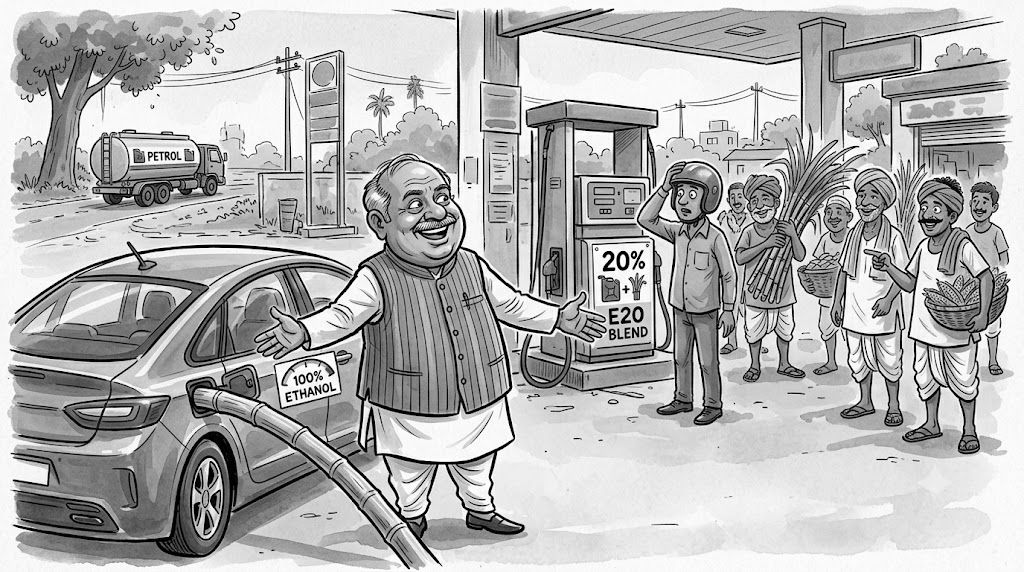
E20 Debate Isn’t Over, But Gadkari Is Already Pushing E100 Hybrid Cars
Just as India’s switch to E20 petrol continues to trigger questions over mileage, vehicle compatibility and the experience of older car owners, Union Road Transport and Highways Minister Nitin Gadkari is already looking much further ahead, towards cars that can run on 100 per cent ethanol.
Gadkari has said he has been invited to the launch in October of a Toyota Innova capable of running entirely on ethanol, describing it as part of a new generation of hybrid vehicles that could reduce dependence on petrol and imported crude oil. The proposed technology combines an ethanol-compatible flex-fuel engine with a strong hybrid electric system.
The timing is striking. India has spent months debating E20, with motorists raising concerns about mileage, compatibility and the impact of higher ethanol blends on older vehicles. The government, however, has rejected claims of widespread engine damage and says laboratory tests, field trials and industry consultations found E20 safe for vehicles meeting prescribed standards.
Gadkari has himself defended E20, challenging critics to identify a vehicle damaged specifically because of the blend. At the same time, independent reporting has documented concerns among some motorists and mechanics, particularly over fuel economy and older vehicles.
Now comes the bigger pitch: E100.
Gadkari has argued that a strong hybrid could operate on electric power for a substantial part of a journey, reducing fuel consumption further. He has also said ethanol-based motoring could bring running costs down to the equivalent of petrol costing around ₹25 a litre, although the actual economics for consumers would depend on ethanol prices, vehicle costs, fuel availability and real-world mileage.
For the government, the attraction goes beyond cheaper motoring. Ethanol is produced domestically from crops including sugarcane and maize, creating an additional market for farmers while potentially reducing India's dependence on imported crude oil.
But the leap from E20 to E100 is not simply a matter of changing the fuel at the pump. A mass transition would require compatible vehicles, adequate ethanol production, reliable distribution infrastructure and clarity over pricing and warranties.
Toyota has previously showcased an Innova-based flex-fuel hybrid prototype, but the company's public material has described it as a prototype, making the exact nature and timing of any commercial launch important for consumers to watch.
So, while India is still arguing over whether E20 was the right step and how smoothly motorists can make the transition, Gadkari's message is already considerably more ambitious: why stop at 20 per cent when the target could be 100 per cent?