
ECI Convenes National Conference to Bolster Electoral Legal Framework
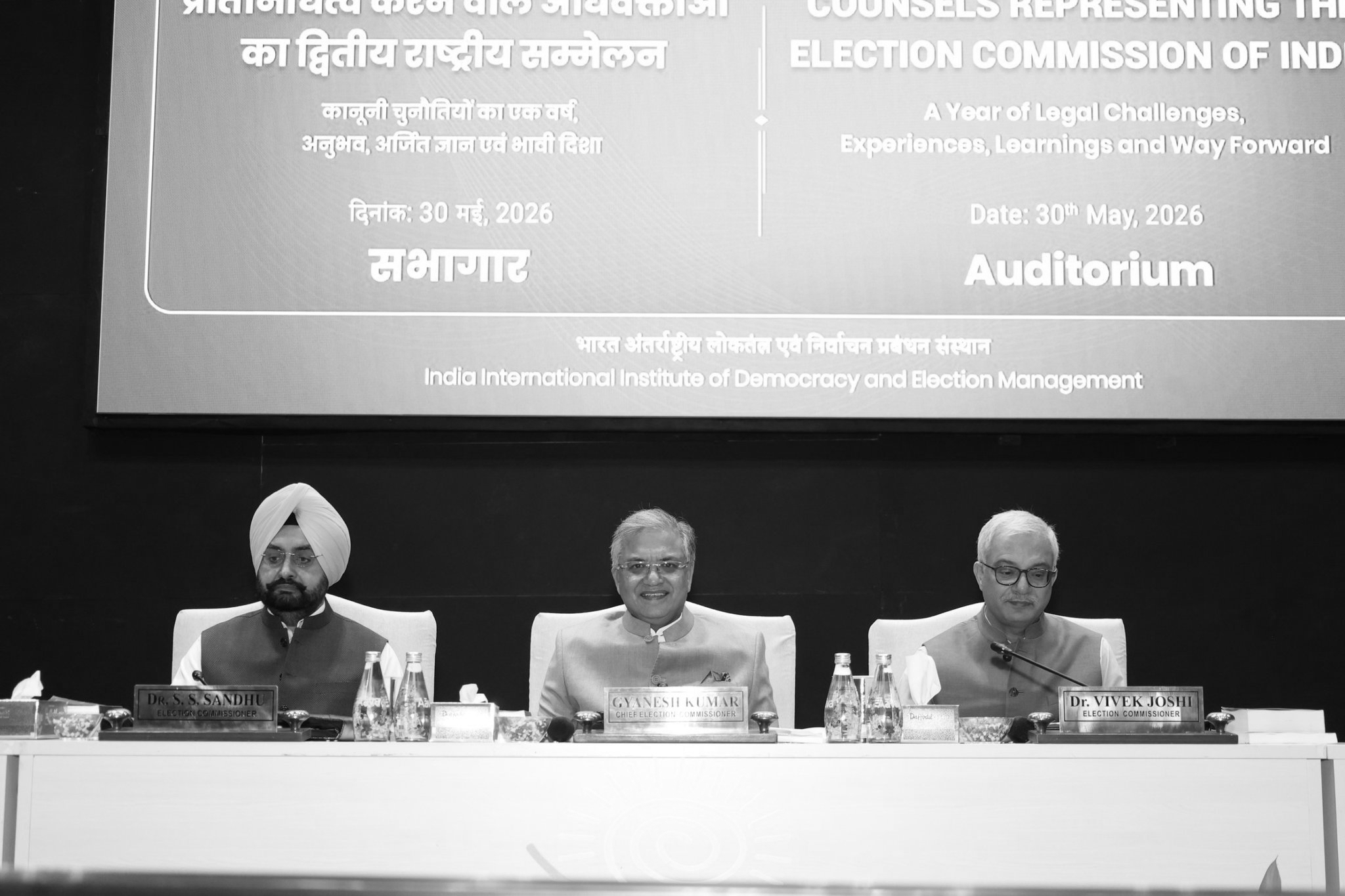
The Election Commission of India (ECI) on Saturday convened the 2nd National Conference of ECI Counsels at the India International Institute of Democracy and Election Management (IIIDEM) in New Delhi, bringing together legal representatives, election officials, and senior administrators to strengthen the Commission’s legal framework and litigation strategy.
The conference was inaugurated by Chief Election Commissioner Gyanesh Kumar in the presence of Election Commissioners Dr. Sukhbir Singh Sandhu and Dr. Vivek Joshi . Advocates representing the Commission before the Supreme Court and various High Courts, along with Chief Electoral Officers and senior ECI officials, participated in the deliberations.
Addressing the gathering, Kumar emphasized the importance of accurate electoral rolls, stating that “fair rolls lead to fair polls.” He also praised Booth Level Officers (BLOs) and Booth Level Agents (BLAs) for their contribution to electoral roll management and acknowledged the strong voter participation witnessed in the recent Assembly elections in Assam, Kerala, Puducherry, Tamil Nadu, and West Bengal.
Held under the theme “A Year of Legal Challenges, Experiences, Learnings and the Way Forward,” the conference featured discussions on electoral roll management, Special Intensive Revision (SIR), polling and counting procedures, election laws, judicial proceedings, legal reforms, and emerging challenges in election administration. Demonstrations of Electronic Voting Machines (EVMs) and presentations on technology-driven initiatives, including ECINET, were also conducted.
Election Commissioner Dr. Sandhu highlighted the importance of stronger coordination between the ECI and its legal representatives, while Dr. Joshi stressed the need for effective legal strategies to uphold electoral integrity.
The conference builds on the outcomes of the 2025 edition and aims to enhance institutional preparedness. Strengthening election-related legal mechanisms has become increasingly important in a highly contested political environment, where electoral decisions and processes frequently face judicial scrutiny and public debate.