
El Niño Is Back: What Could It Mean For India Through 2027?
What happens thousands of kilometres away in the Pacific Ocean could increasingly shape everyday life in India over the coming months. The return of El Niño, with forecasts indicating that the phenomenon could persist until February 2027, is raising questions not only about the monsoon but also about agriculture, farm incomes, food prices, water reserves, electricity demand and the wider economy.
The World Meteorological Organization (WMO) has warned that the current El Niño is strengthening and could become a very strong event. It has estimated an almost 100% likelihood of persistence through February 2027, although the eventual impact on individual countries will depend on the strength and duration of the phenomenon and its interaction with other climate patterns. For India, that uncertainty is particularly important because El Niño does not automatically mean that every part of the country will experience drought or below-normal rainfall.
The bigger concern is the changing character of rainfall. Instead of simply asking whether India will receive enough rain, policymakers and farmers may have to deal with a more difficult question: will rainfall arrive at the right time and in the right places? A monsoon can produce substantial rainfall in a few intense spells while leaving crops exposed to long periods of dryness. Heavy rain can also generate runoff and flooding without adequately replenishing soil moisture or groundwater.
That makes the distribution and timing of rainfall particularly important for Indian agriculture, which remains closely linked to the monsoon. A delayed arrival of rain can postpone sowing, while prolonged dry spells can affect germination and crop growth. Excessive rain in a short period can damage standing crops, wash away nutrients and cause waterlogging. An early withdrawal of the monsoon can leave crops without adequate moisture during critical stages of development.
The impact is already becoming a concern in several agricultural regions. The 2026 monsoon has been uneven, with rainfall weakness during August and concerns over September conditions. Crops including cotton, soybean, maize and pulses are facing risks from inadequate or poorly distributed rainfall. The effects could extend beyond the current kharif season if declining soil moisture and reservoir storage affect the planting and development of rabi crops later in the year.
For farmers, the problem is not limited to crop yields. A weak or erratic monsoon can increase the cost of cultivation. When rainfall fails, farmers may have to depend more heavily on groundwater irrigation, raising electricity or diesel expenses. Yet additional spending on irrigation does not guarantee a good harvest if water shortages persist or crops have already suffered during critical growth stages. Farmers can therefore face a combination of higher input costs, uncertain yields and weaker incomes.
The pressure could become particularly difficult for small and marginal farmers who have limited financial capacity to absorb a failed crop or repeated irrigation costs. A poor harvest can affect their ability to repay loans, purchase inputs for the next season and spend on household needs. This is why a weather shock can quickly become a rural income shock.
The effects may then move into food markets. If production falls significantly, supplies of pulses, vegetables, oilseeds, cereals, sugar and other commodities can tighten. India has policy tools to manage such shortages, including food stocks, imports and changes in trade measures, but a prolonged production shortfall could still place upward pressure on prices.
The connection between rainfall and food inflation is therefore indirect but powerful: irregular rainfall can reduce crop production, lower supplies, increase market pressure and eventually raise consumer prices. If several commodities are affected at the same time, households could face higher food expenditure even as rural incomes come under pressure.
The situation becomes more complicated because rainfall also determines how much water India carries into the months ahead. A weak monsoon can reduce inflows into reservoirs and affect the replenishment of rivers, lakes, groundwater and soil moisture. Reservoirs are required for multiple purposes, including drinking water, irrigation, industry and hydropower generation. When storage declines, governments face increasingly difficult choices over how available water should be allocated.
The consequences can continue into the next agricultural season. Less water stored during the monsoon can mean greater dependence on groundwater during the rabi season. If farmers across large regions increase pumping to compensate for rainfall shortages, groundwater levels can fall further. What begins as a seasonal rainfall problem can therefore become a longer-term water-security challenge.
Water stress can also have an important connection with electricity. Hotter and drier conditions can increase the use of air-conditioners, coolers, refrigeration and other cooling equipment, pushing electricity demand higher. Farmers may also require more power to operate irrigation pumps when rainfall is inadequate.
At the same time, lower rainfall can reduce inflows into reservoirs that support hydropower generation. India therefore could face a potential double pressure: higher electricity demand because of heat and irrigation, alongside greater pressure on water-dependent power generation. This does not mean El Niño will automatically result in a nationwide power shortage, given India's diversified generation capacity, but it could make peak-demand management more challenging.
India's rapidly expanding renewable-energy capacity provides an important buffer, particularly during periods of strong daytime solar generation. However, the challenge becomes more complicated when electricity demand remains high after sunset or when transmission and storage capacity limit the ability to move or retain power. The combination of heat, irrigation demand and changing hydrological conditions could therefore increase the importance of grid flexibility, energy storage and transmission infrastructure.
The wider economy could feel the impact through several interconnected channels. Agriculture may contribute a smaller share of India's economic output than services and industry, but rural incomes have a significant influence on consumption. When farmers earn less, spending on motorcycles, consumer goods, farm equipment, construction and other products can weaken.
At the same time, higher food prices can reduce the amount of money households have available for non-food purchases. This creates an uncomfortable economic combination: weaker rural purchasing power alongside higher household expenses. If the situation persists, the effects could spread beyond agriculture into consumption and businesses that depend heavily on rural demand.
Inflation could create another challenge. Weather-related food inflation is difficult to address through conventional monetary policy because higher interest rates cannot increase rainfall or immediately restore crop production. However, if food-price pressures become persistent, they could complicate the broader inflation outlook and limit the policy space available to support economic activity.
Industry could also be affected if water shortages become severe. Manufacturing, power generation, chemicals, metals, textiles and food processing all require reliable water supplies. In areas where reservoirs and groundwater are already under pressure, businesses could face higher operating costs or restrictions on water use. A prolonged water shortage could therefore transform a climate problem into an industrial and infrastructure challenge.
Government finances could come under additional pressure if the situation requires larger interventions. Authorities may have to spend more on farmer assistance, crop insurance, irrigation, drinking-water supplies, rural employment, food imports and electricity-sector measures. The objective would be to prevent a temporary weather shock from developing into a prolonged economic disruption.
India has already begun preparing for these risks through a cross-sector approach involving agriculture, water, power, health, rural development and economic authorities. The next step will be ensuring that preparations reach the district and farm level, where the effects of rainfall variability are actually experienced.
Governments will need to closely monitor rainfall, soil moisture, reservoir storage, groundwater levels, crop conditions, food stocks and electricity demand together rather than treating each issue separately. Vulnerable districts could require early access to alternative seeds, drought-tolerant crops, irrigation support, crop insurance and drinking-water arrangements.
Water management will be particularly important. Authorities will need to balance drinking-water requirements with irrigation and power generation while encouraging groundwater recharge, rainwater harvesting, micro-irrigation and more efficient use of available water. Protecting water reserves before they reach critical levels will be far more effective than relying entirely on emergency measures after shortages emerge.
The power sector will similarly need to prepare for the possibility of high temperatures coinciding with high electricity demand and lower hydropower availability. Maintaining sufficient generation capacity, strengthening transmission networks, expanding storage and improving demand management can help reduce the risk of localised stress even if overall national power availability remains adequate.
Food policy will also have to remain flexible. Early monitoring of crop conditions can help authorities determine whether buffer stocks, imports or temporary trade measures are required. The aim would be to prevent a supply disruption from becoming a prolonged food-inflation problem while also protecting farmers from a collapse in market prices when production conditions vary sharply between regions.
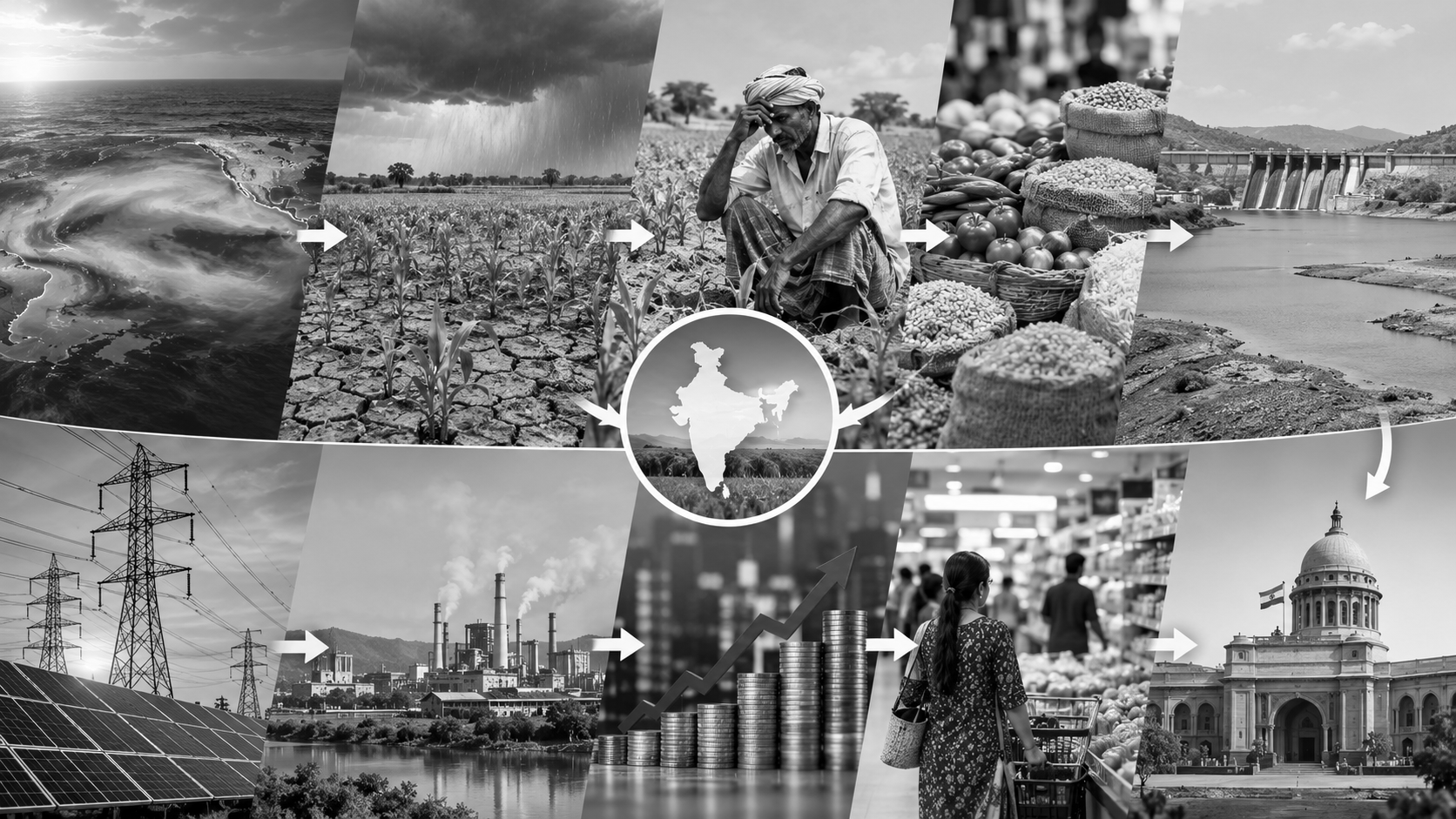
Ultimately, the significance of El Niño for India lies not in one rainfall forecast but in the chain reaction it can potentially trigger. A change in rainfall can affect soil moisture; soil moisture can affect crops; crop losses can affect farm incomes; lower production can influence food prices; weaker rainfall can reduce reservoir storage; water shortages can increase irrigation and electricity demand; and the combined pressure can eventually reach household consumption, government spending and economic growth.
Yet El Niño should not be treated as a prediction of economic crisis. India's diversified economy, food reserves, expanding renewable-energy capacity, irrigation infrastructure and policy tools provide important buffers. The impact will depend heavily on the actual distribution of rainfall, the condition of reservoirs, crop resilience, global commodity prices and the effectiveness of government intervention.
If El Niño weakens during 2027 as expected, some of these pressures could gradually ease. But the experience could still reinforce a larger lesson for India: weather risk is increasingly becoming economic risk.
The real question for the months ahead, therefore, is not simply whether India will receive enough rain. It is whether the country can ensure that unpredictable rainfall does not become unpredictable food supplies, water availability, electricity demand, farm incomes and economic growth.
El Niño may begin in the Pacific Ocean, but its consequences will ultimately be measured much closer to home in India's farms, markets, reservoirs, power grids and household budgets.