
Election Officials Detect 89 Lakh Errors in Telangana Voter Database
Telangana's election machinery has uncovered nearly 89 lakh discrepancies and anomalies in the state's electoral database during a large-scale pre-verification exercise, paving the way for one of the most extensive voter roll cleansing operations undertaken in decades. The findings emerged from the ongoing Pre-Special Intensive Revision (Pre-SIR) process being conducted under the supervision of the Election Commission of India (ECI) ahead of a comprehensive revision of electoral rolls.
According to Chief Electoral Officer (CEO) C. Sudharshan Reddy , election officials identified 11 categories of technical and logical inconsistencies while comparing existing voter records with historical electoral data. The anomalies primarily involve age-related and family relationship mismatches, including cases where parents and children were shown with implausibly small age gaps, siblings were recorded with age differences of less than nine months, and family relationship details did not align with earlier electoral records.
The exercise is part of a broader effort to create a transparent, accurate and error-free voter database before future elections. Officials have been mapping current voter information against the 2002 electoral rolls , which are being used as a reference point to verify historical records and establish family linkages. However, election authorities have clarified that voters whose names do not appear in the 2002 rolls will not be removed automatically and will instead be given an opportunity to submit approved identity documents for verification.
Interestingly, election officials observed that rapidly urbanising constituencies around Hyderabad , including areas such as Quthbullapur, Uppal, LB Nagar and Serilingampally , reported significantly higher levels of discrepancies compared to rural regions. Officials attribute this trend to factors such as migration, frequent changes of residence, apartment-based living patterns and duplication of records across locations. Rural constituencies, by contrast, generally showed greater stability in voter data.
The Election Department believes that a majority of these anomalies can be resolved through document verification and public hearings. Affected voters will receive notices seeking clarification, and corrections will be carried out only after supporting records are examined. Officials estimate that most discrepancies are technical in nature rather than indications of fraudulent voting.
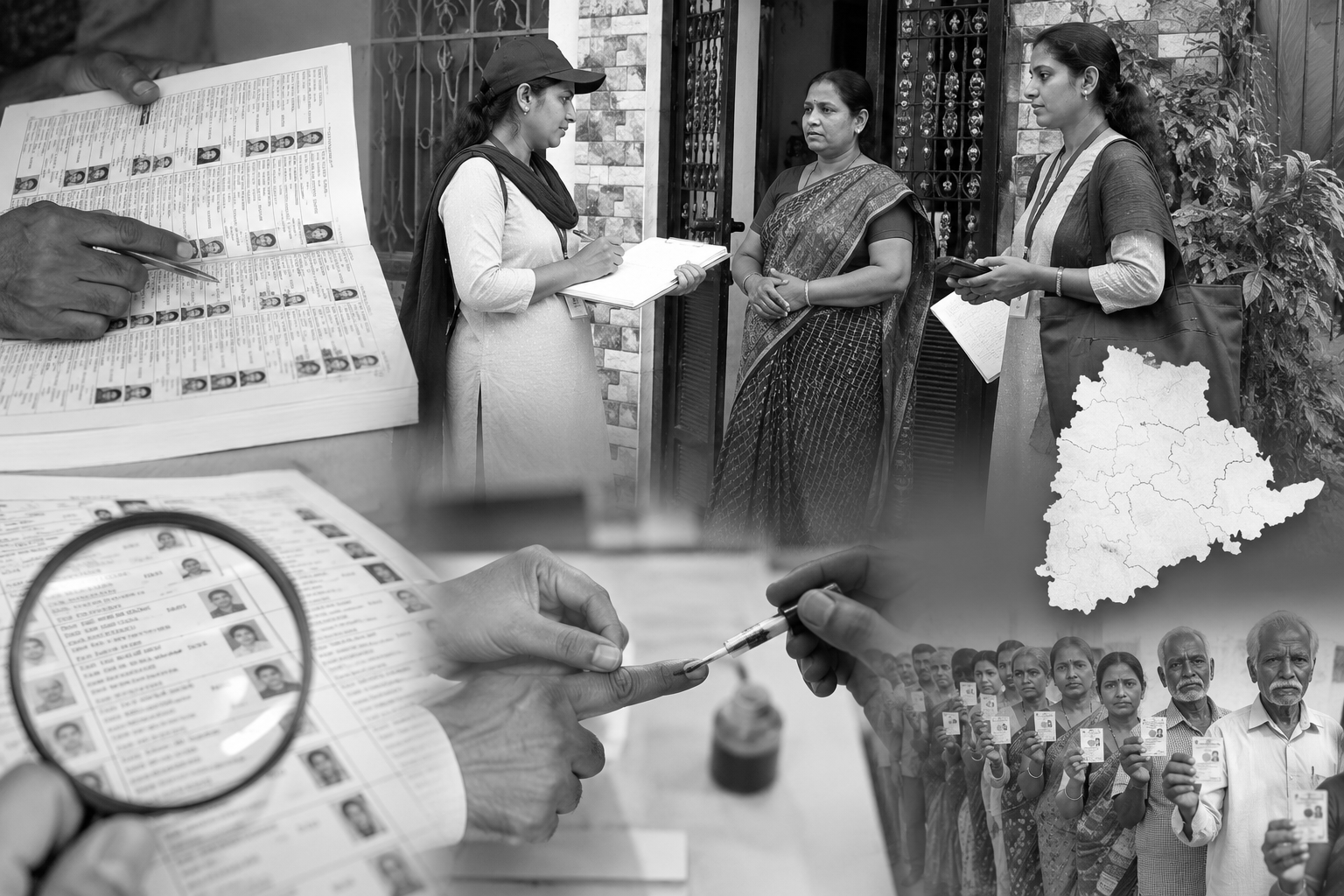
The official Special Intensive Revision (SIR) process is scheduled to begin on June 15 , with preparatory activities continuing until June 24 . The most crucial phase— door-to-door voter verification —will run from June 25 to July 24 , during which Booth Level Officers (BLOs) will visit every household, distribute enumeration forms, collect updated voter information and upload verified details into the electoral database. Locked houses will be revisited multiple times to ensure maximum coverage.
Following the field verification exercise, a draft electoral roll will be published on July 31 . Citizens will then have a month, until August 30 , to submit claims for new registrations, corrections and objections. After scrutiny and hearings, the final electoral roll is scheduled to be published on October 1 .
The significance of the exercise lies in its scale. A similar Special Intensive Revision was last conducted in the undivided Andhra Pradesh in 2002 , making this the first such comprehensive voter-roll verification effort in nearly 24 years . Election authorities view the initiative as a critical step toward eliminating duplicate entries, correcting legacy errors and strengthening the integrity of Telangana's electoral process ahead of future polls.