
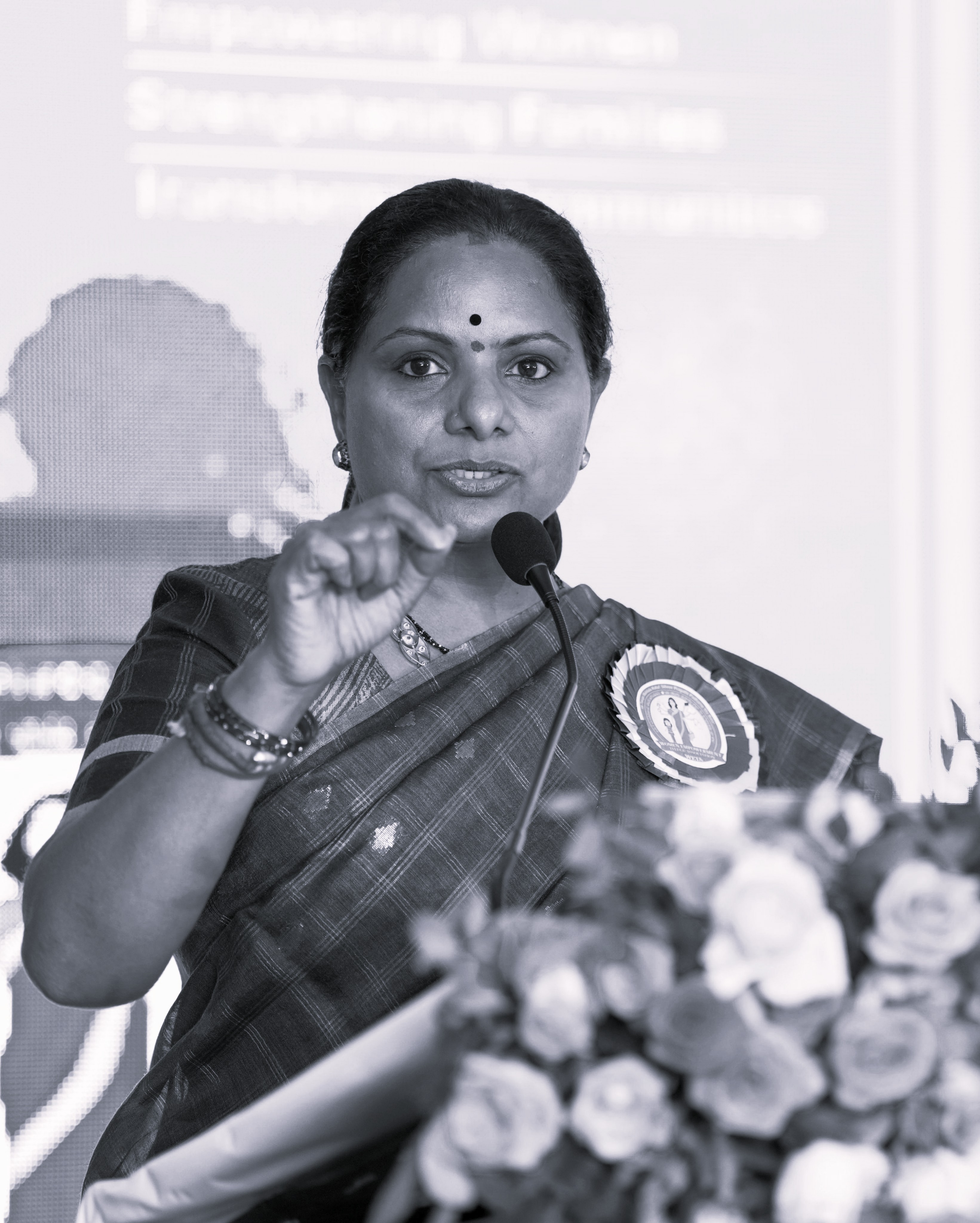
Empowerment Needs Family Support, Not Just Policies: Kavitha
Gender bias continues to shape opportunities and outcomes for women across sectors, despite decades of progress in education, employment and public representation, Kalvakuntla Kavitha said on Wednesday, calling for a collective effort from families, communities and institutions to achieve meaningful empowerment.
Addressing the VETA India Women Empowerment programme at the Jubilee Hills Convention Centre in Hyderabad, the president of Telangana Rakshana Sena (TRS) spoke about the challenges women face in their professional and personal lives, arguing that societal attitudes remain one of the biggest obstacles to gender equality.
Kavitha said women often encounter barriers even after proving their abilities and qualifications. Describing the issue as a systemic problem, she remarked that the world continues to function with an inherent bias against women. According to her, women from diverse backgrounds may belong to different communities, but they frequently share common struggles in their pursuit of education, careers and leadership roles.
Highlighting the persistence of the glass ceiling , she recalled a conversation with a woman judge who pointed out that while a large number of women successfully clear competitive examinations and enter the judicial system, only a limited number manage to reach higher positions. This, Kavitha said, reflects the invisible barriers that continue to exist in many professions.
She urged women to remain focused on their ambitions and not allow uncertainty or social pressures to derail their goals. Once a decision is made, she said, determination and hard work become essential for success.
The former MP stressed that women’s empowerment cannot be achieved through government policies alone. Referring to Telangana's 33 percent reservation for women in police constable recruitment , she noted that many posts remain unfilled because women often lack the necessary support from their families to pursue such careers. True empowerment, she argued, requires encouragement at home as much as opportunities in the workplace.
Kavitha also expressed concern over early marriages and teenage motherhood , citing statistics that show 7.2 percent of girls aged 15 to 19 in Telangana have become mothers. Even in Hyderabad, widely regarded as a major technology and innovation hub, the figure stands at 2.7 percent . These numbers, she said, indicate that traditional mindsets surrounding girls and marriage have not changed as rapidly as economic development.
Drawing from her own experience in public life, Kavitha said women in politics continue to face disproportionate criticism and gender-based trolling on social media platforms. She observed that women leaders are often judged differently from their male counterparts and are subjected to personal attacks unrelated to their work.
In a notable observation, Kavitha said that emerging technologies such as Artificial Intelligence (AI) are not entirely free from societal prejudices. Since AI systems are trained using historical data, they can sometimes reproduce existing biases unless developers consciously address them.
Calling on young people to focus on self-improvement rather than social media validation, she encouraged them to build confidence, acquire skills and work steadily towards their aspirations. She also praised VETA India and its founder Jhansi for creating opportunities that help women become entrepreneurs, professionals and independent contributors to the economy.
The event brought together entrepreneurs, professionals and aspiring leaders to discuss pathways for greater female participation in leadership, business and public life, reinforcing the growing conversation around gender equality and inclusive development.