
Ethanol-Blended Petrol Safe For Vehicles, Won’t Affect Insurance: Government
India's ethanol blending programme remains safe, consumer-friendly, and economically beneficial, the government said on Tuesday, dismissing concerns that the use of E20 fuel could affect the validity of vehicle insurance policies , even as a growing number of vehicle owners across the country report fuel efficiency losses, engine irregularities, and performance issues they attribute directly to ethanol-blended petrol.
The Ministry of Petroleum and Natural Gas said claims linking E20 fuel use to insurance invalidation had been verified with relevant stakeholders and found to be incorrect. The PIB Fact Check unit separately labelled the viral claims as false, urging citizens to verify fuel-related information through official channels. "Ethanol blending is a globally accepted practice and is successfully implemented in several countries, including the United States, Brazil, and Japan," the ministry said, noting that Brazil operates on E27 as its standard petrol blend.
The government's statement addressed a range of social media concerns including engine reliability, water contamination, and the assertion that E20 attracts insects, all dismissed as misinformation. Bharat Petroleum Corporation Limited clarified that fuel-grade ethanol undergoes fermentation and distillation that eliminates residual sugars, and that fuel ethanol contains denaturants repellent to insects. The ministry maintained that since E20's nationwide rollout, no widespread cases of engine failure or vehicle breakdown attributable to ethanol blending have been reported.
However, that position sits uneasily with what many motorists are experiencing on the ground. Across online automotive forums, owner communities, and social media platforms, vehicle owners, particularly those operating older two-wheelers and entry-level cars , have reported measurable drops in mileage, rough idling, fuel system corrosion, and difficulty starting in colder conditions since E20 became the standard fuel. Independent mileage tests conducted by automotive outlets have consistently recorded efficiency losses of between three and seven per cent on E20 compared to E0 petrol, losses the government has acknowledged only in passing, attributing them to driving habits, tyre pressure, and maintenance rather than fuel composition.
Industry experts have long acknowledged that ethanol contains less energy per litre than conventional petrol , which directly influences vehicle range and fuel economy, a fact the PIB statement does not substantively address. Multiple independent mileage comparisons have suggested that the lower retail price of ethanol-blended fuel does not always translate into lower running costs for consumers.
The Ministry of Petroleum and Natural Gas itself, in an August 2025 response to public concerns, acknowledged that an efficiency drop in E10 vehicles has been marginal, and noted that vehicles tuned specifically for E20 deliver better acceleration, implicitly conceding that older, non-optimised vehicles may not benefit equally from the transition. Vehicles manufactured before 2009, which form a significant share of India's two-wheeler fleet, were not designed with ethanol compatibility in mind, raising legitimate questions about long-term engine wear and fuel system degradation that the government has yet to answer comprehensively.
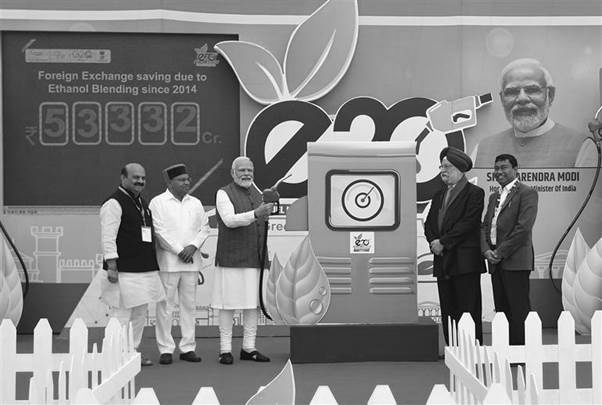
The ethanol blending programme has helped India save more than Rs 1.4 lakh crore in foreign exchange , with Union Minister Hardeep Singh Puri placing the updated figure at Rs 1.84 lakh crore , noting that blending rose from 1.53 per cent in 2014 to 20 per cent today, five years ahead of the original 2030 target. E85 fuel , launched on World Environment Day 2026, is currently available at 48 public sector OMC outlets, with expansion planned to 5,000 outlets by December 2027 .
The macroeconomic gains are real and significant. Yet for the Indian motorist filling up at the neighbourhood petrol pump, watching the mileage meter tick lower than it used to, the government's assurances of safety, scientific validation, and consumer-centricity must contend with an inconvenient parallel reality: that the transition to E20 was designed around fleet averages and national targets , not around the crores of older vehicles still on Indian roads whose owners were never meaningfully consulted, compensated, or even warned.
"Ethanol blending plays an important role in enhancing India's energy security , reducing carbon emissions and advancing the country's transition towards cleaner mobility ," the ministry said. That may well be true. Whether it is equally true for the owner of a 2007 Hero Splendor watching his tank empty faster than it used to is a question the government has yet to answer with the same confidence.