
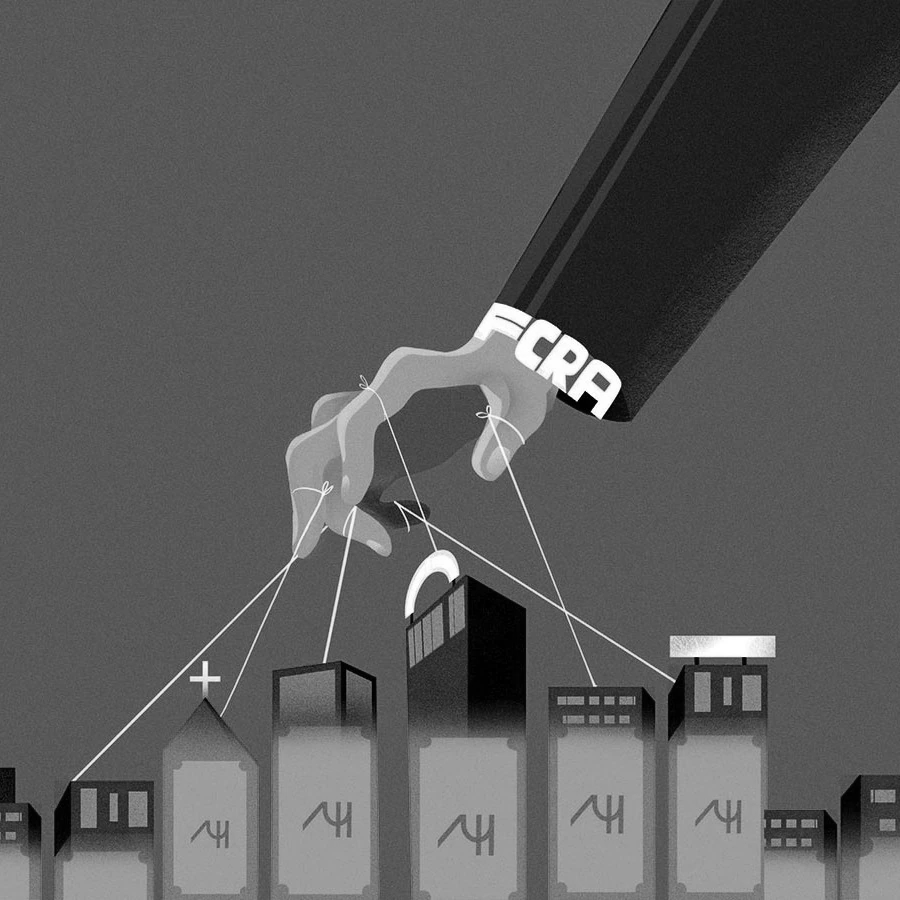
Fewer NGOs, More Foreign Money: India’s FCRA Funding Has Nearly Doubled Per Active NGO
The number of active NGOs registered under India’s Foreign Contribution (Regulation) Act has almost halved in a decade, but the foreign money flowing into the remaining organisations has moved in the opposite direction, raising fresh questions about how overseas funding is now concentrated.
Data presented by the Ministry of Home Affairs to the Joint Parliamentary Committee examining the FCRA Amendment Bill, 2026, showed that active FCRA-registered NGOs fell from 29,022 in 2015 to 14,466 in 2024-25. Yet foreign contributions increased from Rs 17,832 crore in 2015-16 to Rs 22,974 crore in 2024-25.
The figures suggest a major change in the funding structure. Fewer organisations are now eligible to receive foreign money, while the overall pool has grown. Between 2022 and 2024, one NGO received more than Rs 500 crore, 14 received between Rs 100 crore and Rs 500 crore, and 294 received Rs 10-50 crore. At the other end, 4,508 organisations received between Rs 5 lakh and Rs 50 lakh.
The concentration is also visible in the donor base. The US contributed Rs 12,113 crore, more than half of the total, followed by the UK at Rs 2,414 crore, Germany at Rs 1,782 crore, Switzerland at Rs 733 crore and Singapore at Rs 669 crore. Social-sector organisations received Rs 13,071 crore and education-related organisations Rs 6,933 crore, indicating that much of the money goes into large development and welfare programmes rather than religious activities.
The decline in registrations also needs context. The government says 21,983 FCRA registrations have been cancelled, with 91.3 per cent attributed to failure to file annual returns, 7.9 per cent to inactivity and 0.4 per cent to legal violations. Thus, the fall in active registrations cannot simply be described as thousands of NGOs being shut down for financial wrongdoing.
Stricter compliance has also changed the landscape. Since the 2020 amendments, foreign contributions cannot be transferred from one NGO to another and the administrative-expense ceiling was reduced from 50 per cent to 20 per cent. The 2026 rules now require organisations seeking renewal to show that they used at least Rs 10 lakh in foreign contributions during the previous two financial years, while also requiring more detailed project-wise reporting.
Another revealing figure is the amount not yet spent: Rs 35,968 crore in foreign contribution remained unutilised in 2024-25, including Rs 21,140 crore kept in fixed deposits.
The issue is now at the centre of the proposed FCRA overhaul. The government says the Bill seeks greater transparency, accountability and safeguards against misuse, while Opposition members have raised concerns over provisions dealing with assets of organisations whose registrations cease. The JPC has been asked to submit its report before the Winter Session.
The bigger picture is therefore not simply that India has fewer NGOs. It is that foreign funding is increasingly concentrated within a smaller, more closely regulated pool of organisations, while billions of rupees remain with them awaiting utilisation. That shift, and who receives the largest grants, from whom and for what projects, is likely to remain the most important question as Parliament examines the new law.