
Five Decades of Mining Cause ₹4,000-Crore Damage to Goa Village: Study
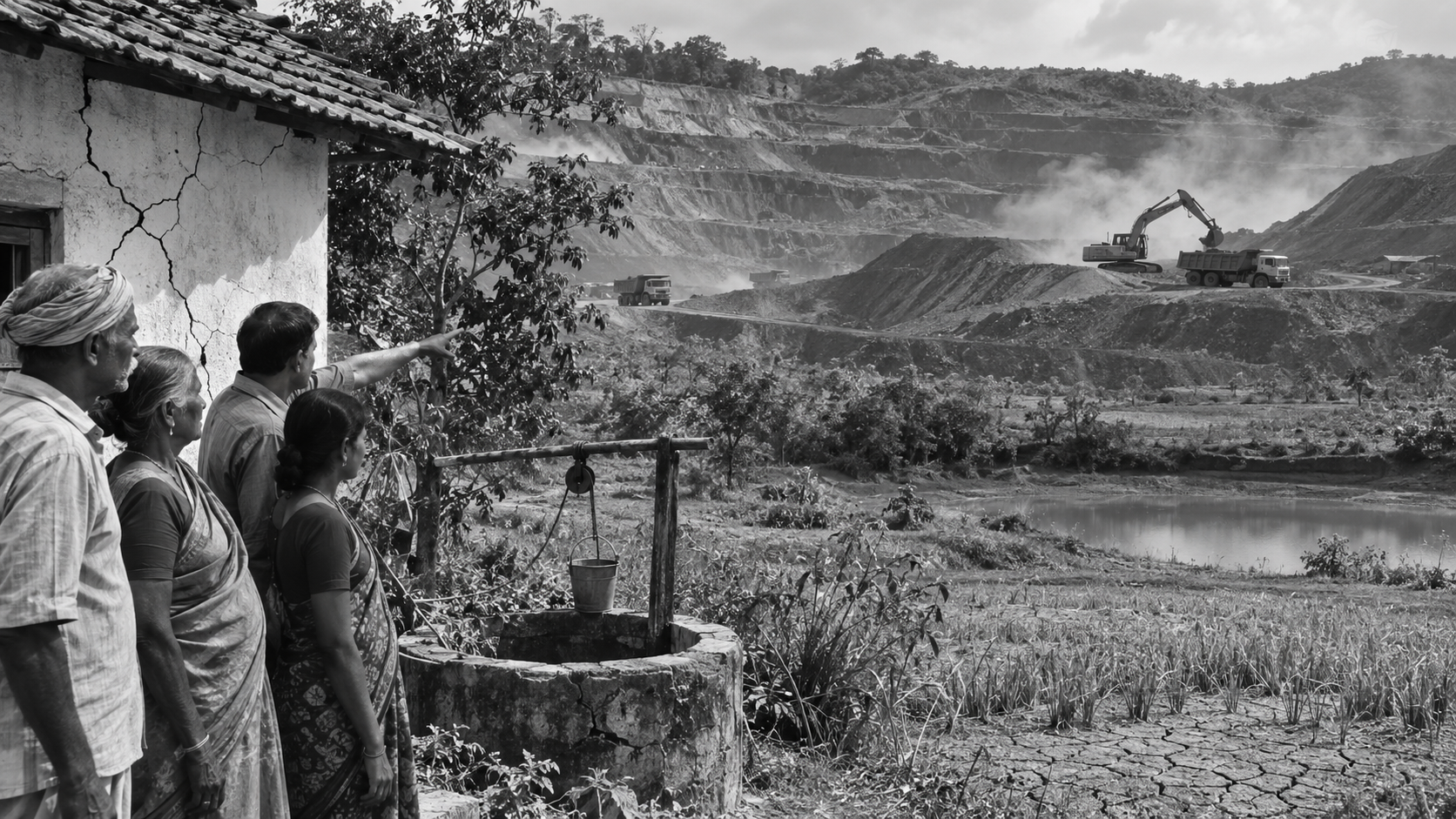
Five decades of iron ore mining have caused an estimated ₹4,000 crore in environmental, economic and social damage to Sirigao village in North Goa's Bicholim taluka, nearly 60 per cent of the ₹7,000 crore in gross revenue generated from ore sales during the period, according to a new environmental assessment released on Tuesday. The study highlights groundwater depletion, agricultural losses, declining traditional livelihoods and potential health risks, while calling for compensation from mining companies, ecological restoration and stricter community participation before fresh mining permissions are granted.
Authored by Dr Sagar Dhara of the South Asia People's Action on Climate Change (SAPACC), the report was commissioned by Sirigao villagers and completed in September 2026 after a two-year research exercise. Released by the Goa Foundation, it estimates direct human and livelihood losses at ₹1,000 crore, social and environmental externalities at ₹2,000 crore and initial ecological restoration costs at another ₹1,000 crore.
The assessment documents the loss of traditional clean water sources, declining paddy, cashew, coconut and mango production, and damage to dairy farming and traditional fisheries. Residents have also reportedly lost access to forest resources, including firewood, timber, kokum and tamarind. Mining-related vibrations and environmental changes have allegedly caused visible cracks in houses.
The findings revive concerns documented by the National Environmental Engineering Research Institute (NEERI) in 2009 following a public interest litigation filed by villagers in 2008. Its investigation found that almost all dug wells in Sirigao had dried up by December 2008 and identified groundwater depletion linked to deepened mines and reduced recharge areas. Mining overburden deposits had also affected agricultural soil fertility. NEERI proposed groundwater recharge measures estimated at ₹660.25 lakh and soil remediation costing approximately ₹1.8 lakh per hectare. Subsequent monitoring recorded the rejuvenation of around 80 per cent of village wells by May 2010. However, its earlier water tests did not establish chemical contamination in the samples examined.
The latest study estimates an elevated lifetime cancer risk of 6,900 to 8,200 per million people due to exposure to polluted air and water and identifies respiratory illnesses, including asthma. These are modelled risk estimates, not confirmed cancer cases, and require independent epidemiological verification.
Goa's mining industry has faced repeated regulatory interventions. Following the Justice M.B. Shah Commission's investigation into illegal mining operations were suspended in 2012. The Supreme Court intervened in 2014 and again in 2018, quashing the renewal of 88 mining leases. Commercial mining resumed under an auction-based framework in April 2024.
The Goa Economic Survey 2025-26 reported that 12 blocks had been auctioned, six of which were operational, generating ₹252.83 crore in upfront payments. Chief Minister Pramod Sawant subsequently said in November 2026 that 17 blocks had been auctioned and 16 operationalised, with annual production reaching 19.15 million tonnes against the Supreme Court's 20-million-tonne ceiling. He projected potential production of 45 million tonnes annually through fresh extraction and ore-dump processing, with estimated annual revenue of ₹4,000 crore and 4,000-5,000 employment opportunities. He also flagged 153 mining leases within Western Ghats eco-sensitive areas.
Seeking accountability, the Sirigao report recommends compensation for health and livelihood losses, detoxification of soil and water, independent safety testing and ecological rehabilitation. It calls for cancellation of existing mining permissions, unanimous Gram Sabha consent for fresh mining and substantial bank guarantees from future operators, held by the High Court.
The recommendations build on the Goa Mineral Policy, 2013, which provides for mine reclamation, groundwater recharge and agricultural rehabilitation. The Supreme Court had also directed contributions to the Goan Iron Ore Permanent Fund to support sustainable development and future generations.
The study places the polluter-pays principle at the centre of the debate, raising questions about corporate accountability as Goa pursues mining expansion. For Sirigao, the challenge is ensuring that mineral wealth is matched by compensation and a credible restoration programme.