
From Cash to QR: Is India Moving Towards a Truly Cashless Society?
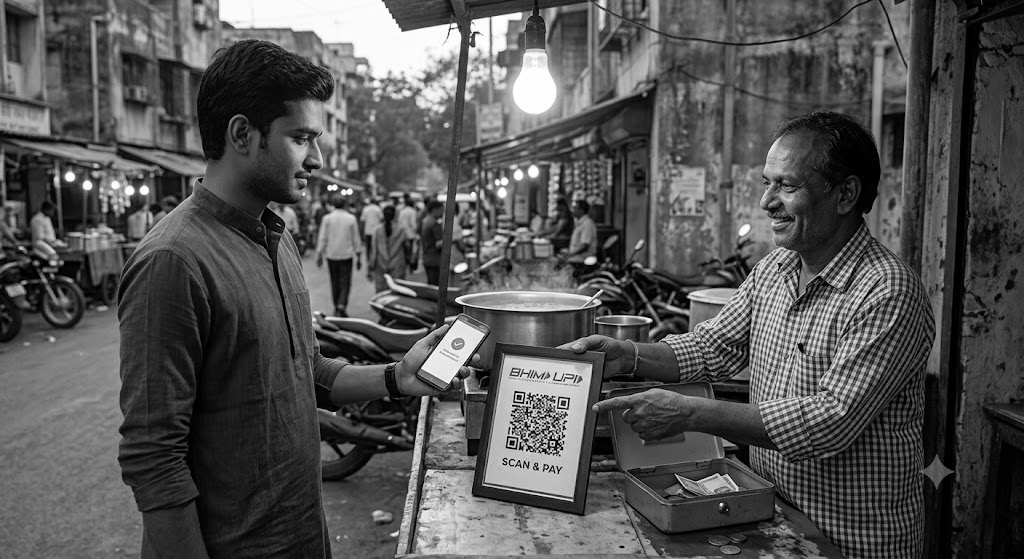
At a small tea stall, a customer holds out a phone instead of a ₹20 note. The shopkeeper points towards a QR code pasted beside the cash box. Within seconds, the payment is done. A few years ago, such a scene would have seemed unusual. Today, it is part of everyday life in India. From roadside tea stalls and vegetable vendors to shopping malls, taxis and neighbourhood stores, digital payments have become almost impossible to ignore. But behind the familiar sound of a successful UPI payment is a bigger question: is India actually moving towards a cashless society, or simply becoming a country where cash and digital payments exist side by side?
The scale of India's digital payment revolution is difficult to overlook. The Unified Payments Interface (UPI), launched in 2016, has grown from a relatively new payment system into the backbone of India's retail digital-payment ecosystem. UPI accounted for 85 per cent of India's digital-payment transactions by volume in FY 2025-26 and, by June 2026, had more than 55.49 crore users. It was also serving around 6.5 crore merchants and connecting hundreds of banks on a common platform.
The latest numbers show that this growth has not slowed. According to the National Payments Corporation of India (NPCI), UPI processed 24.51 billion transactions in August 2026, involving transactions worth nearly ₹29.82 lakh crore. The number of banks live on the platform had also increased to 752. These figures show how deeply digital payments have entered the daily economic life of the country.
But the story of UPI is not only about technology. Its success came from making digital payments simple enough for ordinary people. Instead of remembering bank account numbers and IFSC codes, users could send money using a mobile number, UPI ID or QR code. For small businesses, a printed QR code was much easier and cheaper than installing a traditional card-payment machine. The smartphone, affordable mobile data, expanding bank-account access and the growth of fintech services together created an ecosystem in which digital payments could spread rapidly.
The change was also helped by a series of developments that pushed people towards electronic transactions. Demonetisation in 2016 gave digital payments an early boost, while the COVID-19 pandemic later made contactless transactions more attractive. What began as an alternative to cash gradually became a routine habit. For many young Indians, scanning a QR code has now become as normal as handing over cash.
The biggest change, however, can perhaps be seen among small merchants. A government-backed assessment found that 94 per cent of small merchants reported adopting UPI, while about 72 per cent said they were satisfied with digital payments. Around 57 per cent reported an increase in sales after adopting digital payments. Faster transactions, easier record-keeping and operational convenience were among the benefits reported by merchants.
For a small shopkeeper, the importance of digital payments goes beyond avoiding cash. A digital transaction leaves a record, reduces the need to keep large amounts of money at the shop and can make it easier to track daily business. For customers, it eliminates the familiar problem of not having change. Even very small purchases can now be completed digitally, something that would have been difficult with traditional card-based systems.
Yet, the picture becomes more complicated when the focus shifts from cities to rural India. A QR code may be easy to use for a digitally confident customer, but digital payments still depend on a combination of a functioning phone, connectivity, a bank account and basic digital awareness. India has made considerable progress in expanding banking access. Government data shows that 99.92 per cent of inhabited villages were served by a banking outlet, Business Correspondent or India Post Payments Bank outlet within a five-kilometre radius as of July 2026.
That expansion creates an important foundation for digital financial services. But having access to a banking point does not automatically mean that every person is comfortable making digital payments. The gap between having access and having confidence remains important, particularly for elderly people, people with limited digital literacy and those who have had little exposure to smartphones or online banking.
For many elderly users, the problem is not necessarily unwillingness. It is the fear of making a mistake. A younger person may quickly scan a QR code, check the amount and complete a transaction. An older user may worry about entering the wrong PIN, clicking the wrong option or accidentally transferring money. The Reserve Bank of India has noted that digital payment adoption is stronger among younger groups and has highlighted the need for digital-literacy initiatives suited to different demographic groups.
This is where India's cashless ambition faces one of its biggest tests. If a person needs a family member to help complete every digital transaction, the technology may have increased access but not necessarily independence. Digital inclusion should therefore mean more than giving people bank accounts or smartphones. It should also mean giving them the confidence and knowledge to use financial services safely on their own.
There is another reason why many Indians continue to keep cash: trust. Cash is tangible. People can see it, count it and immediately know how much they have. It does not depend on a mobile network, battery, server or application. During a connectivity failure or technical problem, a ₹100 note can still be used. For a daily-wage worker, street vendor or small trader, that reliability can matter more than the convenience of a digital transaction.
Digital payments also bring a new kind of risk. The same speed that makes UPI attractive can make fraud dangerous. Fake customer-care numbers, phishing links, fraudulent payment requests, QR-code scams and fake screenshots of successful payments have created new challenges for consumers and merchants. The RBI and other authorities have consequently been strengthening security requirements and fraud-monitoring mechanisms around digital transactions.
For shopkeepers, the problem can be particularly difficult. A merchant may see a customer showing a payment screen and assume the transaction is complete, only to discover later that no money has actually reached the account. As digital payments become more common, basic awareness about checking transaction status rather than relying only on screenshots becomes just as important as having a QR code.
This raises a larger question: can a country become truly cashless when a significant section of its population still considers cash a safer backup? The answer may not be as simple as replacing one payment method with another. India's experience suggests that people do not necessarily abandon cash when they start using digital payments. Instead, they often use both depending on the situation.
Someone may use UPI for groceries, electricity bills and online shopping but still carry cash for a roadside purchase. A small trader may accept digital payments from customers while keeping cash for suppliers. A traveller may use UPI in a city but prefer cash in a location where internet connectivity is uncertain. In other words, the rise of digital payments does not automatically mean the disappearance of physical money.
This coexistence is sometimes described as the shift towards a less-cash economy, rather than a completely cashless economy. The distinction matters. A cashless society would mean that cash has largely disappeared from everyday economic activity. A less-cash society means that cash remains available, but people increasingly choose digital methods because they are faster, easier or more convenient.
India's next phase of digital payments is likely to focus on removing some of the barriers that still remain. Payment systems are already expanding beyond conventional smartphone-based transactions, while efforts are being made to improve accessibility, security and reliability. The growth of rural banking infrastructure and digital-literacy programmes will also determine whether the benefits of digital finance reach people who are currently less comfortable with technology.
The direction of travel is clear. UPI is no longer simply a payment option used by technology-savvy urban consumers. It has become part of India's everyday economic infrastructure, connecting individuals, businesses and banks at an enormous scale. Its international expansion also shows that the Indian model is being viewed as more than a domestic payment innovation.
But the real measure of India's digital-payment success should not be the number of transactions alone. A society cannot be called digitally inclusive simply because billions of payments are processed every month. The more important questions are whether a farmer can make a payment without fear, whether a small vendor can identify a genuine transaction, whether an elderly person can use digital banking independently and whether people have a reliable alternative when technology fails.
India may therefore be moving towards a future where cash becomes less important, but not necessarily irrelevant. The QR code may increasingly replace the cash box for many everyday purchases, but the note in someone's wallet is unlikely to disappear overnight. For millions of people, cash still represents familiarity, control and security.
The future is more likely to be a combination of both worlds. Digital payments will continue to expand, become easier and reach more people, while cash will remain a backup and, in some situations, the preferred option. The real achievement would not be eliminating cash completely, but ensuring that nobody is forced to depend on it simply because they lack access, confidence or digital literacy.
India's cashless journey, therefore, may not end with a country without cash. It may instead lead to a country where people have more choices, safer ways to pay and greater confidence in using them. The question is no longer whether India will become digital. It already is. The bigger question is whether that digital transformation can remain inclusive enough to ensure that no one is left behind.