
From GST to Women's Quota: 8 Constitutional Amendments That Changed India Since 2014
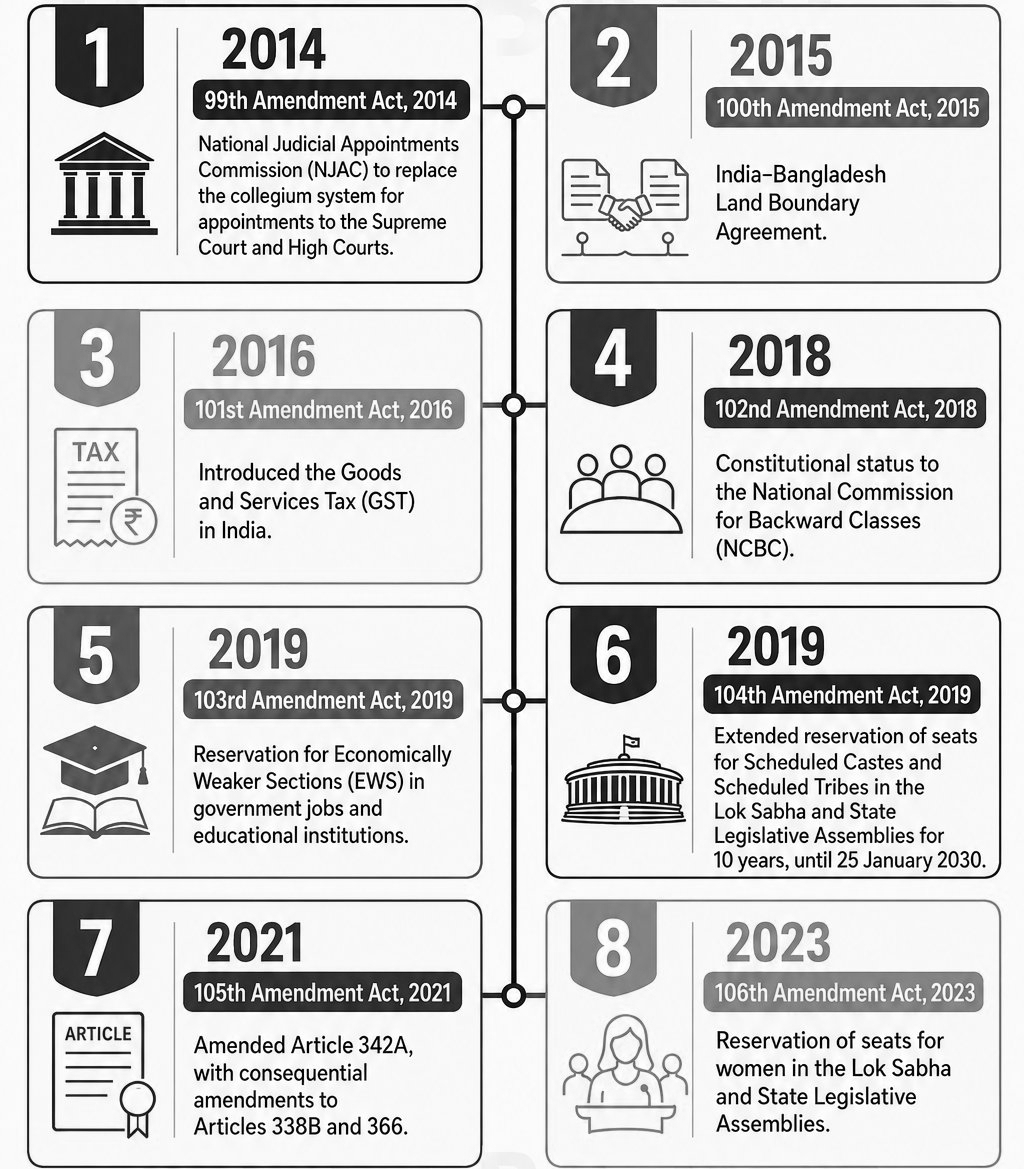
Eight amendments to the Constitution of India have been enacted over the past twelve years, the Union Minister of Law and Justice, Arjun Ram Meghwal, informed the Lok Sabha in a written reply on Friday. The list, tabled in Parliament, traces the country's constitutional evolution from 2014 to 2023.
The earliest of the eight, the 99th Amendment Act of 2014, sought to replace the collegium system with the National Judicial Appointments Commission (NJAC) for appointing judges to the Supreme Court and High Courts. This was followed by the 100th Amendment of 2015, which gave effect to the Land Boundary Agreement between India and Bangladesh, and the 101st Amendment of 2016, which introduced the Goods and Services Tax (GST) regime nationwide.
The 102nd Amendment of 2018 granted constitutional status to the National Commission for Backward Classes, while 2019 saw two significant changes: the 103rd Amendment, which introduced 10 per cent reservation for Economically Weaker Sections (EWS) in government jobs and educational institutions, and the 104th Amendment, which extended reservation of seats for Scheduled Castes and Scheduled Tribes in the Lok Sabha and state assemblies for another ten years, until January 25, 2030.
The 105th Amendment of 2021 restored the power of States and Union Territories to prepare their own lists of socially and educationally backward classes, following changes to Articles 342A, 338B and 366. The most recent in the list, the 106th Amendment of 2023, popularly known as the Women's Reservation Act, provided for one-third reservation of seats for women in the Lok Sabha and state legislative assemblies, though its implementation was tied to delimitation following the next census.
Notably, the government's subsequent attempt to operationalise that women's quota ran into trouble this year. The 131st Amendment Bill, 2026, introduced in April to enable a Lok Sabha seat expansion ahead of delimitation, failed to secure the required two-thirds majority in the Lok Sabha, marking the first time a Modi government constitutional amendment bill has been defeated in Parliament.