
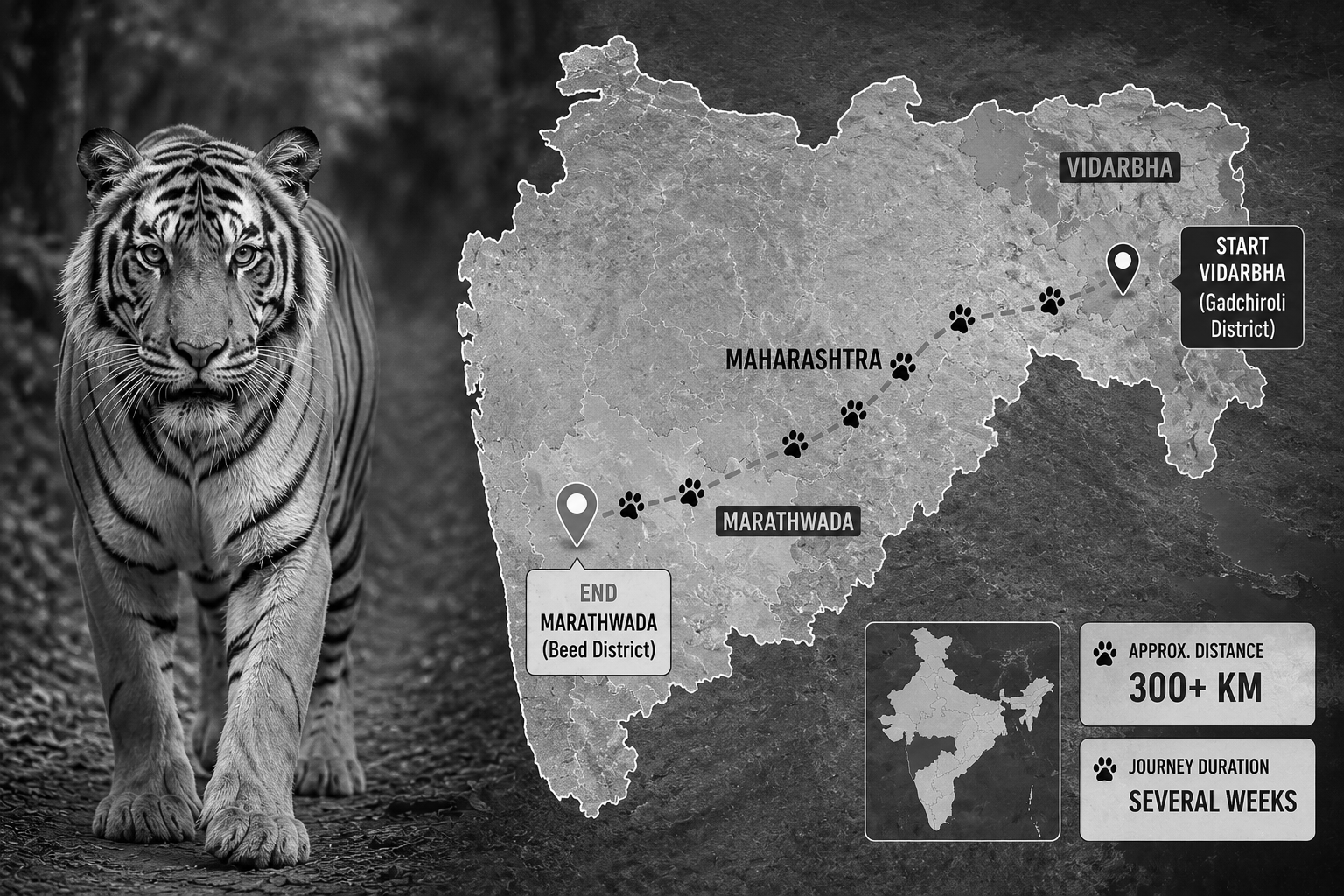
From Vidarbha to Marathwada: How One Tiger Is Redrawing Maharashtra’s Wildlife Map
As tigers venture beyond established strongholds into Marathwada, Maharashtra faces both a conservation opportunity and a management challenge. The movement of a young tiger from Tipeshwar Wildlife Sanctuary over 400 km highlights how wildlife corridors can connect fragmented habitats and allow dispersing animals to search for territory.
The tiger has travelled through Beed, Latur, Dharashiv, Solapur and Ahilyanagar over about two years. Its continued presence in the region indicates that parts of the landscape offer three essentials: prey, water and suitable cover.
Adequate prey is critical because tigers need large quantities of food and expansive hunting grounds. Wild ungulates and other animals can sustain them where populations remain healthy. However, the Brahmagaon cattle kill also shows the risk. When livestock becomes easier to hunt than wild prey, repeated attacks can impose economic costs on farmers and potentially fuel resentment.
Water is equally important in Maharashtra’s dry landscape. The tiger’s extended stay suggests that water sources remain available across parts of its range, allowing it to move and establish temporary territories.
Habitat quality matters too. Dry deciduous forests, wooded hills, scrub and forest patches can provide cover for resting, stalking prey and moving between locations. Most importantly, the Tipeshwar–Yedshi Ramling Ghat corridor appears to remain functional, enabling movement across a landscape rather than trapping wildlife inside isolated protected areas.
Yet a roaming tiger also creates difficult administrative challenges. A tiger does not recognise district or forest-division boundaries, so officials must coordinate camera trapping, tracking, rapid response, public alerts and livestock-loss assessments across jurisdictions. Protecting corridors from roads, construction and habitat fragmentation is equally important.
The priority should be to prevent conflict before it escalates. Timely compensation for livestock losses, community awareness, safer livestock management and careful monitoring can help maintain local support for conservation.
The tiger’s journey therefore represents more than an individual animal’s search for territory. It is evidence that Maharashtra’s landscape can still support wildlife movement and a reminder that biodiversity conservation depends on protecting connected habitats beyond sanctuary boundaries.