
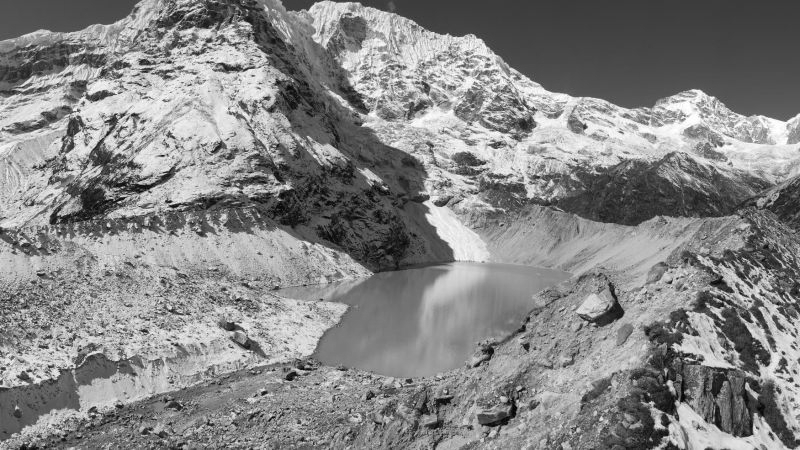
Glacial lake outbursts in Himalayas ‘very serious’, expert urges stronger regional cooperation
Glacial lake outbursts in the Himalayan region have turned out to be a “very serious” threat , with climate change accelerating risks that demand urgent monitoring, preparedness and cooperation among neighbouring countries, international environment expert Pema Gyamtsho has said.
Speaking at the World Sustainable Development Summit 2026 in New Delhi, Gyamtsho, Director General of the International Centre for Integrated Mountain Development (ICIMOD), Nepal , said rising temperatures are causing both extreme floods and droughts in the mountains. “During monsoons, rainfall comes in torrents, causing floods, while at other times, springs are drying up, leading to droughts,” he said.
Glacial lake outburst floods, or GLOFs, happen when lakes formed by melting ice and loose glacier debris suddenly burst, releasing huge volumes of water downstream. These breaches can be triggered by rapid glacier melt, intense rain, landslides or earthquakes as climate change destabilises high-altitude environments. The resulting floods can destroy villages, roads, bridges and farmland far below the Himalayan slopes.
Experts estimate that there are more than 200 potentially dangerous glacial lakes in the region, yet monitoring systems remain inadequate. According to the Central Water Commission , the area of glacial and other high-altitude water bodies in the Himalayas increased by about 10.81 per cent between 2011 and 2024 , signalling a growing risk of GLOFs.
Gyamtsho stressed that because many glaciers and river systems such as the Koshi, Gandaki and Karnali cross national borders, transboundary cooperation is essential . “There is enough water for all of us if we manage it well and are willing to share resources,” he said, noting India’s role as both an upstream and downstream country in several basins.
India and Nepal already work together with ICIMOD and national agencies on disaster risk management, lake monitoring and water‑source restoration. Both countries have also engaged with Chinese counterparts on early warning systems for lakes near the Tibet border.
Because major Himalayan rivers, including the Indus, flow through China, India, Nepal and Pakistan, experts say cooperation among all four could strengthen early warning networks and data sharing. Political differences pose challenges, but scientists argue that shared interests in protecting communities can help drive joint mitigation planning.
Gyamtsho also warned about the hidden danger of melting permafrost destabilising slopes, and said without investment in risk assessment and mitigation, such disasters will become more frequent.