
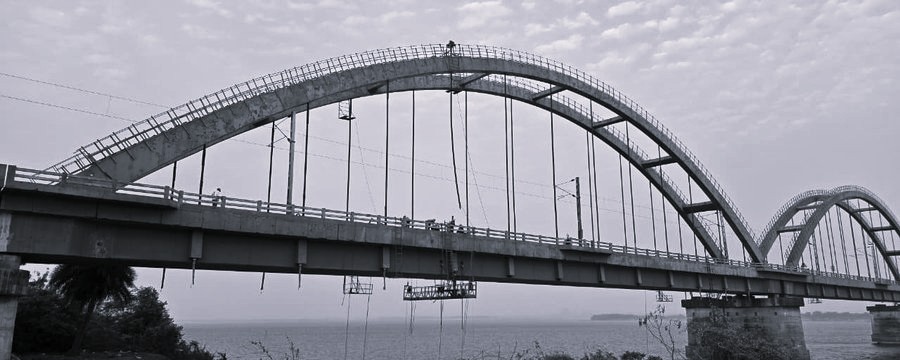
Godavari Arch Bridge Restoration Crosses Major Milestone as 500 Hanger Cables Replaced
The restoration of the iconic Godavari Arch Railway Bridge between Rajahmundry and Kovvur has reached a major engineering milestone, with 500 of the bridge's 672 hanger cables successfully replaced, marking nearly 74 per cent completion of one of Indian Railways' most complex bridge rehabilitation projects.
The Vijayawada Railway Division said the work has been carried out without disrupting train services on the busy Vijayawada–Visakhapatnam railway section , ensuring uninterrupted movement of both passenger and freight trains throughout the restoration process.
The bridge, officially known as Bridge No. 248 , spans the Godavari River and is a prominent railway landmark in Andhra Pradesh. The ongoing project aims to strengthen the nearly three-decade-old structure by replacing ageing and corrosion-affected hanger cables with a modern cable system that meets international standards.
Railway officials said cable replacement has already been completed in 20 of the bridge's 28 spans , accounting for more than 71 per cent of the total span coverage. Carrying out such large-scale structural work while maintaining regular rail operations and ensuring the bridge's stability has made the project a significant engineering achievement.
The newly installed hanger cables incorporate high ultimate tensile strength (UTS) PSC strands and feature an advanced four-layer anti-corrosion protection system imported from Europe. The cables are also equipped with wax-filled anchorages designed to improve durability and long-term performance under varying environmental conditions.
The stressing methodology for the cable replacement programme was developed by international cable-stayed bridge specialists from Italy, while engineers from IIT Bombay have been providing technical supervision and guidance. Railway authorities said these upgrades are expected to substantially enhance the bridge's safety, reliability and service life.
To further strengthen safety and maintenance capabilities, a sophisticated Bridge Health Monitoring System (BHMS) has been installed with support from Australian instrumentation experts. The cloud-based system uses more than 272 smart sensors positioned across the bridge's 2.8-kilometre length.
The monitoring network continuously tracks arch movement, cable stress, deck behaviour, wind effects and environmental conditions in real time, enabling early detection of potential issues. A dedicated BHMS laboratory has also been established on the Rajahmundry side for continuous monitoring and preventive maintenance.
Being executed under an EPC contract, the restoration project is progressing according to schedule. Once completed, it is expected to significantly improve the structural reliability and longevity of one of India's most distinguished railway bridges while preserving its engineering heritage for future generations.