
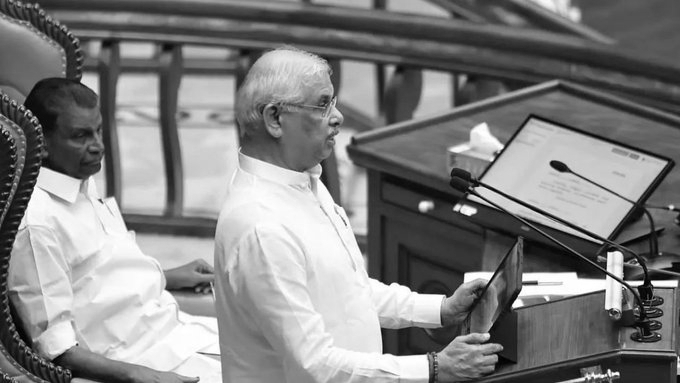
Governor Flags Protocol Lapse Over ‘Vande Mataram’ in Kerala Assembly
Kerala Governor Rajendra Vishwanath Arlekar has expressed strong displeasure over the manner in which the national song Vande Mataram was presented during the Governor’s address to the Kerala Legislative Assembly , reigniting debate over protocol, tradition, and ceremonial conduct in official state functions.
The issue arose after it was observed that only the opening stanzas of Vande Mataram were rendered by a police band before and after the Governor’s policy address, instead of a complete vocal rendition. The Governor termed this a deviation from established protocol , stating that when the constitutional head of the state is present in the House for formal occasions, the national song is expected to be sung in full rather than merely played.
Speaking after returning to Raj Bhavan , Arlekar said he had already raised the matter with the Assembly Speaker and expected appropriate corrective steps. He stressed that established conventions should be strictly followed during high level constitutional events, especially when the Governor is present in the House.
The incident has triggered renewed political discussion in Kerala over the presentation of Vande Mataram . In recent years, variations in its rendition during official events have occasionally drawn attention, and this latest episode has once again brought focus to the lack of uniformity in ceremonial practice.
Political reactions followed quickly. Leaders of the Bharatiya Janata Party (BJP) alleged that the incomplete rendition amounted to disrespect toward the national song as well as the office of the Governor. On the other hand, representatives associated with the United Democratic Front (UDF) maintained that ceremonial arrangements in the Assembly are guided by administrative practice and convention, though the matter continues to be debated in political circles.
The controversy also highlights the recurring institutional friction between the Governor’s office and the state administration in Kerala, where differences over protocol, governance, and ceremonial norms have surfaced multiple times in recent years.
As the discussion continues, attention is now on whether the Assembly authorities will issue a clearer guideline on the rendition of Vande Mataram during official sessions, particularly when the Governor attends. For now, the episode has once again underscored how symbolic practices in legislative spaces can quickly evolve into larger political and constitutional debates.