
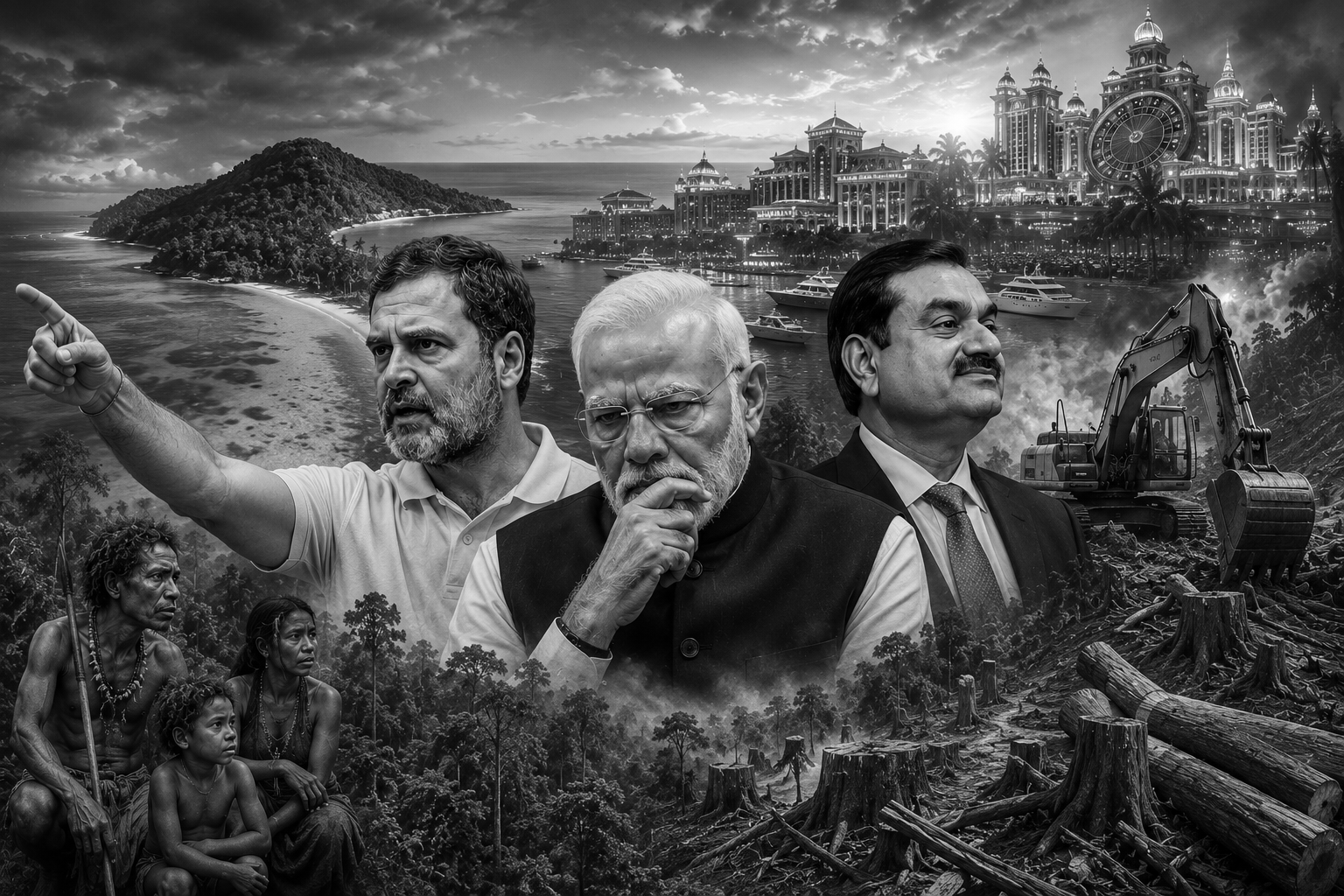
Green Over Greed: Rahul Gandhi Says Modi Is Destroying Great Nicobar and Adani Is Why
Congress leader Rahul Gandhi did not release a statement. He released a reckoning. In a video shot during his visit to the Andaman and Nicobar Islands in late April, Gandhi stood at Indira Point , India’s southernmost tip, and made an accusation that the government has so far refused to meaningfully answer: the Rs 81,000-crore Great Nicobar Island project is not about defence, not about strategic ports, and not about India’s maritime future. It is, he alleges, about one man, Gautam Adani .
The project spans about 166 square kilometres , nearly one-fifth of the island, and involves the diversion of over 130 square kilometres of forest land . Conceived by NITI Aayog during the Covid-19 pandemic in 2021 and fast-tracked by the environment ministry with what critics call questionable environmental clearances in 2022, the project includes an international container transshipment terminal , a greenfield international airport , a gas and solar power plant , and two new coastal cities. The government insists it is a strategic masterstroke , vital to countering China’s growing presence in the Indian Ocean. Gandhi calls it a masterclass in ecological crime .
Adani Ports and Special Economic Zone is among the key contenders to develop the proposed transshipment terminal, a link that has intensified the political controversy. Gandhi contends the defence argument is a cover; India is already building a transshipment port in Kerala on the mainland, he points out, making the Nicobar rationale redundant. He has offered an alternative: expand INS Baaz , the existing naval base on the island, which the Navy has been requesting for five years, a demand the government has not acted on.
The human cost is even more severe. Half the project land overlaps with tribal reserve areas inhabited by the Shompen , a seminomadic hunter-gatherer community with only a few hundred members and minimal contact with the outside world. In February 2024, 39 genocide experts wrote to President Droupadi Murmu warning that the project could become a “death sentence for the Shompen” , amounting to genocide under international law. The tribal council that initially gave consent later withdrew it in 2022, while legal petitions argue that the community may not have fully understood the documents presented to them. As of April 2026, the National Green Tribunal cleared the project, relying heavily on findings of a committee critics say replaced real consent with bureaucratic procedure.
In what critics call the Great Nicobar swap , the environment ministry proposed compensatory afforestation 2,400 km away in Haryana’s Aravalli region , while clearing ancient rainforest on the island itself. Conservationists say this is ecological distortion: ancient tropical forests cannot be replaced by saplings elsewhere.
Gandhi, who also dived into coral reefs and spoke with local settlers about inadequate compensation, has launched a petition urging the government to choose green over greed . The government’s counter, that opposition to the project serves China’s interests, is seen by critics as a deflection. What remains at the centre is a sharper question: when 1.5 crore trees , a tribe of 300 , and some of the world’s most fragile coral ecosystems stand in the way of a mega-project linked to corporate interests, what does development truly mean?