
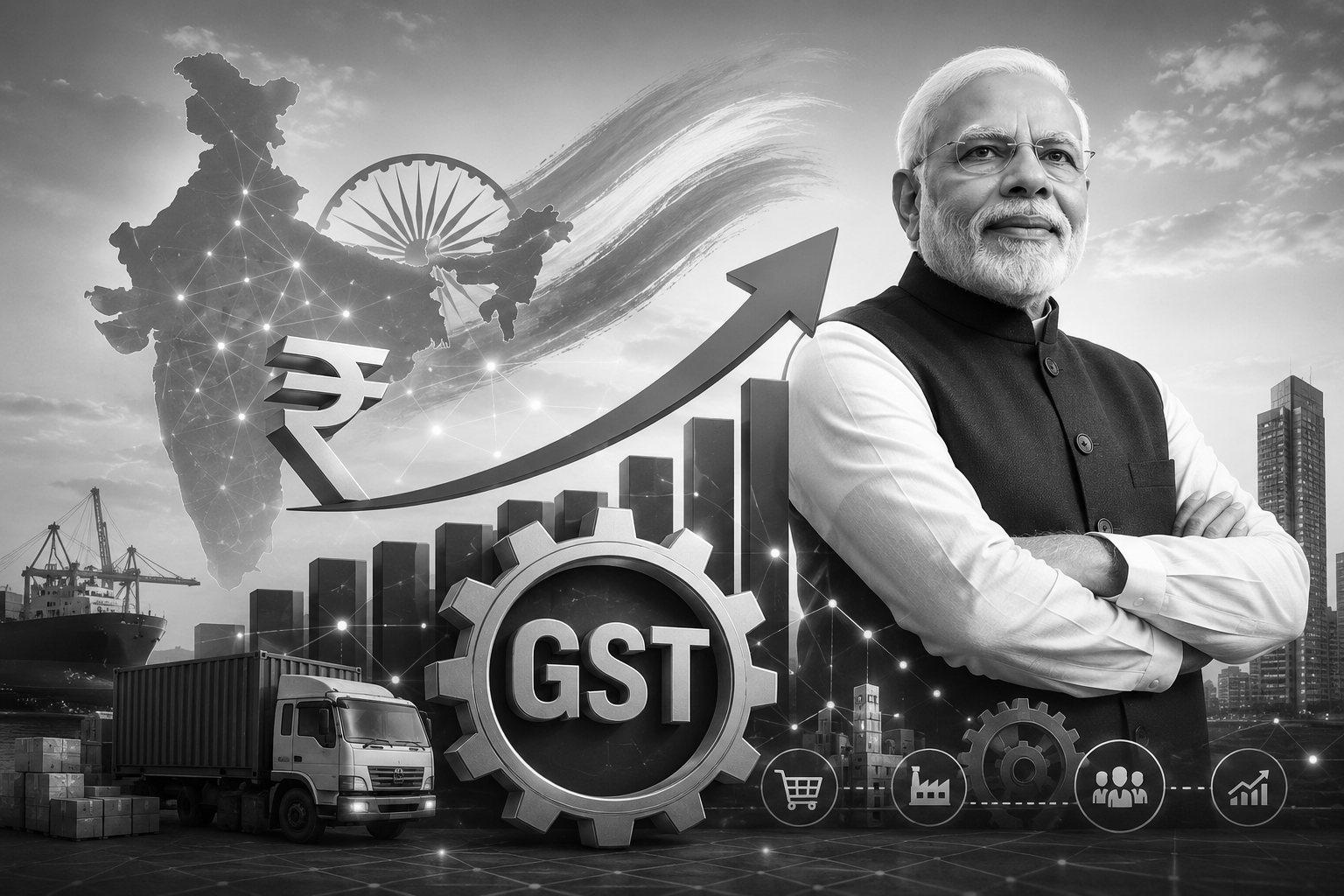
GST at 9: A Tax Reform That Reshaped India's Economic Landscape
India marked nine years of the Goods and Services Tax (GST) on July 1, 2026 , with celebrations held across the country under the national theme "Sugam Kar Vyavastha, Sashakt Bharat" (Simple Tax System, Empowered India). What began in 2017 as one of the country's most ambitious economic reforms, unifying a patchwork of central and state levies into a single "one nation, one tax" system, has today grown into a cornerstone of India's fiscal architecture.
Higher GST collections over the years point to a larger trend, growth of India's formal economy and better tax compliance. India collected around Rs 1.95 lakh crore as GST in June, recording a 13.9 per cent year-on-year growth . The number of GST-registered taxpayers has risen from 66.5 lakh in 2017 to 1.65 crore till May 2026, while gross GST collections have grown from Rs 7.4 lakh crore in 2017-18 to Rs 22.27 lakh crore in 2025-26. Collections in April and May 2026 alone had already crossed Rs 4.37 lakh crore . In 2025 , the government launched GST 2.0 , shifting focus toward easing compliance rather than just implementation, rationalising tax rates, simplifying return filing, lowering compliance costs for MSMEs and start-ups, and speeding up registrations.
Celebrations unfolded in commissionerates nationwide following the fortnight-long "GST Pakhwada" observed from June 16 to 30, featuring taxpayer outreach programmes, GST Samvaad interactive sessions, help desks and awareness drives. In Indore , the CGST Commissionerate felicitated top revenue contributors including Bharat Petroleum , HDFC Limited and MRF Limited , alongside honouring departmental officers and a meritorious student. Mumbai East Commissionerate engaged students through essay writing and drawing competitions, while also hosting interactive sessions where officers addressed trade and tax professionals' queries on filing appeals and returns.
In Bengaluru , the CGST Zone held its 9th GST Day function at Cauvery Hall, Central Revenue Buildings, with Karnataka High Court Chief Justice Vibhu Bakhru as chief guest and Chief Commissioner Kajal Singh presiding. The event honoured top-performing taxpayers and outstanding officers for achievements in taxpayer facilitation, revenue administration, audit and anti-evasion work. Karnataka's own GST story stood out: the state posted collections of ₹1.63 lakh crore in FY 2025-26 , the second-highest in the country, and uniquely collected ₹4,488 crore from OIDAR (Online Information Database Access and Retrieval) registrants, a first for any Indian state. Notably, Karnataka achieved this despite ranking only fifth nationally in taxpayer base.
Before GST's rollout , businesses grappled with a maze of levies, VAT, excise duty, service tax, central sales tax, entry tax, octroi and various state cesses, each with different rates and rules across states. GST replaced this fragmented structure, easing interstate trade and administrative burden while pushing India toward a more transparent, technology-driven tax regime built on digital filing and e-way bills.
As officials reaffirmed their commitment to strengthening taxpayer services and voluntary compliance in pursuit of "Viksit Bharat," GST's ninth anniversary served as both a celebration of the reform's scale and a reminder of the continuing work to make India's tax system simpler for citizens and businesses alike.