
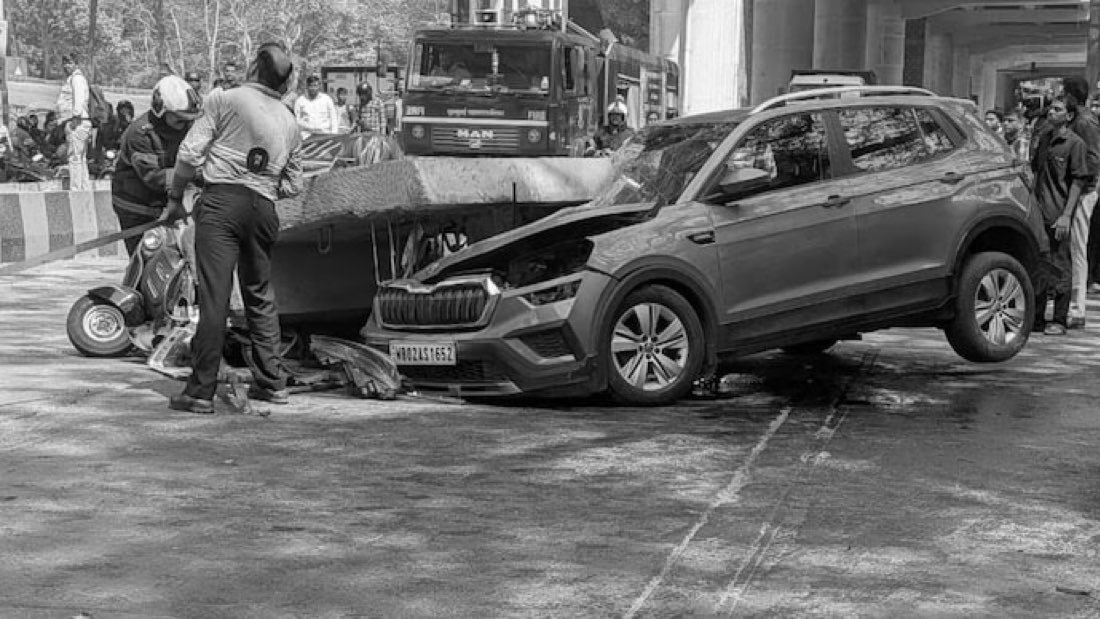
How cheap is human life in India? Death by negligence in Mulund Metro collapse
Ramdhani Yadav, a 46-year-old migrant from Uttar Pradesh, travelled to Mumbai in search of livelihood and opportunity. He did not know that his journey would end abruptly, without any fault of his own, beneath a collapsing Metro construction site.
Yadav was seated in the rear of an autorickshaw travelling along the busy LBS Road in Mulund around 12.15 pm when a parapet segment from the under-construction Metro Rail Line 4 (connecting Wadala to Kasarvadavali) collapsed onto passing vehicles. The impact crushed the autorickshaw, killing him on the spot. Three others were injured, including the driver, who remains in critical condition. In seconds, another ordinary life was lost to what many describe as death by negligence .
The incident triggered swift administrative, criminal, and financial action. Maharashtra deputy chief minister and urban development minister Eknath Shinde ordered the suspension of executive engineer Satyajit Salve, holding him responsible for supervisory lapses. The Mumbai Metropolitan Region Development Authority said it would bear the full medical expenses of the injured, while chief minister Devendra Fadnavis announced ₹5 lakh ex-gratia compensation for the victim’s family and ordered safety audits across all metro sites.
Police registered an offence against managers, engineers, supervisors, and workers of Milan Road Buildtech , the subcontractor of the Reliance Infrastructure–Astaldi joint venture , and DB Hill LBG , the supervisory consultancy firm. Five individuals, including senior project officials, were arrested on charges of culpable homicide not amounting to murder and criminal negligence. The MMRDA imposed penalties totalling ₹6 crore and halted construction along the affected stretch. In addition, the authority has constituted a high-level inquiry committee to investigate structural lapses and safety failures across the entire Metro Line 4 corridor, examining construction methodology, quality control, supervision, and third-party oversight to prevent further incidents.
However, even as contractors and site officials face arrests and fines, a critical question remains unanswered: why no FIR against MMRDA officers , who are responsible for project approvals, safety audits, regulatory oversight, and on-ground supervision. Local residents said visible cracks and structural weaknesses had appeared on nearby pillars days before the collapse and that multiple complaints were ignored. When these concerns were flagged, officials dismissed them as public fear-mongering and even indicated possible action against those sharing the information. The tragedy has now raised troubling questions about ignored warnings and selective accountability .
The Mulund tragedy is not an isolated incident. Across India, fatal accidents rooted in negligence continue with alarming regularity. In Faridabad , a recent sink accident exposed glaring failures in urban safety planning. In Delhi , the Kamal pit hole incident shocked residents after a pedestrian fell into an uncovered cavity. In another disturbing case, Yuvraj Mehta lay trapped for nearly two hours before rescue teams arrived, raising serious concerns over emergency response systems. Stampedes at religious gatherings, railway stations, and public events continue to claim lives, often due to poor crowd management, weak infrastructure, and delayed administrative action.
The incident has also revived public outrage over another viral Mumbai infrastructure failure , where a newly built four-lane flyover abruptly narrows into two lanes , highlighting poor planning, flawed execution, and fragmented accountability across civic agencies.
Together, these incidents paint a grim picture of systemic neglect and institutional apathy , where meaningful reform often follows tragedy rather than preventing it. The compensation cheque has become the routine official response, quietly converting human loss into a financial transaction.
Safety experts and commuters observe bitterly that navigating Indian roads already demands constant vigilance against stray animals, sudden pedestrians, potholes, open drains, wrong-side drivers, abrupt lane changes, erratic autos, heavy vehicles, loose gravel, sudden barricades, and unfinished flyovers. Now, collapsing infrastructure overhead has been added to this list of everyday hazards.
They warn that commuters should avoid driving under any form of construction above roads as far as possible, as falling debris can instantly turn an ordinary journey into a fatal accident, reducing a human life to a ₹5-lakh compensation cheque .
As similar tragedies continue to unfold across cities and states, the nation is left confronting an uncomfortable reality. When deaths caused by preventable negligence become routine headlines, the question becomes unavoidable: how cheap is human life in India?
The Mumbai incident should serve as a wake-up call for every state .