
'I'm The Boss, And If They Misbehave, We'll Drop Bombs': Trump's G7, Where Threats Pass For Diplomacy And Everyone Applauds
The three-day G7 summit in the French Alpine resort of Évian-les-Bains drew to a close on Wednesday with the world's most powerful leaders united behind US President Donald Trump's tentative ceasefire agreement with Iran , endorsing a deal whose full text remains unreleased, whose contradictions with Israel remain unresolved, and whose durability faces mounting scepticism in Washington's own corridors.
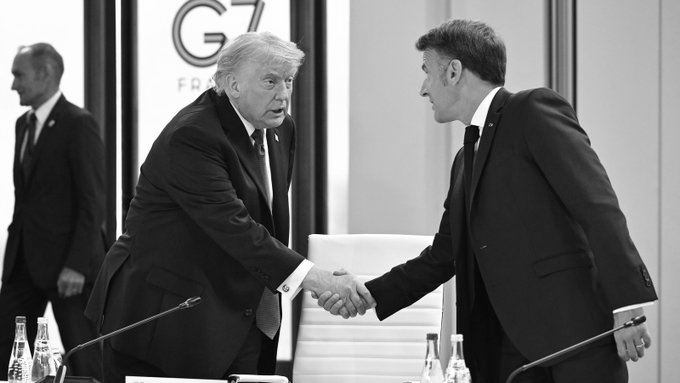
Trump set the tone for the final day by arriving nearly an hour late, striding into the room as host French President Emmanuel Macron had already begun proceedings, and announcing to the assembled heads of government: "I'm the boss." The room laughed. Trump grinned and took his seat between Macron and British Prime Minister Keir Starmer . In closing the summit, Macron called the Iran agreement a "very good deal," saying G7 allies back it "because it's an agreement that puts a stop to a situation of great instability that had terrible consequences for our economies."
In a flurry of overnight declarations, the leaders called the accord a "historic opportunity to prevent Iran from acquiring any nuclear weapon" and pledged they were "ready to contribute to its implementation", even though neither Washington nor Tehran has released the text. According to leaked copies of the interim memorandum, Iran will immediately move to reopen the Strait of Hormuz once the deal is signed and will be permitted to sell its oil without restrictions. Before the Iran war began on February 28, a fifth of all oil and natural gas traded globally transited the strait, which Iran has kept effectively sealed since the opening days of the conflict. The accord is due to be formally signed at a ceremony on the shores of Switzerland's Lake Lucerne on Friday.
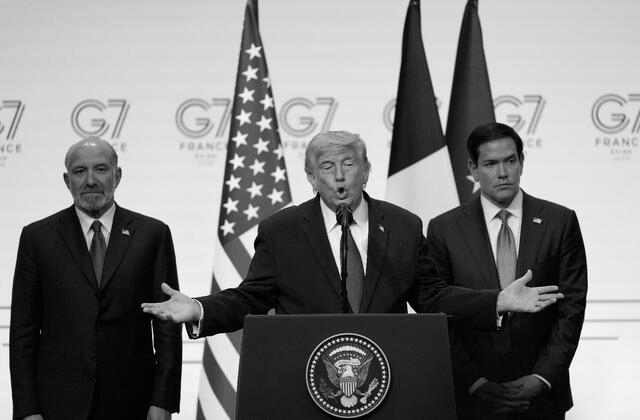
Trump was characteristically blunt about the terms. "Nobody knows what it is but it's very strong," he told reporters at his bilateral with Egyptian President Abdel-Fattah el-Sissi . He then added, with no apparent irony: "It's a memorandum of understanding and if I don't like it, we'll go back to shooting at them, dropping bombs right smack in the middle of their head because they misbehaved for 47 years."
The deal's most combustible provision concerns Lebanon. It calls for an immediate end to all fighting between Israel and Hezbollah , but Iran insists Israeli forces must withdraw from Lebanese territory under the agreement, language that does not appear in the leaked text. G7 leaders reiterated their support for "an immediate robust ceasefire" in Lebanon and efforts to disarm Hezbollah while strengthening Lebanon's sovereignty. Israeli strikes in Lebanon have killed nearly 4,000 people and displaced more than one million since hostilities there began on March 2. Trump made no effort to conceal his frustration with Israel. "Israel's fighting Hezbollah too long, and too many people are being killed," he said, adding pointedly that the prolonged campaign "throws a negative light on the big deal."
Trump also told reporters at his meeting with UAE President Sheikh Mohammed bin Zayed Al Nahyan that he welcomed sending the deal to Congress. "I like the idea, send it to Congress please," he said. "I mean, who wouldn't approve it?" Republican lawmakers have been pressing for more information, with several openly doubtful the memorandum goes far enough to defang Iran's nuclear programme. Trump met separately with Qatar's Emir Sheikh Tamim bin Hamad al-Thani , with both Gulf leaders having been invited by Macron as the region navigates one of its most fraught moments in decades. A working lunch with the Gulf leaders and G7 heads also explored building alternative energy supply infrastructure to bypass the Strait of Hormuz, including overland routes through Egypt.
On Ukraine, the summit delivered a firmer consensus than many had expected. G7 leaders reaffirmed their "unwavering support" for Kyiv, committed to increasing military assistance including longer-range capabilities, and pledged to expand sanctions targeting Russia's oil and gas sectors . Trump said the Russian oil sanctions eased earlier this year to cushion energy prices could now return. "The oil is now flowing," he said. "We're in a position to do that soon." Ukrainian President Volodymyr Zelenskyy , who joined the leaders for a 75-minute session, said Russia was "playing games" while Ukraine remained serious about peace. The United Kingdom separately announced a new sanctions package targeting Russia's shadow oil fleet , including vessels servicing the sanctioned Arctic LNG 2 project.
The summit's final formal session turned to artificial intelligence, with the CEOs of OpenAI , Google DeepMind and Anthropic joining a working lunch on AI's safe deployment, a discussion shadowed by growing European anxiety over American dominance of the technology. Leaders also discussed China flooding export markets with subsidised goods and pledged to step up the fight against the international drug trade and human trafficking.
Trump departed with a flourish. He had extended his stay expressly to accept Macron's invitation to a private dinner at the Palace of Versailles , timed to mark America's 250th anniversary next month. "Versailles is not gold leaf, Versailles is the real deal," he said. It was a fittingly grand exit for a summit he had dominated from start to finish.