
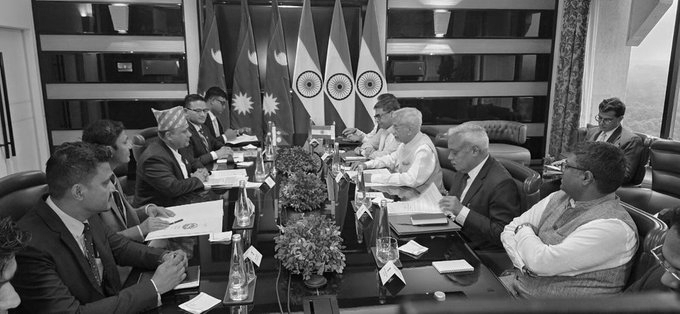
India And Nepal Agree To Deepen Ties, Reject Third-Party Role In Border Dispute Talks
India and Nepal on Saturday reaffirmed their commitment to significantly expand bilateral relations, with both sides agreeing to take engagement to “new heights” during high-level talks between External Affairs Minister S Jaishankar and Nepalese Foreign Minister Shishir Khanal in New Delhi.
The discussions came amid renewed sensitivity over the India–Nepal boundary issue, following recent remarks by Nepal Prime Minister Balendra Shah suggesting that both countries may have encroached on each other’s territory and proposing involvement of third parties such as the UK and China. India has firmly rejected any third-party mediation, reiterating that boundary issues must be resolved bilaterally through established mechanisms.
During the meeting, Jaishankar described the India–Nepal relationship as “very special” and rooted in civilisational, cultural and people-to-people ties. He stressed that both countries should work towards a “decisive shift” in cooperation, expanding beyond traditional areas into emerging sectors such as artificial intelligence, startups, digital technology and renewable energy.
Nepal’s foreign minister reiterated that Kathmandu attaches the highest priority to relations with India and is committed to a “transformative” partnership without “old baggage.” He also confirmed willingness to deepen engagement across trade, connectivity, energy, education and development cooperation.
Both sides reviewed progress in key initiatives, including post-earthquake reconstruction projects in Nepal, expansion of cross-border digital payment systems linking India’s UPI with Nepal’s network, and the operationalisation of the Mutual Legal Assistance Agreement in criminal matters.
The two countries also discussed enhanced cooperation in security coordination along their open border and welcomed new collaboration in digital infrastructure and language technology projects.
Officials said the talks reflected renewed momentum in bilateral ties and a shared intent to broaden cooperation across strategic and emerging domains.